Your betta fights since he’s wired to defend every leaf like it’s prime real estate—territorial instinct, not drama.
Solo males need 5 gallons minimum, 10 to dial down aggression.
Two males? Never.
Even in 40 gallons with plants, they’ll brawl until someone dies.
Female sororities work in 15+ gallons with odd numbers and dense cover, but expect some fin-nipping at first.
Breeding demands divided tanks and immediate post-spawn separation—he gets possessive fast.
Heal injuries with pristine water and Indian almond leaves, intervene at first blood, and ditch mirrors so he isn’t shadowboxing himself.
Setup choices make or break the peace, and the specifics below show you exactly how to stop the tank wars before they start.
At A Glance
- Male bettas cannot coexist peacefully; even 40-gallon planted tanks fail to prevent fatal fights.
- Female sororities of 3-5 need 15+ gallons, heavy planting, and odd numbers to minimize bullying.
- Flaring, trembling fins, and darkened colors are early aggression signals requiring immediate separation.
- Intervene at first torn fin or defensive pause; fights can last 15 minutes and end in death.
- Breeding requires calm genetic lines, divided introductions, and female removal post-spawning for safety.
Why Your Betta Fights: Territorial Instincts Explained
Your betta isn’t just being a jerk—he’s wired that way. That gen instinct? It’s survival programming from the Mekong Delta, where your fish’s ancestors fought for prime real estate in shallow rice paddies. You’re dealing with hardwired hierarchy dynamics, not aquarium attitude.
In the wild, your betta claims roughly three square feet—back off, or get flared at. Captivity’s the problem: your five-gallon tank shrinks that territory to pocket-sized proportions. No escape routes, no visual breaks, just stress and simmering rage. It’s like being stuck in a studio apartment with your worst enemy.
Small tanks amplify everything. Your fish isn’t broken; he’s bored, cramped, and defending crumbs. Give him space, plants, and hiding spots—basic dignity, really—and you’ll dial down the drama significantly. Using a betta divider plate can create separate territories within the same tank to prevent aggression.
Can Male Bettas Live Together? The Definitive Answer
You can’t keep male bettas together, full stop. Betta genetics have hardwired them for territorial war—centuries of selective breeding for aggression don’t fade since you want a buddy tank. Even with perfect water chemistry, two males will fight to injury or death in standard setups.
That 5‑gallon minimum for one fish? Double it, add a solid divider, maybe—stressful, but survivable. Otherwise, you’re running a gladiator pit. Some people try heavily planted 40‑gallon experiments; most fail.
You’re not a bad owner for wanting companionship, just a realistic one. House males solo, period. Using a Triple‑Scale Hydrometer helps you monitor specific gravity for stable water conditions.
Female Betta Sororities: Reducing Fighting Through Group Setup
Since male bettas are basically aquatic UFC fighters in scales, you’ll probably wonder if the ladies play nicer—and yeah, they do, mostly.
You’ll start your sorority with three to five females in fifteen gallons minimum, since tight quarters turn tea parties into turf wars. Plant heavily, add caves, and let them sort their sorority hierarchy naturally—that pecking order keeps the peace. Remember, breeding genetics shape temperament; some lines run hotter than others.
- Give each girl her own “room” with silk plants and driftwood
- Expect minor nipping at first—it settles
- Keep odd numbers to prevent bullying pairs
- Watch for that one diva who won’t share
- Quarantine newbies before adding them to the clique
Bottom line: spacious, planted setups let you enjoy their sisterhood without the bloodsport.
For transporting new fish or performing water changes, consider using collapsible buckets with handles for convenient and tidy maintenance.
Male-Female Pairing: Safe Setup vs. Danger Signs
When setting up a male-female betta pairing, ensure the tank has strong filtration, such as a hang‑on‑back filter, to handle the waste from both fish and maintain stable water conditions during the introduction process.
Introducing Bettas Safely: Step-by-Step Acclimation
When you’re finally ready to stop watching your betta flare at his reflection and give him some actual company, acclimation becomes the make-or-break moment—get it wrong, and you’ll witness aquatic World War III before dinner’s ready.
- Float the bag for 20 minutes, temperature matching prevents shock
- Mix tank water slowly, Water chemistry changes stress fish fast
- Dim the lights, aggression drops when bettas can’t see clearly
- Don’t feed right away, proper Betta nutrition starts after settling
- Watch for 48 hours, separating quickly beats funeral planning
You’re building a community, not a battlefield.
Using dual optical sensors provides sub-millimeter precision for maintaining stable water levels during acclimation.
Which Fish Can Live With Bettas Without Getting Attacked?
If you’re hoping to turn your betta’s solo apartment into a shared house, you’ll need roommates that know how to keep their heads down—and their fins to themselves.
You’re looking for plain-colored fish, nothing flashy that screams “competition.”
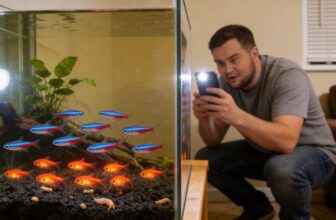
Neon tetras work, they’re fast, they mind their business, and they stick to the middle of the tank where your betta’s less territorial.
Bristlenose plecos? Solid choice, they’re basically aquatic wallflowers who clean algae and avoid drama entirely.
Glass catfish slip through, literally invisible, no threat detected.
Match water parameters closely, and remember tank mates shouldn’t compete for betta diet foods.
Ten gallons minimum, you’re building a community, not a boxing ring.
To support this setup, choose a substrate like non‑clouding natural stone that prevents murky water after setup and helps maintain clear conditions for your betta and its tank mates.
Tank Size to Prevent Betta Fighting: Minimums That Work
The cramped quarters you’re about to read about might sound familiar—like that studio apartment you swore was “cozy, actually,” until you realized you could cook, eat, and shower without taking a single step.
That “cozy, actually” studio where you could cook, eat, and shower without moving.
Five gallons minimum keeps one betta sane, though ten gallons shifts those aggression thresholds meaningfully—more swimming room, less murder in the morning. Tank dimensions matter more than volume alone; long and low beats tall and narrow, giving lateral territory to patrol without constant collision. You’re not building a fish UFC cage, you’re crafting breathing room.
- 5 gal = solo survival, barely
- 10 gal = community possible, tensions drop
- 20+ gal = actual peace, who knew
- Long tanks > tall tanks for territory
- Space = lower stress, fewer flare-ups
Bottom line: upgrade or watch the fins fly.
Proper weight distribution through a heavy-duty steel stand prevents the structural wobble that stresses fish and triggers fights.
Hiding Spots and Barriers That Stop Aggression
Since your betta sees every inch of glass as territory to defend, you need to break that sightline—or prepare for the Splash Zone smackdown.
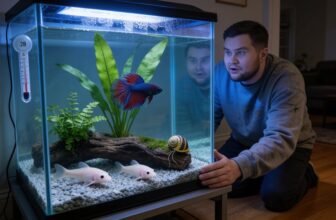
Dense aquarium décor transforms war zones into neighborhoods. Think java moss, driftwood caves, and silk plants (rough plastic shreds fins, and nobody wants a betta with a bad haircut). Visual barriers matter most: position tall decorations to block 60-70% sightlines between rivals, or you’ll witness round-the-clock stare-offs.
You’re building peace through architecture, not luck. Stack rocks, add floating frogbit, create dead zones where fish vanish completely. Your betta’s stress drops, colors pop, and you finally stop refereeing aquatic cage matches.
For extra security, a clear mesh aquarium lid prevents jumpers from escaping during aggressive displays.
Reading Betta Body Language: Flaring and Warning Signs
Barriers break sightlines, but you’ve still got to know what’s happening under the surface.
When your betta starts showing flaring colors and fin trembling, you’re witnessing a fish having a very bad day, not conducting an opera. That puffed-out gill display? That’s threat theater, basically. You’re seeing territorial rage in 4K resolution.
- Flaring = “Back off, buddy, this leaf is MINE.”
- Trembling fins often precede the real chaos.
- Darkened coloration signals stress joining the party.
- Rapid gill movement means adrenaline’s pumping.
- A betta staring, motionless? That’s the quiet before the storm.
Learn this language. You belong in this hobby. After all, shared smiles require no translation when decoding these fin-tastic warning signals.
What to Do If Your Betta Attacks Tank Mates
Your betta’s gone from model citizen to underwater menace, and you’ve got about two minutes before someone loses a fin. Grab a net, remove the victim or attacker immediately—separate container, any clean vessel works.
Check your water chemistry; ammonia spikes above 0.25 ppm turn docile fish into jerks. Test strips cost $8, cheap insurance. Regular pH monitoring helps spot imbalances that stress your fish.
Review your Betta diet—malnourished fish get cranky, so feed high-protein pellets twice daily.
Add silk plants, driftwood barriers, break sightlines.
Rehome persistent bullies; some bettas need solo apartments, no shame in that.
You’ve got this, tank warrior.
Healing Fight Injuries: Torn Fins and Scale Damage
Torn fins look dramatic, but they’re usually fixable—think of it as a bad haircut that grows back weird at first, then fine.
Torn fins look bad but heal fine—just a weird-growing-out phase, like a botched haircut.
You’ll see fin regeneration kick in within a week, though full recovery takes a month or two.
Scale healing works likewise—damaged armor patches itself, given clean water and patience.
Your job? Don’t panic.
- Keep water pristine; bacteria love open wounds
- Add Indian almond leaves; tannins speed healing naturally
- Feed high-protein foods; growth demands fuel
- Skip the mirror; flaring stresses damaged tissue
- Watch for fin rot; fuzzy edges mean trouble, not healing
You’re not failing. Bettas bounce back.
How Long Fights Last and When to Intervene
Watching two bettas square off feels like witnessing a tiny, underwater bar fight that got way out of hand.
You’ll see flaring, circling, then sudden strikes. Wild scraps wrap up in minutes when one retreats. Your tank-raised fish, bred for aggression through stress genetics, might brawl 15 minutes—or until death in extreme lines. Don’t wait that long.
Intervene immediately when fins tear or one stops defending. Poor water chemistry worsens injuries, so test parameters first. Keep a divider handy, maybe $8 online. You’re the bouncer here.
Bottom line: separate at first blood, no exceptions.
Breeding Setup: Controlling Aggression While Spawning
Breeding bettas is like setting up a first date between two people who might stab each other—you need to be the chaperone. Genetic selection matters here, people. Pick calmer lines, not championship fighters. Water chemistry (pH around 7.0, 78–80°F) keeps tempers cool and eggs healthy.
- Start with a divided tank, you’re basically playing matchmaker with a barrier
- Watch for the male’s bubble nest—that’s his “I’m ready” signal, not a trap
- Introduce her briefly, then separate before jaws snap
- Floating plants give her escape routes, because everyone needs an exit
- Remove her post-spawn, he’s Dad now and gets possessive
Control the chaos, belong to the breeding club.
Solo Betta Tanks: Eliminating Fighting Risk Entirely
If you want zero chance of your betta turning into a tiny aquatic cage fighter, you keep him solo—end of story.
Betta genetics hardwire aggression into these fish, no matter how plush his pad. You eliminate every territorial trigger by housing him alone, period.
- Zero tankmate stress, zero fin-nipping casualties
- You control water chemistry precisely—no competing bioloads crashing your parameters
- 5 gallons minimum, heater set to 78°F, gentle filter
Sure, you miss the community tank aesthetic. But you gain a thriving, flaring showpiece who owns his kingdom completely.
Bottom line: solo tanks aren’t lonely, they’re smart. Your betta agrees, trust me.
Frequently Asked Questions
Can Betta Fish Recognize Their Owners?
Yes, your betta recognizes you.
They’ll learn your face, associate you with food, and get excited when you approach—kinda like a wet, scaly puppy.
Bettas have decent eyesight and long memories for fish, so consistent attention from an owner builds trust.
You’ll notice them flaring less, swimming to the glass, even following your finger.
It’s not love, exactly, but it’s recognition, and for a fish with a reputation for fighting, that’s downright affectionate.
Why Do Bettas Fight Their Reflection?
Your betta sees its reflection as a rival male intruding on its turf—classic mirror aggression kicks in since these fish are hardwired to defend territory.
You’ll notice flaring, charging, and stress that can exhaust or injure your fish.
Cover three sides of the tank, adjust your tank setup with plants and hides, stick to consistent lighting cycles so reflections fade naturally, and feed high-protein diet preferences to reduce frustration-driven energy.
It’s not vanity—it’s survival instinct misfiring in glass walls.
Remove or block mirrors; your fish doesn’t need an enemy that never leaves.
Do Betta Fish Fight at Night?
You notice your betta flaring at 2 AM, and you wonder if he’s picking fights in the dark.
Bettas don’t sleep like you do; they’re alert predators with nocturnal displays that can spark nighttime aggression. Their territorial instincts don’t clock out. In dim light, they’ll still attack tankmates, reflections, or anything moving. Darkness won’t stop a grudge, it’ll just make it harder for you to see the damage.
Can Betta Fights Cause Permanent Blindness?
Yes, they can.
Betta fights cause eye damage through fin-nipping, body blows, and ocular stress—you’ll see cloudy eyes, ruptures, or bleeding. This ain’t a paper cut, it’s trauma. Here’s the breakdown:
- Physical damage: Direct strikes to the eye socket, ouch
- Infection risk: Open wounds in dirty water, double ouch
- Recovery odds: Gen recovery varies; some heal, some stay blind
Verdict: Don’t risk it. One betta per tank, period—not a suggestion, it’s math. Your wallet and conscience’ll thank you.
Does Water Flow Affect Betta Aggression Levels?
Does your betta flare like he’s got something to prove? Flow current stresses bettas, it’s true—they prefer calm waters, think gentle lake edges, not raging rapids.
High current triggers a stress response, ramping up aggression as they fight to establish territory and social hierarchy.
Keep your filter baffled, aim for minimal surface movement, and watch your fish relax.
Less turbulence means fewer confrontations, plain and simple.
Rounding Up
So you’ve learned bettas fight since nature wired them that way, not since they’re tiny jerks—though let’s be honest, the fin-flaring drama suggests otherwise. You’ll house them solo, or carefully, or not at all. The choice is yours, really. Just remember: a $5 fish can cost you $50 in tank repairs if you ignore territorial basics. Keep it simple, keep them separated, and everyone’s scales stay where they belong.