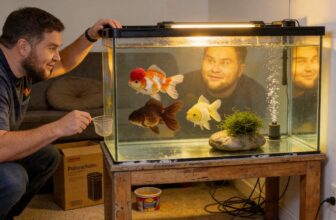
Betta fish don’t actually “like” music—they feel bass vibrations through their lateral line (a row of pressure sensors along their sides) and tiny inner ears, turning your playlist into underwater earthquakes rather than melodies.
Water carries sound five times faster than air, so even whisper-quiet tunes hit hard in a small tank.
Stick to soft classical or ambient at barely audible levels, keep speakers three feet away, and watch for frantic darting or clamped fins—your fish’s way of saying “turn it off, dad.”
You’ll find better alternatives, and safer setups, just ahead.
At A Glance
- Bettas detect vibrations through their lateral line and inner ear, not airborne melodies.
- Soft genres like classical or ambient produce gentle ripples; heavy bass causes stress.
- Whisper‑quiet volume is essential—if you can hear it clearly, it’s too loud.
- Proper tank dampening and speaker distance matter more than playlist choice.
- Individual bettas vary; frantic swimming or hiding means stop the music immediately.
Do Betta Fish Hear Music or Just Feel Vibrations?
Even though you might picture your betta nodding along to your favorite playlist, the reality’s a bit more mechanical than melodic.
Your betta doesn’t hear music—vibrational perception, meaning they feel pressure waves through their lateral line and small inner ears, replaces actual listening entirely.
Their acoustic sensitivity, basically how tuned-in they’re to water-borne vibrations, makes them surprisingly responsive to your voice but utterly confused by your Spotify.
- No eardrums, no problem—just vibration receptors doing heavy lifting
- They’ll notice bass drops, not beats
- Your singing? Possibly comforting. Your subwoofer? Stress city
Bottom line: You’re not sharing earbuds, you’re sharing ripples.
For example, using a precise digital pH meter to monitor water quality can reduce stress, but sudden loud vibrations from a subwoofer can spike tank acidity.
How Does Sound Travel Differently for Betta Fish?
Since you’re landlocked and your betta’s basically living in a different dimension, sound works completely differently for them—and spoiler alert, it’s not in their favor.
Water density changes everything. Sound travels nearly five times faster underwater than through air, thanks to hydoustic resonance—that’s just fancy talk for how water molecules pack together and transmit vibrations like an overenthusiastic game of telephone. Your betta doesn’t “hear” your Spotify playlist; they feel it rattling their entire body.
Their tiny frame amplifies every thump. What sounds mellow to you registers as an earthquake to them. No wonder they hide when you crank the bass. A magnetic aquarium lid can further dampen airborne vibrations while preventing jump scares.
Signs Your Betta Is Stressed by Loud Noises?
Your betta won’t tap you on the shoulder and ask you to turn it down, but he’ll absolutely let you know you’ve crossed the line, usually by acting like he’s having a very bad day.
Watch for frantic darting, erratic swimming, or sudden hiding—classic responses to stress vibrations overwhelming his sensitive lateral line. He’ll clamp those gorgeous fins tight against his body, lose his appetite, or hover listlessly near the bottom. Aggression spikes too; your mellow guy might suddenly bully tankmates.
Excessive noise creates chaotic water currents he can’t escape. His tiny ears detect every vibration amplified, disrupting equilibrium. You’re basically shaking his entire world. These effects are similar to how acrylic stands dampen resonance to reduce tank noise.
Check his “dance”—if it’s panicked, not playful, you’ve got problems.
Bottom line: Loud sounds stress bettas profoundly. Keep volume low, observe closely, and respect his limits.
What Music Genres Are Safest for Betta Fish?
If you’re dead-set on sharing your Spotify with your betta, you’ll want to stick to genres that won’t turn his tank into a subwoofer nightmare. Think of it as *genre*oustic enrichment—picking sounds that soothe, not shock.
Your safest bets:
Classical, ambient, soft jazz, acoustic folk, and nature sounds—steady vibrations that soothe rather than startle.
- Classical and ambient—slow, no sudden crashes
- Soft jazz or acoustic folk—steady pulse, gentle vibration
- Nature sound compilations—rain, streams, your betta’s backyard
Skip heavy metal, EDM, anything with aggressive drumming. That bass drop? Stress bomb.
Rhythm therapy works when it’s subtle—predictable patterns let your fish settle in, not brace for impact.
Bottom line: keep it mellow, skip the surprises.
For consistent monitoring, consider using a digital hygrometer to track tank humidity and temperature shifts that could affect your fish’s comfort.
Safe Volume Levels for Betta Tanks
That means your speaker’s “low” is their *loud*.
Here’s your volume safety guide:
- Keep it whisper‑quiet. If you wouldn’t nap through it, it’s too much for a fish the size of your thumb.
- Invest in volumeoustic tank design—thick glass (10mm+), cabinet stands, and padding underneath. Budget $30–$60 for foam mats or specialized pads.
- Vibration dampening matters. Rubber feet, cork bases, or even a folded towel between tank and furniture cuts transmission dramatically.
- Consider pairing vibrations with gentle bubble flow from a sponge filter to mask sudden noise spikes while maintaining safe water conditions.
Watch your betta’s movement: frantic darting means shut it off
Bottom line: when in doubt, headphones.
Should You Put Your Betta Tank Near a Speaker?
In spite of what your interior design instincts might scream, parking a speaker right next to your betta tank is basically signing your fish up for a 24/7 vibration rave he never asked for.
Sound travels four times faster in water than air, so your betta feels every bass drop as a full-body earthquake. His tiny ear structures, protected by a thin layer but hyper‑sensitive to vibration, can’t handle that sensory barrage.
Your decor placement matters here. Even five feet beats direct proximity.
Need that aesthetic? Invest in acoustic shielding—dense foam barriers, cabinet backing, or thick aquarium stands that absorb rather than transmit. Twenty bucks well spent.
Skip the subwoofer sidekick. Your betta’s stress levels will thank you.
Using a timer to stabilize daily light cycles can help reduce your betta’s overall stress by mimicking natural dawn and dusk.
Can Betta Fish Recognize Your Voice?
Yes, your betta can learn who’s dumping flakes into his penthouse, though he won’t be writing you sonnets anytime soon.
Fish don’t have ears like ours—they feel sound through water vibrations—but that doesn’t stop voice recognition from kicking in.
Talk to your betta daily; he’ll start linking your specific vocal patterns with food and safety.
It’s like a tank vibration filter built into his tiny brain, sorting friend from threat.
Skip the operatic high notes, though. Keep your voice low, consistent, and close to the glass.
You’ll notice him swimming up, fins flared in greeting. Bond established.
Testing your water with aquarium test strips can help ensure the tank conditions remain stable while building that bond.
Why Loud Noises Make Your Betta Lose Their Balance
Since your betta’s built like a tiny seismograph wrapped in scales, loud noises don’t just annoy him—they genuinely throw his world out of whack. You’ll want to understand why.
Sound moves four times faster through water than air, meaning your roommate’s subwoofer hits your betta like a freight train.
- Vibration overload: His sensitive lateral line system detects every tremor, processing constant tremors sends his nervous system into chaos.
- Equilibrium disruption: His inner ear, basically a fluid-filled gyroscope, scrambled by sudden pressure waves. He’ll list, stumble, maybe crash into the glass like he’s had one too many.
Keep it quiet, friend. He’ll thank you by swimming straight. Maintaining stable conditions prevents stress from vibration overload.
Can Music Actually Calm an Aggressive Betta?
If you’ve got a betta who’s acting like a tiny, fins-out bar brawler, you might wonder whether some smooth jazz could turn him into a zen monk. Truth is, music won’t magically chill your fish. Behavior aggression triggers—like cramped tanks, reflections, or poor water—drive that feisty attitude far more than your Spotify playlist ever could. Vibration isolation matters here: bettas feel sound through their bodies, not their ears, and heavy bass can actually amp up stress. Some keepers swear soft tunes help, but science shrugs. You’re better off fixing tank conditions than cranking Coltrane. For an aggressive betta, ensuring a minimum 20‑gal tank with plenty of plants and sight breaks reduces stress far more than any melody.
| Betta Vibe | Your Move |
|---|---|
| Flaring at reflections | Block sightlines with plants |
| Charging the glass | Reduce lighting, add hideouts |
| Ignoring music entirely | Don’t take it personally, fish are rude |
| Hiding when bass hits | Vibration isolation via tank padding |
| Aggression persists | Check water parameters pronto |
How Long Can You Play Music Near Your Betta?
Your tank setup matters more than your musical taste here.
Frequency tank placement saves your betta’s sanity. Keep the aquarium away from speakers, subwoofers, and that Bluetooth beast you got on sale. Sound travels fast underwater—four times faster than air—so your fish feels every bass drop like a tiny earthquake.
Acoustic insulation helps. A thick tank mat, foam padding underneath, or even a bookshelf buffer works wonders. Think of it as noise-canceling headphones for your fish, minus the subscription fee.
Limit sessions to 30 minutes daily, low volume only. Watch for frantic swimming—that’s your cue to hit pause. Many tested filters operate at under 40 dB, quieter than a typical conversation, but vibrations from speakers can still stress your betta.
What Sounds Can Replace Music for Your Betta?
Why limit yourself to Spotify playlists when your betta couldn’t care less about your indie folk phase anyway? You’re part of a community that knows tank therapy works wonders, so lean into it.
Try these sound alternatives that actually resonate with your fish:
- Gentle water trickling from a low-flow filter—calming, predictable, like a lullaby you didn’t know you needed.
- Your own soft humming near the glass; bettas recognize your voice, and honestly, it’s free.
- Substrate resonance from light tapping on the tank base—vibrations travel through gravel, not air, so it’s gentler on their tiny ears.
- Bubbler bubbles at whisper volume, creating white noise without the drama.
Skip the bass drops. Your betta wants peace, not a concert.
What to Do If Your Betta Hides From Music
When your betta vanishes into his cave the second you hit play on that lo‑fi playlist, you’ve got a problem, and pretending he’s just “appreciating the vibes” won’t cut it.
Stop the music. Your fish isn’t being dramatic—he’s overwhelmed. Check your tank décor: add more caves, plants, or floating betta logs ($8–$15) so he controls his exposure.
Dim your tank lighting; bright LEDs plus vibration stress double his anxiety. You’re building a sanctuary, not a nightclub. Try softer genres, lower volume, or headphones.
If he still hides, music isn’t his thing, and that’s okay—your betta’s comfort beats your playlist every time.
Can Betta Fish Lose Hearing From Chronic Noise?
If you’ve been blasting classic rock near your betta’s tank for months, you might be doing more damage than you think.
Chronic noise doesn’t just stress your fish—it can cause permanent hearing degradation.
Your betta’s tiny ears detect vibrations through water molecules, and sound travels faster there, so you’re basically shouting through a megaphone.
Loud, constant exposure wears down those sensitive receptors over time.
Here’s what chronic noise does to your aquatic buddy:
- Destroys hearing cells—irreversible damage, like wearing out your favorite earbuds, except fish can’t buy new ones.
- Disrupts predator detection—your betta becomes vulnerable, unable to sense danger coming.
- Harms communication—they can’t chat with tank mates, leading to isolation in their own community.
- Triggers blindness—yes, really, loud noise can wreck their eyes too, since stressed bodies break down everywhere.
That hearing loss? Permanent.
Small tanks amplify everything, so your “reasonable” volume is their rock concert.
Keep it soft, or you’re not really keeping them company—you’re slowly silencing them.
How to Reduce Vibrations Around Your Betta’s Tank
Sound waves don’t play nice with betta fish, so you’ve got to outsmart them.
Your move: Slide vibration dampening mats (think $15-30 rubber pads) under your tank stand. They absorb foot traffic, slamming doors, that bass‑heavy neighbor who uncovered dubstep.
Upgrade path: Stash your setup in an acoustic‑isolated cabinet—basically a fancy box with foam lining, runs $80-200. It muffles airborne racket and physical thumps.
Pro tip: Keep speakers three feet away minimum. Your betta’s tiny ears pick up what you don’t.
Bottom line: Control the shake, spare the fish.
Frequently Asked Questions
Do Betta Fish Have Favorite Songs?
No bettas don’t have song preferences in the way you’d hope. You can’t ask them to pick between Mozart or Miles Davis, and they won’t bob along to your workout playlist.
Their ears detect vibrations, not melodies, so acoustic enrichment means gentle low‑frequency pulses they feel through the water.
You might notice your fish responding to your voice, that’s recognition, not musical taste. Keep it soft, keep it brief, and watch their swimming for stress signals.
Can Betta Fish Hear Ultrasonic Sounds?
No, they cannot. Your betta lacks the ultrasonic perception needed to detect frequencies above roughly 1,000–5,000 hertz, far below true ultrasonic ranges (20,000+).
Their frequency thresholds top out in the lower-mid range, so that “mosquito repellent” app you’ve got? Pointless, like bringing a bicycle to a submarine race.
Stick to vibrations they *can* feel—soft music, gentle taps. Skip the ultrasonic gadgets; your wallet thanks you.
Do Wild Bettas React Differently to Noise?
Wild bettas show a sharper acoustic preference than their tank‑bred cousins, since they haven’t been numbed by aquarium humdrum.
Their ambient response sound is survival‑first: loud splashes mean predators, soft ripples mean lunch.
You’ll notice they freeze or bolt—no leisurely swims here.
It makes sense, really, wild fish can’t afford chill suburbs where carbines drown out danger.
They’re twitchy, and honestly, who’d blame them?
Can Music Affect Betta Fish Breeding Behavior?
Music can disrupt your betta’s breeding behavior, but let’s unpack why.
Your fish relies on vibrational cues—subtle water-borne signals—to coordinate spawning rituals.
Loud music scrambles these private fishy conversations.
You’re additionally throwing off lighting synchronization, since bettas need stable day-night cycles to trigger mating instincts.
Breeding pairs get confused, timing goes haywire, and eggs scatter everywhere.
Bottom line: keep the tank quiet during breeding, maybe hum softly if you must—your betta won’t judge your shower vocals.
Should I Play Music When I’m Away From Home?
You shouldn’t leave music playing as you’re away. Your betta hears vibrations, not melodies, and ambient music can actually spike stress rather than reduce it when no one’s present to monitor reactions.
Focus on what truly matters: your tank setup, consistent lighting schedule, stable water temperature, and reliable feeding routine. These foundations—plus smart substrate choice, live plant selection, appropriate filtration type, and proper aquarium size—drive stress reduction far more than background noise ever will.
Rounding Up
Your betta won’t beg for beats, but gentle, low‑volume vibes won’t vex them either. Skip the subwoofer, stick to soft strings or simple silence, and study their swimming—stress shows when they skitter or shelter. Sound travels through water as vibration (think of it like feeling bass in your chest at a concert), so keep it subtle. Bottom line: your fish’s fancy fins flourish in peaceful, predictable places, not pounding playlists.