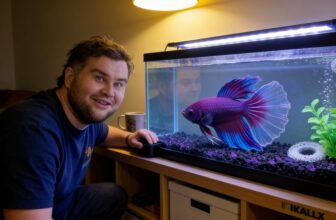
Your Jack Dempsey needs a 55-gallon tank with warm water, 72 to 86 degrees, and a filter that moves 125 gallons each hour to keep things clean.
You’ll see their scales flash blue and green like spilled oil when they’re happy. Give them caves made from driftwood and thick plants like Java Fern so they can hide when they feel crabby.
Feed them pellets and frozen bloodworms, but scoop out any food they don’t eat within three minutes. Watch for their color turning dark, almost black—that’s their way of saying they need space, especially when they want to breed on flat stones.
Take your time with these fish, and you’ll notice more about their curious habits waiting just ahead.
At A Glance
- Provide a minimum 55-gallon tank for one adult, adding 20 gallons per extra fish to reduce aggression.
- Maintain water temperature between 72–86°F with pH 6.0–8.0 and gentle filtration flow.
- Feed high-quality pellets and frozen foods, removing uneaten portions within three minutes.
- Create multiple caves and sight barriers using driftwood and dense plants to manage territorial behavior.
- House with robust cichlids or large fast swimmers, removing bullied fish immediately to prevent injury.
What Makes Jack Dempseys Popular Among Cichlid Keepers?
If you’ve ever walked into a pet store and spotted a fish that looks like it’s wearing blue lipstick, you might’ve met a Jack Dempsey.
These fish catch your eye immediately. Their iridescent scales flash blue, green, and turquoise against deep backgrounds, and you’ll notice chromatic variations ranging from gold to pink to brilliant electric blue. Some hobbyists spend years collecting different strains.
These fish catch your eye immediately—iridescent scales flashing blue, green, and turquoise against deep backgrounds.
The historical naming adds character too. This fish honors the 1920s boxing champion, Jack Dempsey, since it fights with similar ferocity. That combination of knockout beauty and bold personality, like a gentle friend who speaks directly, keeps you watching.
Unlike bettas that thrive in compact 2-gallon tanks, Jack Dempseys demand substantial space due to their aggressive territorial nature and potential to reach 10 inches in length.
Jack Dempsey Size: How Big Do They Get?
Jack Dempseys grow larger than many people first expect, and you’ll want to know exactly what you’re signing up for when you bring one home.
A healthy adult stretches ten to fifteen inches from nose to tail, about as long as a standard ruler plus half another. Females stay smaller, reaching eight to ten inches, while males fill out the full fifteen.
Their size shapes how they look. As they grow, juvenile stripes fade into deeper, richer color patterns—iridescent blues and greens spreading across their scales like oil on water. Breeding genetics play a role too, since selective pairing can produce smaller electric blue variants.
You’ll watch this transformation over months, not weeks, so patience matters. Given their eventual size and waste output, a sump baffle system helps maintain stable water parameters by improving filtration efficiency and reducing maintenance demands.
Jack Dempsey Tank Size: Minimum vs. Ideal
Those ten to fifteen inches of fish need room to turn around without bumping their noses, and that’s where your tank choice becomes the next puzzle to solve.
A fifteen-inch fish needs room to turn without bumping its nose.
Start your tank selection with at least fifty-five gallons for one adult, like a studio apartment for a growing teenager.
Add twenty more gallons for each roommate, since cramped fish feel stress, and stress makes them mean.
A seventy-five-gallon glass box lets you keep a pair, with space left for driftwood caves where tempers cool.
Do a quick price comparison: the bigger tank costs more today, but you’ll spend less replacing killed tank mates tomorrow.
Splurge on space.
With such a large volume to filter, you’ll want a system rated for at least 125 GPH flow rate, which cycles water five times daily to keep waste from building up in this cichlid’s territory.
Filtration for Jack Dempseys: Clean Water, Minimal Flow
Since your Jack Dempsey carries eleven years of life in its scales, you’ll need a filter that keeps working even when you’re tired.
Think of it like a quiet river, not a rushing stream. Your fish prefers slow water, so you’ll pick a canister or hang-on-back filter, then slow the flow with a spray bar or baffle.
A dense foam sponge filter offers an excellent alternative, providing gentle bubble flow that mimics calm river conditions while maintaining robust biological filtration through high surface area foam.
| What Happens | How Your Fish Feels |
|---|---|
| Water sits still | Tired, gasping, hiding |
| Flow crashes like waves | scared, pressed to corners |
| Filter stops | poison builds, panic |
| Gentle current, clean home | calm, bold, showing colors |
Biofilm control matters too. You’ll rinse mechanical media monthly in old tank water, never tap, preserving good bacteria that eat waste.
Jack Dempsey Water Parameters: Temperature, pH, and Hardness
Your filter now moves water gently, but that water itself needs a recipe your fish understands.
You’ll want temperatures between 72 and 86 degrees Fahrenheit, which lets your Jack Dempsey feel safe enough to show his best colors.
Keep pH from 6 to 8, and hardness between 9 and 20 dGH. These numbers matter since the coloration trends you see—those bright blues and greens—depend partly on water chemistry working with genetic variation. Some fish carry genes for gold or pink hues, but poor water dulls them.
Test weekly. Stable parameters mean less stress, and less stress means a fish who trusts you. A pH precision of 0.01 helps you catch small shifts before they stress your fish.
Substrate and Caves: Building Territories Jack Dempseys Defend
Jack Dempseys dig, they sift, they rearrange what you give them. You’ll want two inches of substrate depth—fine sand or gravel—so they can burrow and feel secure.
Cave placement matters more than you’d expect. You’ll space three or four hiding spots across the tank’s bottom, not clustered together, so each fish builds its own territory. Flat stones work for spawning. Driftwood and rocks complete their caves.
When performing water changes, a collapsible 5‑gallon bucket with reinforced seams and an anti‑tip base keeps spilled water off your floor while you vacuum around those carefully arranged territories.
You’re building neighborhoods, really—separate but equal spaces where these fish feel safe enough.
Jack Dempsey Diet: What Carnivores Actually Need
When you open the freezer for your own dinner, you’ll want to peek in for them too.
Jack Dempseys need a varied diet, just like you do. Their carnivorous bodies crave protein from multiple sources to stay strong and colorful. You’ll serve high-quality pellets as the base, then rotate frozen bloodworms, brine shrimp, and crickets for complete nutrition—think of it as building a balanced plate, nutrients spread across colors and textures.
Your feeding schedule matters: adults eat once or twice daily, juveniles need two to three meals. Offer only what vanishes in three minutes, then remove leftovers. This routine prevents overfeeding, keeps water clean, and protects against head and lateral line erosion, a disease caused by poor nutrition.
Unlike planted aquariums that require copper-free shrimp fertilizers to maintain delicate invertebrate health, Jack Dempsey tanks focus on protein-rich foods that match their aggressive carnivorous nature.
Jack Dempsey Temperament: How Aggressive Are They Really?
Why does a fish with such sweet, round eyes guard its corner of the tank like a tiny dragon?
You’ll find your Jack Dempsey owns every rock, every cave, chasing away intruders with surprising speed.
This territorial drive peaks during breeding, when even gentle color morphs—electric blue, soft pink, golden pearl—darken to near‑black warnings.
Don’t mistake this for pure meanness. You’re witnessing breeding migration instincts, ancient wiring that compels them to secure safe ground before raising young.
Give them space, plenty of hiding spots, and you’ll see calmer fins.
Respect their boundaries, and they’ll show you quiet loyalty instead of endless fights.
Adding dense aquatic foliage like Java Fern or Water Spangles creates natural sight barriers that help diffuse territorial tension between tank mates.
Jack Dempsey Tank Mates: Compatible Species
A sturdy rock sits heavy in your palm, and you understand why your Jack Dempsey clings to its territory so fiercely.
You’re choosing companions for this fish, which means respecting its nature.
Compatible tank mates include robust cichlids like Firemouths, Blue Acara, and Convict Cichlids—fish that can hold their ground without starting wars.
Large, fast swimmers such as Silver Dollars and Clown Loaches work well, too, though you’ll need a 75-gallon tank or larger for this community to breathe.
Plecos make excellent partners, their armor plating protecting them from occasional squabbles.
Color morphs don’t change temperament, so an Electric Blue Jack Dempsey behaves just as territorially as the wild-type green.
Watch for breeding behavior, which darkens your fish nearly black and multiplies aggression tenfold.
During these periods, even tolerant companions may face relentless attacks.
You’ll feel the tension rise, like a storm gathering behind glass.
Create sight breaks with rocks and plants, giving everyone escape routes.
Trust your observations—remove bullied fish before injury, and accept that sometimes your Jack Dempsey needs its own kingdom.
Maintaining pristine water quality through mechanical filtration helps reduce stress-induced aggression among tank inhabitants.
Small Fish to Avoid With Jack Dempseys
A single neon tetra, no longer than your thumb, drifts past your Jack Dempsey‘s cave, its silver belly flashing like a coin in sunlight.
Your Jack Dempsey sees coin-sized prey, not a neighbor.
In the wild, these cichlids are natural predators of anything small enough to swallow, and they don’t unlearn this in your tank. During breeding, which happens yearly once pairs form, parents defend territories with fierce intensity, attacking fish one-third their size without hesitation. Guppies, cardinal tetras, and dwarf rasboras—all under two inches—trigger this response. Their quick movements signal food, not friendship.
You’ll watch them disappear.
Unlike the balanced protein and fat content found in complete turtle nutrition formulas, predatory fish like Jack Dempseys require live protein sources that match their hunting instincts.
Jack Dempsey Diseases: Symptoms, Causes, and Treatments
Identifying a Healthy Jack Dempsey and Common Diseases
You’ll see blue-green scales flashing under LED lights, red dorsal fin tips, and alert, curious eyes following your movement.
When disease strikes, you’ll notice changes fast. Ich shows up as tiny white spots, like grains of salt, covering fins and body. You’ll raise the temperature to 86°F to stop it. Poor nutrition causes head and lateral line erosion, where pits form near the eyes. You’ll fix this with varied live foods—bloodworms, shrimp, crickets.
Watch ammonia and nitrate levels closely. Clean water prevents most problems, since stress from dirty conditions weakens fish, making them catch illnesses easier.
Don’t chase market trends for quick fixes. Good genetics from reputable breeders give your fish stronger immune systems from the start.
Preventing Hole-in-Head Disease in Jack Dempseys
Since you’re already keeping the water clean and feeding good food, you’ve got most of what you need to stop hole-in-head disease before it starts.
This illness, likewise called HLLE, creates tiny pits around your fish’s face and lateral line.
Nutrition and Diet
Your nutrition diet protects against it. You’ll want high-quality pellets, frozen shrimp, and occasional live treats—variety matters more than volume. Vitamin deficiencies weaken your fish’s defenses, like skipping breakfast makes you sluggish.
A varied diet defends against hole-in-head disease better than simply feeding more—think quality nutrition, not empty calories.
Disease Prevention
Test water weekly, change 25% monthly, and avoid carbon filtration that strips minerals. Skip stressed, newly imported fish.
Watch for early pits: catch them small, and you’ll heal them fast.
Jack Dempsey Breeding: How to Trigger Spawning
Setting Up Spawning Conditions
To get your Jack Dempseys ready to spawn, you’ll first need a flat stone, about the size of a dinner plate, resting firmly on the sandy bottom of their tank.
Breeding triggers work like nature’s calendar for fish, telling their bodies it’s time to make babies.
You’ll notice spawning cues when your pair’s colors turn almost black, like mood rings showing they’re ready.
Raise the temperature slightly, to about 78-82 degrees, and feed them live foods like bloodworms.
Their cleaning behavior begins, scrubbing that stone obsessively, preparing a nursery.
Watch quietly, you’re witnessing ancient rhythms written in their genes, patience rewarded with new life.
Caring for Jack Dempsey Fry: The First Month
Jack Dempsey Fry Care
Once the wriggling cloud of fry abandons their gravel pit nursery, you’ll find yourself suddenly responsible for hundreds of tiny mouths no larger than pencil shavings.
You’ll need infusoria, or liquid fry food, for their first three days.
Then you’ll switch to newly hatched brine shrimp, which you can culture in a simple soda bottle.
Feed them five times daily, tiny amounts they finish in two minutes.
You’ll test water chemistry every other day, keeping ammonia at zero and nitrates below twenty parts per million.
Change thirty percent of the water twice weekly.
Frequently Asked Questions
Do Jack Dempseys Recognize Their Owners?
Yes, Jack Dempseys develop owner cognition over time. You’ll notice they recognize you during feeding, often swimming to the front glass and displaying excitement when you approach, linking your presence to their feeding preferences.
Can Jack Dempseys Live in Outdoor Ponds?
You can keep Jack Dempseys in an outdoor pond pond if you’re in a warm climate where seasonal temperature fluctuations stay within their 72–86°F range year-round; otherwise, you’ll need heating or indoor housing during cold months.
How Long Do Jack Dempseys Live in Captivity?
You’ll find your Jack Dempsey exceeds ten years with proper tankitat setup and feeding schedule. Maintain stable water, balanced nutrition, and you’ll enjoy this feisty companion’s iridescent colors for over a decade easily.
Do Jack Dempseys Change Color When Stressed?
Yes, you’ll notice your Jack Dempsey’s stress response involves dramatic color darkening, sometimes nearly black. Diet adaptation can help—poor nutrition likewise dulls their colors, so you’re improving both health and vibrancy with quality foods.
Are Jack Dempseys Jumpers?
Yes, you’ll notice jumping behavior in your Jack Dempsey, especially when territorial aggression spikes during breeding. Keep your tank securely lidded, as they’ll leap to escape threats or claim space, and you won’t lose your fish.
Rounding Up
You hold a water test kit in your hand, and you understand now that this fish asks you to pay attention. The Jack Dempsey rewards your care with fifteen years of presence, of watching personality bloom in blue scales. You will make mistakes with water changes or tank mates, and that is ordinary. What matters is returning, adjusting, learning. The boxer in your aquarium does not need perfection. It needs your steady, noticing self.