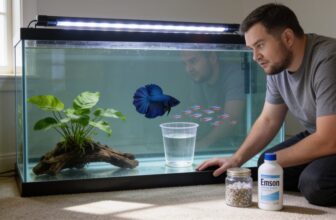
You’ll find betta fish colors fall into three camps: solids, bi-colors, and wildcards that’ll keep you guessing.
Solid reds come from stacked chromatophores (pigment cells—think tiny paint factories), whereas blues and greens shimmer thanks to iridophores, which use guanine crystals like microscopic mirrors to bounce light around.
Yellows rely on xanthophores, and true blacks demand hyperactive melanophores—rare, pricey, and moody about it.
Bi-colors split the difference: Mustard Gas pairs dark bodies with electric fins, Butterfly fades solid to light edges, and Chocolate sounds delicious but isn’t.
Then there’s the Marble gene, which basically gives your fish a lifetime subscription to unpredictable color subscription boxes—patches appear, vanish, resurface, sometimes overnight.
Solid whites scatter light through sparse pigment and dense iridophores, looking pearlescent until you realize you’re staring at a fish that matches your tax returns.
Your tank’s the real decider though—dark substrates make metallics pop like they owe you money, while pale gravel turns even showstoppers into wallflowers.
There’s more to this rainbow than meets the eye.
At A Glance
- Chromatophores produce reds, yellows, and blacks through pigment cells.
- Iridophores create blues, greens, and metallic sheens via guanine crystal reflection.
- Solid colors include red, blue, yellow, black, and white variants.
- Bi-color patterns include Mustard Gas, Chocolate, Butterfly, and Mask types.
- Marble gene causes unpredictable, shifting color patterns throughout life.
How Do Betta Fish Get Their Colors?
Betta fish sport three main pigment cells—chromatophores, to get technical for a second—and if that word makes you groan, you’re not alone.
These tiny factories pump out reds, yellows, and blacks, as iridophores bounce light around like disco balls, flashing blues and greens.
You’re witnessing centuries of obsessive historical genetics here, friend.
Breeders played matchmaker for generations, stacking traits until your fish practically glows.
Seasonal hue shifts happen too—your betta might dress down for winter, then crank saturation come spring.
Age, stress, and water quality tweak the dial.
It’s living art, and you’re just keeping the lights on.
Consistent water chemistry supports stress-free color expression and overall health.
Which Betta Color Works Best for Your Tank?
So you’re staring at fifty tanks of shimmering fins, wondering which shade won’t clash with your sanity—or your decor.
Your tank’s personality matters. Dark substrates swallow pale fish whole, as bright gravel turns everything into a carnival. Consider your tank behavior: active swimmers need contrast to track, lazy loungers pop against muted backgrounds.
Dark substrates swallow pale fish whole, as bright gravel turns everything into a carnival.
Breeding selection shapes more than color—it predicts temperament. Some lines flare constantly, others chill.
Here’s your cheat sheet:
- Match substrate darkness to your fish’s base tone
- Test lighting angles before buying—iridescence shifts dramatically
- Factor in plant colors; green foliage loves red or blue contrast
- Accept marble genes will betray your aesthetic plans eventually
Pick what makes you smile daily.
Smaller tanks, like a 2-gallon betta kit, demand daily attention and accurate interior volume verification to prevent crowding stress.
What Are the Most Popular Solid Betta Colors?
You’ve already wrestled with substrate contrast and marble chaos—now you’re ready for something straightforward that actually cooperates with your tank design.
Red dominates. Carotenoid-rich diets keep it blazing.
Blue—electric, royal, steel—leans on iridophores for that metallic pop.
Yellow holds up under stress better than most.
Understanding bet genetics helps you pick winners. Color psychology matters too: red energizes, blue calms.
Black orchids, copper bronzes, clean whites—each brings something. Pick what speaks to you.
Consider using high light transmission netting to keep your vibrant betta safe from jumping while preserving the color-enhancing brightness of your tank lights.
Which Bi-Color Betta Patterns Should You Know?
Why settle for one color when you could mis-match your betta like you mis-match your socks? Bi-color patterns showcase two distinct zones—body versus fins—and you’re about to learn the big four.
- Mustard Gas: Dark body, electric yellow-orange fins. A crowd favorite, like wearing neon shoes with a black suit.
- Chocolate: Rich brown body paired with orange or gold fins. Sweet, not edible.
- Butterfly: Solid body fading into lighter fin edges, elegant and floaty.
- Mask: Dark face, contrasting body. Mystery vibes.
Betta pattern genetics makes these splits possible, and recent color-pattern breeding trends favor bold contrasts over subtle blends. Adjustable chambers in sump baffles allow custom water flow to support these breeding setups. Pick what speaks to you.
What Makes Multi-Colored and Marble Bettas Special?
You thought bi-color bettas were chaotic, marble and multi-colored varieties are the fish equivalent of a jazz solo—unpredictable, occasionally messy, and impossible to look away from.
You’re not just buying a fish; you’re adopting a living art project that’ll ghost your aesthetic plans overnight.
You’re not just buying a fish; you’re adopting a living art project that’ll ghost your aesthetic plans overnight.
Marble genetics flip the switch on pigment cells called chromatophores, causing random patches of white, black, blue, or red to bloom across their bodies like inkblots.
This color mutation means your betta might start copper and end cream six months later.
- No two marbles match
- Patterns shift with age, stress, light
- Koi and galaxy types carry these jumping genes
You’ll never Instagram the same fish twice, and honestly, that’s the whole point.
To keep your betta’s water stable, a meter like the VIVOSUN pH & TDS Kit includes three calibration buffers for accurate readings.
How Do Blue and Purple Betta Colors Differ?
Where do blue and purple bettas part ways, and should you even care about the difference? You absolutely should, since these hues aren’t just cosmetic—they’re a window into your fish’s wellbeing.
Blue bettas flaunt iridophores, those reflective cells that bounce light like tiny mirrors. Purple? That’s basically blue wearing a clever disguise, often mixing red undertones that shift under your tank light. True purple remains maddeningly rare.
Here’s what separates them:
- Genetics – Blue needs fewer pigment layers; purple demands precise red-blue stacking
- Lighting tricks – Your LED makes purples pop or vanish entirely
- Stress impact – Both fade when water quality tanks, but purple washes out faster
- Breeding reality – Most “purple” bettas are actually blue-red marbles in costume
Pick blue for reliability, purple if you enjoy surprises.
A purplish-blue betta actually shares its color mechanism with the royal gramma, whose stable water conditions maintain its vivid purple-yellow coloration.
How Do Yellow, White, and Black Bettas Get Their Colors?
While you might guess yellow, white, and black bettas simply rolled out of bed with their outfits already on, the reality’s a bit more dramatic. Your yellow betta owes its sunny glow to xanthophores—cells packed with yellow pigments, reinforced through selective breeding for that genotype genetics magic. Your white betta? They’re not albino; they’ve got reduced pigment interaction, leaving iridophores to scatter light into pale brilliance. Your black betta, meanwhile, cranks melanophores to eleven, though true “melano” blacks often face fertility quirks (nature’s little joke on breeders). To prevent health issues, maintain stable water conditions and avoid overfeeding dry foods, which can cause swim bladder disorders.
| Color | Cell Type | Genetics Note |
|---|---|---|
| Yellow | Xanthophores | Brightens under stress, handy trait |
| White | Iridophores + low pigment | Solid or pearlescent variants |
| Black | Melanophores | Deep melano often sterile, sadly |
Bottom line: you’re not just picking a color, you’re adopting a tiny genetic puzzle.
Why Metallic Bettas Look Copper, Gold, or Blue-Green
You’ve cracked the code on yellow, white, and black bettas, so now you’re staring at that shimmering fish in the store tank wondering why it looks like liquid metal poured into fins.
That glow? It’s iridophores—special cells packed with guanine crystals that bounce light like tiny mirrors, no actual pigment required. Your metallic beauty owes its swagger to a fascinating movement:
That shimmer isn’t color—it’s iridophores, cells packed with guanine crystals bouncing light like tiny mirrors. Pure light physics, zero pigment.
- Iridophore density – more crystals mean brighter shine
- Crystal thickness – thinner stacks flash blue-green, thicker ones gleam gold-copper
- Layer depth – deeper cells create that liquid-metal depth you’re admiring
- Gen gene pigment interaction – the genotype tweaks how underlying pigments blend with reflective layers
Bottom line: you’re not seeing color, you’re seeing light physics. That copper betta? Living jewelry, basically. Just as feeders with portion control prevent overfeeding and water-quality issues in koi ponds, precise maintenance of these reflective layers ensures your betta’s metallic sheen stays brilliant.
How Does the Marble Gene Change Betta Colors Over Time?
Since marble bettas refuse to pick a lane and stick with it, you’ll watch your fish pull a total identity crisis—maybe three or four—over its lifetime.
The marble gene jumbles chromatophores like a toddler with finger paints, so your betta’s color evolution follows zero rules. You might buy a solid blue buddy who sprouts white patches at six months, then dumps them for black splotches by year two. It’s chaos, charming chaos.
This isn’t illness—it’s living art. You’ll belong to a club of owners who literally never know what color fish they’re keeping. Accept the surprise, or don’t, but you signed up for it. Stable parameters prevent stress and enable successful breeding, just as with other species like Stellar Danios.
Which Lighting Brings Out Betta Colors Best?
If you’re squinting at your betta and wondering why it looks more “meh” than magnificent, blame your lighting first and your life choices second.
Your fish isn’t broken, friend. You’re just illuminating it like a gas station bathroom.
Your fish isn’t broken—you’re just lighting it like a gas station bathroom.
Here’s the fix:
- Full-spectrum LED (6500K-7500K) mimics natural daylight, making iridophores pop like you wouldn’t believe
- Adjustable LED spectrum lets you dial up blues for metallic bettas, warm whites for reds
- Strategic tank decor—dark substrates and backgrounds absorb excess glare, so your fish becomes the star, not the tank
- Dimmable fixtures ($15-40) prevent washout; bettas aren’t sunbathers, they’re lounge lizards
Skip the disco strobes. Your betta’s colors deserve better than your college dorm aesthetic.
For reliable color enhancement, choose a fixture with IP67 waterproofing to protect against splashes during maintenance.
What Water Conditions Keep Betta Colors Vibrant?
As your lighting sets the stage, your water chemistry is the real MVP keeping those chromatophores—that’s your fish’s pigment cells, the tiny paint factories in its skin—firing on all cylinders. You’re chasing that electric blue, that crimson pop, and guess what? Your tank filtration does the heavy lifting here.
Without it, ammonia sneaks in like that one friend who overstays, and your betta’s colors go dull fast—not the vibe.
- Stress reduction tip: keep temps steady at 76–82°F, pH around 6.5–7.5
- Weekly 25–30% water changes, no excuses
- Indian almond leaves add tannins, deepening those hues naturally
Your fish breathes easier, you relax. Win-win.
Bottom line: clean water equals confident color. Skip the filtration, and you’re basically asking your betta to paint a masterpiece with dried-out brushes—not happening, my friend.
Which Foods Enhance Betta Fish Colors?
Water quality locked in? You’re ready to feed for color.
Your betta’s brilliance starts on the plate, in the pellet, really. A smart carotenoid diet turns dull fins into living flames.
Four power foods for your fish:
- Krill and brine shrimp, loaded with carotenoids, fire up reds and oranges like nobody’s business
- Bloodworms, the protein punch that keeps fins full and healthy
- Algae supplements, particularly spirulina, backing that iridescent shimmer you paid for
- High-quality pellets with shrimp meal, your daily driver, convenient and complete
Skip the junk. You’re not just feeding fish, you’re joining a fellowship of people who notice the difference.
Why Do Bettas Lose Color With Age or Stress?
Your betta’s once-fiery fins are looking a little washed out, and you’re wondering if you’ve done something wrong—though sometimes it’s just Father Time being his usual jerk, or your fish is having a rough Tuesday.
Genetic aging sneaks up on them. Those chromatophores (pigment cells, basically) slow production after age two, and there’s no fountain of youth for that.
Stress-induced fading hits harder, faster. Bad water, temperature swings, a nosy tankmate—they all trigger it. Your betta literally turns pale to communicate distress. Fix the environment, color returns. Ignore it, and you’re both having a bad Tuesday.
Bottom line: aging happens, stress doesn’t have to.
How to Pick a Betta Color That Stays Vibrant
If you’re chasing a betta that won’t ghost you by turning beige in six months, you’ve gotta shop smarter than the kid picking the shiniest wrapper in the candy aisle.
Color selection genetics matter more than your impulse. Skip marble genes unless you like surprises, and research seasonal hue shifts—some blues deepen in winter lighting, while reds fade fast under stress.
Shop genetics, not glitter. Marble genes mean surprises, and winter blues deepen while stressed reds bleed away.
Here’s your game plan:
- Pick solid reds or yellows; they’re pigment-stable workhorses
- Avoid juveniles promoted as “color changers”
- Inspect under natural and store lighting for true tones
- Ask breeders about parent fish stability
Bottom line: genetic transparency beats flashy fins every time.
Frequently Asked Questions
Do Female Bettas Display the Same Colors as Males?
Female bettas display the same color genetics potential as males, though you’ll often find them slightly less vivid.
The verdict: Yes, genetically, but with caveats.
• Color genetics work identically — chromatophores don’t discriminate by sex.
- Female breeding stock historically prioritized health over flash, so pet-store females often look drab.
- Selective breeding now produces “show females” with male-comparable iridescence.
- Common causes: Marble gene reactivation, melanophore grouping, age-related pigment shifts
- When to worry: fuzzy edges, raised texture, behavior changes—then it’s $30-$50 vet territory
- Typical timeline: spots appear, fade, or migrate over months; no treatment needed
- Water volume and color vibrancy: larger tanks dilute ammonia faster, keeping those chromatophores (pigment cells, basically tiny paint chips in the skin) firing properly; 10 gallons runs about $15‑30, a small price for not having a moody gray fish
- Stable parameters matter more than square inches alone, but small tanks fluctuate wildly—temperature swings, pH crashes, the works—so your betta’s essentially living in a bad mood, and you know how that affects *your* complexion
Males get the spotlight, but your future breeding project might surprise you.
Bottom line: Genetics give females equal potential; availability and conditioning create the gap you’ll actually see.
Can Bettas Change Color Overnight?
No, they won’t pull a full makeover by morning, but you’ll notice shifts.
Stress hits fast—poor water, harsh lighting, or a rowdy tankmate triggers pigment stress, washing out colors within hours.
The marble gene‘s wilder, shuffling patches unpredictably.
Diet drift from carotenoid-rich foods fades reds faster than you’d think.
Check your ammonia, ease the lighting, and yes, maybe talk to your fish—they’re not listening, but it helps you process.
Are Albino Bettas Truly Colorless?
No, they’re not truly colorless. Albino bettas result from albino genetics—a quirky double-recessive trait that triggers complete pigment loss across their bodies.
You’ll spot pale pink or whitish flesh, red eyes (blood vessels showing through), and sometimes faint yellow hints from xanthophores that didn’t quite quit.
They’re delicate, often blind, and pricey—think $40-80. Neat novelty, indeed, but high-maintenance.
Skip them except if you’re experienced.
Why Do Some Bettas Have Black Spots on Their Heads?
Those black spots are usually benign “gen spot” genetics at work, a natural head pigment variation that shows up like freckles on your fish’s noggin.
You’ve got chromatophores—pigment cells—clustering there, sometimes from marble gene expression, sometimes just random genetic quirks.
It’s rarely health-related, more like your betta’s unique fingerprint.
Bottom line: accept the spots. They’re conversation starters, not problems, if they look infected—then you’re the responsible fish parent who catches it early.
Does Tank Size Affect Color Intensity?
Yes, tank size affects color intensity, though not as directly as you’d hope—you can’t buy a bigger tank and expect instant neon fireworks, that’d be like expecting new shoes to make you run faster without, you know, actually running.
• Tank dimensions and hue intensity: cramped quarters spike stress hormones, which wash out your betta’s colors like cheap jeans in hot water—think 5‑gallon minimum, really, unless you enjoy watching fish go beige
Bottom line: go 5+ gallons, keep it clean, feed decent food—color follows comfort, always.
Rounding Up
You now know betta colors aren’t just pretty—they’re biology in motion. Chromatophores (those pigment cells) and iridophores (the shiny, reflective ones) work together like nature’s tiny art team. So, which shade speaks to you? Pick healthy over flashy, feed well, keep that water pristine, and your living jewel will reward you. Solid red, marble swirl, or copper gleam—choose wisely, care consistently, and you’ll have a lively companion for years.