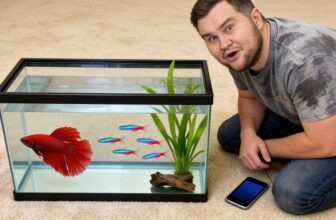
Your betta might be sleeping, since healthy fish rest on dark substrate and perk up when you approach. Check if his gills move slowly and his fins flutter—that’s normal rest.
If he’s tilted sideways, breathing fast, or ignoring gentle taps, something’s wrong. Test your water: ammonia should be 0 ppm (any trace burns gills), nitrates under 10 ppm, and temperature steady at 78-80°F.
Poor flow from a baffled filter, or a tank under five gallons, can stress him into stillness. There are more signs below to help you decide what’s really happening.
At A Glance
- Sleep is normal if fins flutter and gills move slowly when approached.
- Ammonia or nitrates above safe levels burn gills and cause lethargy.
- Cold water below 78°F slows metabolism and bottom‑dwelling behavior.
- Strong filter current exhausts bettas, forcing bottom rest to escape flow.
- Swim bladder or constipation causes buoyancy loss and bottom‑lying posture.
Is Your Betta Sleeping or Something More Serious?
A fish at the bottom of the tank looks still, and stillness can mean two very different things.
You’re watching your betta rest, and you feel a small worry. That’s natural.
A quiet betta stirs something in you—comfort, not fear. That worry means you care.
Bettas sleep at night as they can’t close their eyes, so they find dark spots. If your lighting stays on too long, they nap during daylight instead. Check your timer—twelve hours of light, twelve of dark, keeps their rhythm steady. Tanks with timers like the 3.5-gallon eWonLife kit help automate this cycle for consistent day/night periods.
A healthy sleeper perks up when you approach. Their fins flutter slightly, gills move soft and slow.
Before you panic about illness, notice their diet. Nutrient-rich food keeps energy up; poor meals cause weakness that looks like trouble.
Watch, wait, you’ll learn their pattern.
Quick Signs That Rule Out Normal Sleep
You can tell when stillness stops being rest by watching for signals that break the quiet pattern of healthy sleep. A sleeping betta breathes slow and steady, but rapid gulping means trouble’s brewing.
Check your lighting cycles—fish need darkness from evening until morning, just like you. If lights blaze all night, your betta naps through the day and seems listless when you’re watching.
Diet decay, spoiled food rotting in the gravel, poisons the water and saps energy. You know it’s not normal sleep when your fish ignores gentle taps, tilts sideways, or hides from view. Trust your eyes, and act quickly.
Consistent water flow turbulence from improperly baffled filtration can mask illness by disrupting normal resting behavior, just as noise reducers like the Ultum silencer are designed to spread water flow and reduce stress in reef systems.
Did You Test These Three Water Parameters Yet?
Before you worry about medicines or special foods, grab your water testing kit—those little bottles and color charts hold more answers than you’d think. Your betta breathes water, and when ammonia sneaks past 0 ppm, it burns delicate gills. Nitrates above 10 ppm steal energy, leaving your fish faded and still. Many aquarists prefer 7-in-1 test strips for quick, 30-second results that cover all essential parameters in one dip.
| Parameter | What You’re Looking For |
|---|---|
| Ammonia | 0 ppm, always |
| Nitrate | Under 10 ppm |
| Temperature | 78-80°F |
| pH | 6.5-7.5 |
| Lighting | 8-10 hours daily |
Lighting testing matters too—wrong schedules confuse day and night. Check these water parameters first; fixing them often revives a sluggish fish without costing much.
Is Ammonia or Nitrate Poisoning to Blame?
Those test strips you just used told you a story, and now you’re wondering if that story ends with poison in the water.
You’re checking for ammonia, that invisible burn, and nitrates, the slow fatigue.
Any ammonia above 0 ppm hurts gills, makes breathing hard, and steals energy.
Even trace ammonia burns gills, suffocates, drains life.
Nitrates creeping past 5-10 ppm cause weakness, poor appetite, and color fluctuations you might miss until the blues turn gray.
Your fish didn’t choose this.
Waste breakdown happens fast in small spaces, and without regular changes, toxins accumulate.
Diet quality matters for recovery, but clean water comes first.
Test weekly, change often, watch your fish brighten.
For betta tanks especially, ammonia above 0.25 ppm becomes unsafe and demands immediate water changes to prevent gill damage and lethargy.
Is Your Tank Too Hot or Too Cold?
Your thermometer tells a story your fish can’t speak, and right now it might be murmuring about trouble.
Check your temperature tank immediately—bettas need 78-80°F, like a warm summer afternoon.
Too hot, and your fish pants at the bottom, gasping.
Too cold, and his body slows like maple syrup in winter.
Lighting matters too; twelve hours on, twelve off, lets him rest.
Warmer water holds less oxygen, so plant density helps—those green leaves breathe out what he breathes in.
Water hardness, substrate type, decoration style, tank mates, diet composition, flow size, and filtration type all circle back to one truth: steady warmth keeps him swimming.
Consider an ITC-308 Temperature Controller to automate heating and cooling, sending alerts to your phone if temperatures drift outside the safe zone for your betta.
Is Your Filter Current Too Strong?
The glass thermometer in your hand still holds yesterday’s warmth, but now you’re noticing something else—your betta pressed flat against the gravel, fins rippling in fast little bursts like a flag caught in a storm.
He isn’t lazy; he’s exhausted.
Bettas evolved in still rice paddies, so your filter flow, which is the speed of water moving through the tank, tires them quickly when it’s strong.
Check if he’s hiding behind plants or decorations—that’s a clue he’s seeking shelter from the current.
You can baffle the outflow with a sponge or point it at the glass to slow things down, similar to how ultra‑silent skimmers use sine‑wave technology to reduce disruptive water movement in sensitive aquarium environments.
Your substrate choice, which means the gravel or sand on the bottom, matters too; smooth, rounded pebbles let him rest without fighting suction or rough edges.
Watch for perking up once the water calms—that’s relief you can recognize.
Is Your Tank Too Small?
Since you watched him circle the same plastic castle for the third time in ten minutes, you began to wonder if he might need more room.
A tank smaller than three gallons cramps his style, leaving no space to stretch his fins or investigate.
You can fix this.
Swap cramped quarters for at least five gallons, and suddenly you’ve opened a neighborhood, not a closet.
Scatter tank décor—caves, silk plants, smooth rocks—so he’s territories to patrol and hideaways for rest.
Dim harsh lighting; bright glare stresses small bodies already working hard in tight spaces.
Many five‑gallon tanks now include dimmable LED lighting with sunrise‑sunset simulation to reduce stress and support natural behavior.
He’ll swim more, rest less on gravel, and show you his real personality.
Do Dark Nights Matter for Betta Energy?
When you flip off your bedroom lamp at ten o’clock, your betta needs his darkness too. Bettas follow diurnal activity cycles, meaning they’re active during daylight and rest when it’s dark. Interrupting these nocturnal rhythm patterns with constant lighting confuses their internal clock. You might notice your fish napping at the bottom during daytime, exhausted from poor sleep.
Turn off tank lights each evening, mimicking natural sunset. Dim ambient room lighting helps, too. Think of it like your own sleep—without darkness, you’d feel sluggish. Proper night conditions restore energy, keeping your betta alert and swimming rather than drained on the gravel. For bettas resting on dark substrates, fine black sand like Aqua Natural Galaxy Sand or Carib Sea Moonlight Sand creates a soothing environment that supports their natural rest cycle while protecting their delicate fins.
Could Old Age Be Slowing Your Betta Down?
Your betta’s bright scales may still catch the light, but you’ve noticed him resting on the gravel more than he used to. He’s simply getting older, and that’s okay.
His bright scales catch the light, but he rests more now. He’s simply getting older, and that’s okay.
Bettas typically live three to five years with good care. Genetics play a role here—some fish age faster than others, like how some people run marathons at eighty while others prefer gentle walks. You can’t change his genes, but you can recognize natural changes.
Notice how he perks up when you approach? That’s the key difference between healthy aging and illness. His fins, heavy and beautiful, tire him now. Give him soft places to land, like broad leaves or gentle caves near the surface. If he needs temporary separation from active tankmates, an isolation box with gentle water flow and clear walls allows rest without complete removal from his familiar environment.
Watch for what he does, not just what he doesn’t. Occasional swimming between long rests means he’s comfortable, just slower. You’ll feel a quiet worry, and that’s love showing up—trust it, but don’t let it crowd out observation.
You know him best after all these mornings together.
Is Swim Bladder Disease Causing the Problem?
His pebbles sit flat and solid, until one morning you spot him wedged there, tilting like a boat taking on water. His swim bladder, the organ that keeps him upright, has failed him.
You feel a small worry, like checking if a friend is breathing.
- His belly balloons outward, pressing against gravity
- He drifts nose-up or tail-down, unable to choose his depth
- He struggles to rise for air, then sinks exhausted
- His fins flutter uselessly while his body lists sideways
Diet adjustment—fiber-rich foods—brings relief. Check your algae control products; some disrupt digestion. Dietary enrichment, like varied frozen foods, prevents recurrence.
A properly maintained filtration system with adequate flow and biological media helps reduce stress-induced swim bladder issues by keeping water parameters stable and toxin-free.
Is Constipation Behind Your Betta’s Buoyancy Issues?
Signs Your Betta Is Constipated
A swollen belly presses against the glass, and you notice he hasn’t left a trail of waste in two days.
You check: his belly’s round, he’s floating nose-up or sinking tail-down, and he’s not interested in breakfast.
That’s constipation, friend, and it’s messing with his swim bladder like a clogged pipe backs up a sink.
You’ve been feeding too much dry pellet, I’ll bet. Those expand in his tummy, blocking the works and ruining his gut health. His diet needs changing now.
Try a thawed, chopped pea—no skin—or a tiny bit of daphnia. Fast him for a day, then watch. He’ll poop, feel better, and swim right again.
Could Ich, Dropsy, or Other Diseases Be at Fault?
When a betta hovers near the gravel, fins clamped tight like folded paper, disease might be the quiet culprit you’re missing.
You’re scanning for Ich, those tiny white polka dots like table salt sprinkled on fins and body. You’re watching for Dropsy’s pinecone scales, puffed out like a bristled brush from fluid buildup. You notice clamped fins, labored breathing, or refusal to eat—these whisper that something’s wrong inside.
- Ich hides like dust on smooth tank décor you’ll need to inspect closely
- Dropsy swells the belly until the fish can’t balance on gen substrate
- Velvet coats your betta in gold film, invisible till you shine a flashlight
- Fin rot melts edges like paper in water, spreading if you wait
You’re spotting these signs early, feeling worried but purposeful, since catching illness now means you can act.
What to Do Right Now for a Lethargic Betta
Quick Checks for a Lethargic Betta
Grab your test kit and a clean cup, as you’re about to become a detective with fins.
Test the water for ammonia and nitrates immediately. If levels read above zero, perform a 50 percent water change with temperature-matched water.
Check your lighting schedule; turn off tank lights after dark so your betta sleeps properly, like pulling your own bedroom shades. Poor rest makes anyone groggy, fish included.
Review your nutrition diet—constipation from dry flakes tires fish quickly. Soak pellets first, or offer a tiny bit of blanched pea.
Adjust any strong filter flow, then wait. Watch quietly. Small fixes often wake a weary betta.
When Should You Call an Aquatic Veterinarian?
When to Call an Aquatic Veterinarian
Your test kit sits on the counter, its results now steady, and your betta still rests at the bottom even with the clean water and quiet dark you gave him.
Your water tests perfect, your betta still sinks—something deeper is wrong.
You know the difference between tired and truly sick, don’t you? You’ve watched him long enough to feel when something deepens.
Call a veterinary aquatic specialist when you see:
- Breathing that rushes fast, gills flaring like paper fans
- Scales lifting like pinecones, a pinecone pattern called dropsy
- One eye swelling bigger than the other, clouded like old glass
- Stillness that doesn’t break when you tap gently
This is emergency care. Waiting costs lives you could save.
Frequently Asked Questions
Do Bettas Sleep With Their Eyes Open?
Yes, you’ll notice your betta’s eye open resting at night since they lack eyelids and cannot close them. You should provide darkness for their nocturnal activity, as constant light disrupts their sleep and causes daytime lethargy.
Can New Tank Decorations Cause Bottom-Resting?
Yes, new tank decorations can cause bottom-resting. You’ll see decorative stress if you’ve added unfamiliar items, and substrate choice matters—gravel or sand that’s too rough can discourage exploration, whereas plants provide reassuring resting spots instead.
Does Betta Gender Affect Resting Behavior?
Gender doesn’t significantly alter resting patterns, though breeding females may show gender‑specific lethargy during egg‑carrying. You’ll notice hormonal‑driven positioning in spawning females seeking substrate spots, but males and females otherwise rest similarly when healthy.
Should I Feed My Betta While It’s at the Bottom?
You should pause feeding and check your water quality first, as poor conditions often cause bottom-resting. Once parameters stabilize, resume a light feeding schedule and observe if your betta hunts actively.
How Long Can a Betta Safely Stay on the Bottom?
You can’t set a strict time limit—healthy bettas rest briefly, but you’re health monitoring daily. If bottom‑resting exceeds a day or pairs with faded colors or labored breathing, test water chemistry and adjust immediately.
Rounding Up
Your betta’s rest at the tank bottom holds a story only you can read. You’ve learned to spot the difference between peaceful sleep and silent distress, testing water with drops and strips, watching fins and gills for secret signals. Trust your growing skills. Act early when ammonia climbs or temperature drifts. Keep notes, stay patient, and remember—small tanks demand big care. Your fish depends on your steady hands and calm mind.