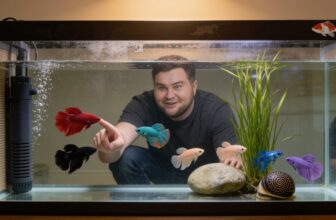
Betta fish and ember tetras—can this combo actually thrive in your tank? With the right setup, these vibrant species create a stunning community display without the usual fin-nipping drama.
Yes, it can work—if you set things up right. These two can coexist peacefully, but a 20-gallon tank is the bare minimum; 40 gallons gives everyone breathing room.
Keep water at pH 6.5–7.5 and 76–80°F. Use a gentle sponge filter ($10) so the betta isn’t stressed by strong currents.
Add six or more ember tetras first to claim the turf before introducing your betta. Stick around, since the first few days will tell you if it’s harmony or a tiny aquatic turf war.
At A Glance
- A 20-gallon minimum tank with stable 76–80°F and pH 6.5–7.5 water ensures harmony.
- Gentle filtration, like a sponge filter, prevents stress from strong currents for both species.
- Introduce ember tetras first so they claim the tank, reducing the betta’s territorial aggression.
- Dense plants, driftwood, and floating cover provide hiding spots and break the betta’s line of sight.
- Schooling six or more tetras creates a coordinated group that does not trigger the betta’s chase instinct.
Water Parameters Both Species Need (pH 6.5–7.5, 76–80°F)
A sudden swing? That spells stress, then disease, for both. These parameters align perfectly—no compromise needed.
Surprisingly, diet compatibility likewise hinges on stable water: stressed fish refuse food. Keep a reliable heater (like the Eheim Jäger, $25–30) and a digital thermometer with ±1 °C accuracy for reliable readings.
Check weekly. Get this right, and your fish practically thrive on autopilot.
Ignore it, and you’re nursing sick pets. The verdict: stable water is non‑negotiable for harmony.
For precise temperature control, consider a model with digital LED controller and dual sensors for redundancy.
Ideal Tank Size for Betta and Ember Tetra Harmony
A 20‑gallon tank is the minimum for a betta and ember tetra community—no shortcuts. Smaller tanks mess with schooling dynamics, leaving tetras stressed and bettas cranky. Here is what works:
- Tank dimensions: 24 inches long, 12 wide, 16 tall—gives tetras swimming room and betta a peaceful zone.
- Schooling dynamics thrive in size: groups of 6+ tetras need space to zip without bumping.
- Water stability: larger volume means fewer parameter swings for both fish.
- Territory: enough floor space lets betta claim a corner without chasing tetras.
- Hiding spots: big tank allows dense planting without cramping anyone.
Bottom line: 20‑gallons isn’t fancy, but it’s the non‑negotiable peace treaty.
This size easily accommodates the heavy bioload and robust filtration necessary to keep both species healthy. For optimal water quality, consider a self‑cleaning filter to reduce maintenance frequency and improve biological filtration.
How to Set Up a Planted Tank for Both Species
Since a 20‑gallon tank is already the baseline for peace, setting up a planted environment that makes both species feel like royalty requires nailing down a few key details. A proper planted tank setup means dense foliage for hiding—think Java fern and Anubias tied to driftwood. For tank scaping tips, create shaded zones with floating plants like Amazon frogbit. Water Spangles also multiply quickly to provide natural shade and reduce algae. Using curved scissors helps trim dense moss without damaging delicate stems.
| Zone | Purpose |
|---|---|
| Top Floating Plants | Soft light, betta rest spots |
| Midground Bushes | Tetra cover, water flow break |
| Bottom Driftwood | Low‑current caves for both |
| Open Swimming Lane | Clear patrol route for betta |
This layout lets each fish own a slice—without drama.
Choosing a Filter That Won’t Stress Your Betta
Choosing a filter for a betta tank is a bit like picking a roommate—you want someone who handles their business without making a scene.
Bettas have low current tolerance, so filter flow must be gentle, like a soft whisper rather than a blast.
Bettas have low current tolerance, so filter flow must be gentle, like a soft whisper rather than a blast.
- Sponge filters: Dead quiet, cheap at $10, and create zero current—perfect for those long, fragile fins.
- Adjustable HOBs: Look for AquaClear 20 ($35) with flow control to dial down the turbulence.
- Canister filters: Use spray bars to diffuse output, turning a jet into a gentle rain.
- Internal filters: Choose ones rated for tanks twice your size, then throttle them.
- Bottom line: Any filter with adjustable flow works; avoid powerheads or high‑velocity units.
For bettas, a filter with a quiet motor ≤40 dB ensures minimal stress and disturbance. Many ultra-quiet canister filters also use brushless motors and insulated housings to reduce vibration and noise below 40 dB.
Where Ember Tetras Come From (And Why It Matters)
The ember tetra hails from the Araguaia River basin in Brazil, a place where blackwater rivers run slow and tea-colored from decaying leaves and tannins.
This South American blackwater environment—soft, acidic, and stained—shapes their needs perfectly.
In the wild, they swim in large schools, their tetra social dynamics built on safety in numbers.
They’re skittish alone, bonding tightly with their group.
Recreating that calm, dimly lit habitat matters since it keeps them confident, not hiding.
No tannins? They’ll feel exposed.
Get the water right, and they’ll glow orange like tiny embers.
Simple, really.
Achieving such soft, acidic water often requires RO/DI systems that remove nearly all contaminants and dissolved solids.
A rimless tank made of low‑iron glass further enhances their vibrant color by eliminating the green tint typical of standard aquarium glass.
Betta’s Wild Home and Why It Matches Ember Tetra Needs
Compatibility often starts with geography. Betta’s natural habitats in Southeast Asia—Thailand, Cambodia, Vietnam—are slow-moving, stagnant waters. Ember tetras from Brazil’s blackwater rivers share similar preferences.
- Native regions: Both thrive in warm, acidic, soft water conditions.
- Natural habitats: Bettas prefer still water; ember tetras tolerate moderate flow, making adjustable filters key.
- Temperature overlap: 76–80°F for both, no heater wars here.
- pH harmony: 6.5–7.5 suits both, no chemistry crises.
- Vegetation needs: Planted tanks with hiding spots satisfy territorial bettas and schooling tetras alike.
The wild match is undeniable; setup accordingly for peaceful coexistence. Incorporating fin-friendly artificial plants provides safe hiding spots without risking fin damage. A black static-cling background can help reduce stress by minimizing reflections and bright light.
What to Feed Bettas and Ember Tetras in One Tank
Feeding a betta and ember tetras together is less about drama and more about logistics. Their needs overlap nicely if you nail the feeding schedule.
Bettas need more protein—aim for a high‑quality pellet like Fluval Bug Bites ($7 for 1.2 oz) that sinks slowly. Ember tetras, greedy little grazers, snatch floating flakes (TetraMin, $6 for 3 oz).
For protein balance, supplement with frozen brine shrimp twice weekly ($9 for 1.6 oz). Everyone eats. Nobody starves.
The Fluval Bug Bites formula contains 40% black soldier fly larvae protein, making it a sustainable and protein-dense choice for bettas.
It’s like meal‑prepping for tiny, colorful roommates—awkward at first, but surprisingly easy once you’ve got a rhythm.
To keep the schedule consistent during short vacations, an automatic feeder with dual power options ensures the fish are fed on time even if the USB battery runs low.
Why Bettas Guard Territory While Tetras Stick Together
In the wild, a betta’s world is a shallow puddle—literally—so it patrols every inch like a tiny, grumpy landlord.
In the wild, a betta’s world is a shallow puddle—so it patrols every inch like a grumpy landlord.
Tetras, living in vast, flowing rivers, rely on numbers, not borders.
- Survival instinct: Bettas see any fish as a rival for limited food and space—aggressive triggers are plentiful in a tiny territory.
- Schooling safety: Tetras avoid conflict by forming a shimmering, darting school—predators can’t target any single fish.
- Lonely landlord: Without neighbors in their puddle, bettas become hyper-vigilant of every leaf and cave.
- Strength in numbers: A tetra alone is vulnerable; a school of six is a floating, coordinated shield.
- Different jobs: The betta guards a home; the tetra defends the group. Both just want to survive. Selecting a tank with a low-flow filtration system helps prevent stressing a betta’s delicate fins during cohabitation. Using a filter with dual-sided mesh can also quietly reduce debris without creating strong currents.
How Ember Tetra Speed Reduces Aggression Risk
Two key traits make ember tetras surprisingly good at dodging betta drama: speed and awareness. Their schooling instinct is a lifesaver—six or more fish move as a single, darting unit. This rapid, coordinated motion triggers a betta’s hunting reflex poorly; they simply cannot lock on. A dark tank background likewise helps, making the bright orange tetras less conspicuous against dense plants. They vanish into shadows before a betta finishes its slow, deliberate patrol. Their dual optical sensors achieve sub-millimeter precision in detecting threats, much like an ATO system’s water-level accuracy. Additionally, ember tetras thrive in larger tanks with gentle flow filtration that mimics their natural calm-water habitat.
Introduce Ember Tetras First to Prevent Aggression
By introducing ember tetras before your betta, you flip the territorial script entirely.
The tetras establish the tank as their safe home first, making your betta the newcomer rather than the landlord.
This simple switch is key for aggression prevention.
- Claims territory first – Tetras settle in, claiming spots before the betta arrives.
- Reduces betta’s defensive mode – A betta added later sees fish already present, not intruders.
- Tank introduction done right – Prevents the betta from viewing the whole tank as its private kingdom.
- Schooling gives confidence – Groups of six or more feel secure, less likely to scatter and trigger chase instincts.
- Starts with calm vibe – A peaceful foundation means fewer surprises, less stress for everyone.
Using a breeding box can further isolate the betta during initial introduction to prevent any early aggression. For example, a Triple-Chamber Plastic Box offers three separate treatment zones that can be used to slowly acclimate a betta to the tetras’ presence.
Monitoring the First Few Days Together
The first few days together are a test run, not a done deal. Watch for subtle signs, like how lighting effects cause shadows; tetras huddling there means they’re stressed.
A proper tank lid design is essential—a startled betta can leap out during these tense hours, so no gaps.
Feed sparingly, observing who eats first.
If tetras school tightly away from the betta, wait it out.
Ensure your cleaning tools are safe by using a floating design that prevents loss in the substrate if separated, as found in many modern aquarium cleaners.
Your tank’s your new tribe; this trial builds harmony. Stay patient, not panicked.
Bottom line: daily, quick checks confirm if the match works. No stress—yet.
Consider using a magnetic fish tank cover for easy access during feeding while preventing jumps.
Signs Your Betta Is Stressed or Aggressive
Watching for stress or aggression in your betta is like reading a mood ring, but with fins. You’ll see clear stress signs and aggression cues if things go sideways:
Watching for stress or aggression in your betta is like reading a mood ring with fins.
- Clamped fins: Fins held tight against body, not flowing—classic stress signs.
- Flaring gills and dark stripes: Aggression cues, often with a puffed-out chin.
- Hiding constantly: Stressed betta vanishes behind plants, refusing to patrol his tank.
- Chasing or nipping tetras: Direct aggression cues—he’s claiming the 20-gallon as his personal kingdom.
- Rapid breathing or glass surfing: Stress signs; gills moving fast, racing along the glass.
- Use a digital hygrometer thermometer to monitor temperature shifts that may trigger stress or aggression in your betta.
- Weekly testing with 8‑in‑1 water test kits can detect ammonia spikes early, preventing illness that often fuels aggressive behavior.
These signals mean trouble’s brewing, so keep watch.
When to Separate Fish and What to Do Next
Then, rehome stressed fish if tetras show clamped fins or hiding; local fish stores or community groups often take them. For the separated betta, choose a recovery tank with quiet filtration to minimize stress. No shame in admitting a mismatch—sometimes, peaceful coexistence just isn’t in the cards. Consider setting up a 2.5 gal self‑cleaning tank as a dedicated quarantine or recovery space for the separated betta. Your remaining fish will thank you with brighter colors and livelier behavior.
Common Mistakes Mixing Bettas and Ember Tetras
Even seasoned aquarists can trip over the same rake when mixing bettas and ember tetras—since this section covers the most common blunders so you can avoid them.
- Tank size fails; a too-small setup triggers territorial drama.
- Betta diet neglect; overfeeding protein-rich pellets pollutes water, stressing tetras, since their wild Tetra origins are omnivorous, needing varied flakes.
- Ignoring flow: bettas hate strong currents, but embers adapt—use adjustable filters, like the Tetra Whisper IQ, at low settings.
- Adding betta first: a rookie move that claims the whole tank as his domain.
- School size mistakes; less than six embers causes chronic stress, breaking the harmony.
- For a 40-gallon tank, a filter like the Hygger HG149 provides gentle flow that won’t disturb bettas while keeping water clean for tetras.
- A steel-frame stand rated for at least 1,100 lb ensures the heavy tank setup remains stable and prevents wobble from daily activity.
Sidestep these, and you’re part of the crew that gets it right.
Frequently Asked Questions
Can Ember Tetras Outcompete Bettas for Food During Feeding?
Ember tetras can outcompete bettas for food, but good feeding strategy stops it. Their swimming speed is higher, so they zip to flakes before a slower betta. This can spark feed aggression if the betta gets frustrated.
To keep peace, sink a pellet for the betta, scattering flakes for tetras. That’s a tank full of full bellies. Separate feeding zones equal happier fish all around.
Do Ember Tetras Ever Nip at a Betta’s Long Fins?
Yes, ember tetras can nip at a betta’s long fins, but it’s rare. Fin nipping usually signals stress or boredom, not pure malice. Aggression triggers include small tanks (under 20 gallons) or sparse plants.
A well-decorated 20-gallon with floating plants gives the betta escape routes and the tetras distractions. Think of it like keeping a grumpy cat with speedy mice—it works if everyone has space to feel safe. So, set up a proper home, and those tiny orange fish will likely mind their own business.
How Many Ember Tetras Are Safest With One Male Betta?
For one male betta, six to eight ember tetras are safest. That’s the smallest group they need to feel secure—any fewer, and they get stressed.
A 20-gallon tank with stable water parameters (pH 6.5–7.5, 76–80°F) gives everyone room to breathe. More tetras means less chance of fin-nipping; the betta stays center stage, and the school does its own thing.
Bottom line: six minimum, but eight is better.
Will Bright Tank Lighting Bother Either Species?
Bright tank lighting won’t bother either species, as long as you manage it. Bettas come from shallow, sun-dappled waters, and ember tetras from tea-stained rivers; both handle moderate light.
Still, a glaring, unshaded fixture can stress them. Use a dimming schedule, like a 24/7 LED cycle, to mimic dawn-to-dusk.
A larger tank size, at least 20 gallons, helps, too—more water volume dilutes light intensity.
Bottom line: light them gently, and they’ll shine.
Can Bettas and Ember Tetras Breed in the Same Tank?
No, they cannot. Hybrid viability is fundamentally zero here—bettas and ember tetras are entirely different species with incompatible genetics.
Each needs its own specific spawning triggers, like soft, acidic water or particular temperature shifts, which cannot be shared. Even though both spawned, the eggs and fry would likely be eaten.
Rounding Up
So, can bettas and ember tetras live together? Yes, but it’s not a guarantee. Think of it like hosting a grumpy uncle at a family reunion—possible, but you need a solid plan. A 20-gallon planted tank is your best bet, with a gentle sponge filter (around $15) to avoid stressing the betta’s fins. Add the tetras first, then the betta last. Watch for flared gills or nipped tails. If trouble hits, separate them. Bottom line: it works, but you’re the referee.