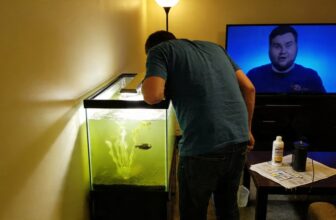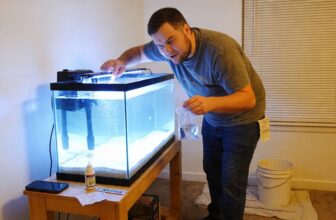
A glass tank, five hundred gallons or more, sits like a small pond in a living room. The fish inside grows to the length of a human forearm, thirty inches, perhaps more. It needs soft sand under its belly, gentle water moving past its fins, and hard shells to crack open for dinner. The keeper must test the water each week, watching numbers like pH and temperature with steady patience. Many want this fish, few can truly house it.
At A Glance
- House in a minimum 500‑gallon tank with soft sand substrate and gentle water flow.
- Maintain water temperature at 75–79°F, pH 7.0–8.0, and hardness 10–25 KH.
- Feed clams, mussels, or snails over two inches five times weekly for beak maintenance.
- Use mechanical, biological, and chemical filtration sized for fish exceeding forearm length.
- Verify legal restrictions, obtain permits, and source captive‑bred specimens when possible.
Is a Giant Freshwater Puffer Right for You?

A fish tank can look small when you stand beside it, but a giant freshwater puffer sees that same space as its whole world.
Owner personality matters here, since this fish lives ten years and recognizes your face.
Ten years is long enough for a fish to learn who you are.
Puffer neurobiology means they feel stress, boredom, and something like play.
Puffer psychology demands interaction, or they wither.
Puffer ethics ask whether wild-caught creatures belong in glass rooms, since puffer trade supplies almost all specimens through capture, not breeding.
Puffer economics sting: five hundred gallons minimum, plus filtration, plus endless shellfish.
Puffer legalities vary by region, so check before buying.
Puffer folklore, puffer mythology, and puffer symbolism across cultures celebrate transformation and defense, yet here, the fish transforms your home, your budget, your daily rhythm.
This commitment rewards patience with strange, beady-eyed friendship.
How Big Do Mbu Puffers Get: and How Fast?
As no one holds a tape measure against a swimming fish, careful observers have recorded what growth looks like in the Tetraodon mbu.
| Age | Size |
|---|---|
| 6 months | 3–4 inches |
| 1 year | 8–10 inches |
| 3 years | 15–20 inches |
| 10 years lifespan | 22–30+ inches |
Growth growth demands patience, like watching a friend grow taller across seasons. The Mbu arrives small, a palm-sized newcomer, yet unfolds slowly, year by year, into something extraordinary. Those who commit to this journey uncover belonging in witnessing transformation—recognizing that greatness builds quietly, steadily, across a decade of shared mornings.
Mbu Puffer Tank Size: Why 500 Gallons Is the Minimum
Why does a fish need a space larger than most living rooms? The Mbu puffer reaches thirty inches, a living submarine requiring room to turn, to cruise, to simply *be*.
Five hundred gallons marks the floor, not the ceiling, of acceptable tank size. Anything less courts stunted growth, stress, shortened longevity. These fish live ten years, sometimes more, and deserve each day uncramped.
The tank itself becomes their world. Length matters more than height, swimming room over depth. Think pond, not aquarium. Think commitment of space, of water, of years. This fish is not a decoration.
Water Parameters Your Mbu Puffer Actually Needs
Picture a thermometer, the old kind with red liquid climbing a glass tube, and imagine it reading exactly 76 degrees.
Picture a thermometer, the old kind with red liquid climbing a glass tube, and imagine it reading exactly 76 degrees.
This temperature sits in the middle of where an Mbu puffer feels safe, swimming without stress. The water color should stay clear and clean, not cloudy or tinted, since these fish watch their world with those large, curious eyes.
Breeding challenges mean most Mbu puffers come from wild rivers, so matching home water to those origins matters deeply.
- Keep temperature steady between 75 and 79 degrees Fahrenheit.
- Measure pH at 7.0 to 8.0, aiming near 7.5.
- Maintain hardness from 10 to 25 KH.
- Test weekly, changing water to preserve clarity.
These numbers build trust, and trust builds belonging.
Safe Substrate and Décor for Scaleless Skin
How does a fish without armor protect itself?
The Mbu puffer‘s smooth, scaleless skin feels delicate, almost like a polished stone.
Soft sand, two inches deep, cushions their belly as they investigate. Gravel cuts them, so avoid it entirely.
Soft flow matters here, too. Strong currents push them against décor, causing scrapes. Gentle water movement keeps them safe, lets them choose where to swim.
Rock placement requires care. Each stone must sit stable, no sharp edges, tested by hand before it enters the tank. Smooth driftwood works, anchored well.
Their home reflects your attention. You belong to a community that protects the vulnerable.
Feeding Your Mbu Puffer: The Shellfish Habit
What does a fish with a beak actually need to eat?
The Mbu puffer grows a beak-like mouth made of fused teeth, teeth that never stop growing without hard food to grind them down. Shellfish sourcing becomes the keeper’s quiet ritual, the way one belongs to this fish’s survival.
The keeper’s ritual: belonging to something that cannot survive without your devotion.
A proper feeding schedule protects the animal from pain:
- Offer clams, mussels, or snails five times weekly, measuring shells at two inches minimum
- Source from clean, contaminant-free waters, never bait shops of unknown origin
- Watch the beak trim itself naturally, a slow, satisfying scrape
- Betray this schedule, and the teeth overgrow, and the fish suffers in silence
Trust builds through such consistency.
Tank Mates for Mbu Puffers: Rare Exceptions
A single large rock sits at the bottom of a thousand-gallon tank, its shadow the only
Why Your Mbu Puffer Will Be Wild-Caught
The rock sits alone since most Mbu puffers in aquariums began their lives far from glass walls. Their wild caught origins trace to African rivers and lakes, where they swam freely before capture.
- No one has figured out how to breed them in tanks yet, so every baby puffer grows up in nature first.
- Trade regulations try to protect wild populations, but demand keeps fishers casting nets.
- The journey from river to store means stress, making careful acclimation vital for belonging in your home.
- Choosing this fish means accepting its wild beginning, a responsibility shared among keepers who understand.
Ich and Common Mbu Puffer Diseases
White spots on a fin can mean trouble, much like one gray cloud warns of rain before the sky turns dark.
Ich, a tiny parasite, causes these spots on skin and gills. Mbu puffers feel stress when Ich arrives, their smooth scaleless bodies making them easy targets.
Scaleless and vulnerable, the Mbu puffer faces Ich’s invasion with nowhere to hide.
Ich treatment works fast at the first sign: raise water temperature slowly to 86°F for 14 days, add aquarium salt carefully, or use copper-based medicine following label directions exactly.
Parasite prevention matters more than cures. Quarantine new fish for 30 days. Test water weekly. Clean filters monthly.
Healthy puffers swim boldly, their maze-patterned skin glowing olive and gold. Sick fish hide, breathe hard, lose appetite.
Watch closely. Act early. Your puffer depends on steady hands and calm attention.
The Real Cost of a Decade With a Giant Puffer
How does a single fish become a ten-year promise, measured not in words but in gallons, dollars, and daily attention?
The long‑term commitment of an Mbu puffer asks more than casual hobbyists expect.
- Tank construction: A 1,000‑gallon custom aquarium runs $10,000–$25,000, more than a modest car.
- Filtration systems: Industrial pumps and weekly water testing demand $3,000 upfront, plus $150 monthly maintenance.
- Food sourcing: Fresh clams, mussels, and snails cost $200–$400 monthly for proper beak health.
- Time investment: Thirty minutes daily, every day, for ten years—that is 1,825 hours of care.
These cost costs separate devoted keepers from dreamers, binding the dedicated into a quiet fellowship of the patient.
Ready for a Mbu Puffer? Your Next Steps
Resolution arrives slowly, like water filling a very large vessel, and it begins with a single sheet of paper placed on a kitchen table.
On that paper, write your aquarium setup plan: 96 inches long, 48 inches wide, 500 gallons minimum, custom-built. Check regional legal considerations, as some areas restrict wild-caught species. Join local clubs, find mentors who remember their first mistakes. Schedule six months for preparation, save money for filtration strong enough for a fish longer than your forearm. This patience builds belonging, each step a small promise kept.
Frequently Asked Questions
Can Mbu Puffers Live in Outdoor Ponds Year-Round?
Yes, with preparation. A season pond must maintain 75-79°F year-round; temperature fluctuations below 70°F cause stress, below 60°F risk death. Seasonal feeding slows in cold months, matching their metabolism. Predator management requires netting or covered enclosures against birds, raccoons. Hardy in stable climates, they thrive outdoors where winters stay mild and summer shade prevents overheating. Success depends on consistent monitoring, backup heating, and secure boundaries that protect these vulnerable, scaleless fish from harm.
Do Mbu Puffers Need Tank Lighting Schedules?
Tank lights, those glowing rectangles above the water, matter more than one might guess. Mbu puffers follow lighting cycles tied to day and night, just as people need darkness to rest. Their photoperiod preferences mimic African rivers: roughly twelve hours of gentle light, twelve of dimness. Without this rhythm, they grow sluggish, confused, their internal calendars broken. A simple timer, costing little, restores their sense of time and belonging.
How Do You Trim an Overgrown Mbu Puffer Beak?
A small pair of flat‑nosed clippers sits ready at the tank’s edge, the tool used when an mbu puffer’s beak grows too long.
Trimming requires firm, gentle holding of the fish wrapped in a soft, wet towel, then snipping the overgrown upper and lower beak tips, much like trimming a fingernail that has curved uncomfortably. The puffer feels brief worry, calmed by quick, confident hands.
Regular hard‑shelled feeding prevents future overgrowth, maintaining sound dental health through natural beak hygiene. Occasional professional assistance guarantees, protecting the sensitive tissue beneath the keratin shell.
Can Mbu Puffers Recognize Individual Family Members?
Yes, mbu puffers demonstrate social recognition of individual people.
These fish form a genuine social bond with their caregivers, much like a child recognizes a parent’s face. Through daily feeding rituals, they learn voices, footsteps, and even facial features. This family bonding creates calm, happy feelings when familiar people approach, whereas strangers may trigger hiding or caution.
Their memory for human companions lasts months, building gentle trust through patient, repeated kindness.
Do Mbu Puffers Sleep or Rest on the Bottom?
Yes, Mbu puffers sleep on soft sand, settling flat along the bottom. Their scaleless bellies press gently into the substrate preference—soft sand, mind you, never rough gravel—so the fish feels safe, cradled. This hab behavior brings quiet relief, like a child tucking blankets under chin. The puffer rests motionless, eyes dim, recharging energy until it wakes playful again.
Rounding Up
A 500‑gallon glass box, weighing as much as a small car, sits in the corner of a quiet room. Water, 75 to 79 degrees, moves slow and soft, like breath held steady.
The giant freshwater puffer grows to your forearm in five years. It eats clams, eight to ten shell pieces weekly, grinding its beak with each crunch. $150 monthly, $25,000 at the start, buys companionship for a decade.
Some creatures ask for much. Some keepers, patient and ready, answer.