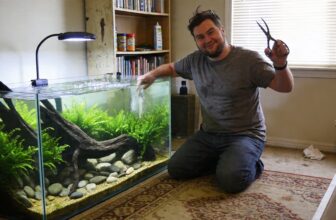
The Fluval Spec V at ~$100 wins for most bettas—5.2 horizontal gallons, upgradeable filter compartment, just add a sponge to tame that jet‑fan outflow.
You’ll want horizontal space since your fish breathes air through a maze organ, basically a built‑in snorkel that demands easy surface access, so vertical tanks mean longer commutes and grumpier fins.
The Marineland Portrait (~$85) works if desk space is tight, but you must throttle that flow.
Curved tanks look slick yet hide no cords.
Pick the Spec V, slow the current, and your betta stops acting like a stressed‑out roommate breathing fumes—plus there’s more gear talk ahead if you stick around.
At A Glance
- Five-gallon horizontal tanks reduce ammonia spikes, stress, and fin rot better than vertical designs.
- The Fluval Spec V offers ideal horizontal space with upgradeable filtration and hidden equipment compartments.
- Marineland Portrait suits tight spaces vertically but requires flow throttling for betta comfort.
- Penn Plax Curved Corner prevents jump-outs with full lid coverage and distinctive viewing angles.
- Reduce filter flow using sponge diffusers, decorative baffles, or weaker impellers for betta health.
How Much Space Your Betta Really Needs (and Why 5 Gallons)
Why does your betta need five gallons when you’ve seen them crammed into tiny cups at the pet store?
Those cups are temporary holding cells, not homes. You know better, and that’s why you’re here. 5 gallon necessity isn’t gatekeeping—it’s basic biology.
In cramped Betta space, ammonia spikes fast, stress hormones flood, and fins rot. Your fish needs horizontal room to patrol, surface access to breathe (they’re maze breathers, meaning they gulp air), and enough water volume to dilute waste between changes.
Three gallons? Technically survivable. Five gallons? That’s where thriving starts. Your betta’s no decoration—he’s a pet with a personality, and you’re the owner who gets that.
Bottom line: Skip the sympathy buys. Start at five, join the club of owners who do right by their fish, and watch those colors pop.
For a five-gallon setup, consider the Fluval SPEC kit, which uses a gentle three-stage filtration flow to avoid stressing delicate fins while maintaining water clarity.
Fluval Spec V Review: The Upgrade-Friendly All-in-One
If you’re the type who buys a fish tank and immediately starts googling “how to make this better,” the Fluval Spec V was built for you.
This 5.2-gallon horizontal kit understands betta temperament—your fish needs easy surface access, and the shallow depth delivers. The included filter’s a bit *too* enthusiastic, though. You’ll want a Fluval Edge pre-filter sponge to gentle that flow, or your betta’ll be doing laps in a whirlpool.
Filter maintenance stays simple: hidden compartment, upgradeable media, no tank teardown required. Open top means faster evaporation—silver lining, easier water changes.
Verdict: Tinkerer’s paradise. Buy it, mod it, join the club.
Unlike larger 20‑gallon setups, this compact kits] often omit a heater, so you’ll need to add one separately for tropical betta health.
Marineland Portrait Review: Top-Rated but Vertical-Good for Bettas?
Even though the Marineland Portrait boasts the highest Amazon rating in its class—four stars from over nine hundred reviewers—you’re right to pause before clicking “buy,” as that vertical silhouette raises a legitimate question: can a betta really thrive in a tank that’s taller than it’s wide?
Verdict: It’s workable, not ideal.
Your betta’s temperament leans horizontal—they’re surface breathers who prefer short commutes for air. That vertical flow forces longer swims upward, which stresses lazy fins. The hidden filter/heater compartment keeps things tidy, though you’ll need to throttle that gentle hum—betta comfort demands low current. Adding a magnetic mesh lid can help prevent jump-outs while maintaining easy access for feeding.
The removable LED‘s handy, no timer needed. Tall decorations finally fit, sure, but you’re trading swimming room for aesthetics. Dad joke: it’s the aquarium equivalent of a studio apartment with high ceilings—nice view, cramped floor plan.
Bottom line: Buy only if space demands vertical, and you’re committed to flow management.
Penn Plax Curved Corner Review: Style That Keeps Jumpers In
As curved glass won’t magically make your betta love you more, the Penn Plax Curved Corner does solve one problem that keeps fishkeepers up at night: jumpers.
The full-coverage lid delivers serious jump prevention, no more heart-stopping moments finding your fish on the carpet.
Those curved corners? Pure corner trends appeal, giving you Instagram-worthy viewing angles without the bow-front price tag.
You’ll get a protective mat (your furniture thanks you), though that LED light lacks an on/off switch—hello, external timer.
The filter works fine, but consider upgrading chemical filtration down the road.
Bottom line: stylish security for nervous owners.
If you prefer a different material, PET plastic bowls offer shatter-proof durability and multi-angle viewing.
Fluval Edge 6-Gallon Review: When the Extra Space Pays Off
The Penn Plax keeps your betta grounded, but maybe you’re the type who eyeballs that extra gallon like it’s free real estate—you’re not wrong. Consider alternatives like the 2.5 gal starter kit with a 2-year warranty for a budget-friendly self-cleaning option.
Verdict: Splurge-worthy if you value tank aesthetics and don’t mind working around quirks.
- That glass cube, top and sides, turns your fish into living art—360° viewing for the win
- Powerful, quiet filter with upgradeable cartridges (your betta thanks you)
- Day/night LED modes support healthy sleep cycles
- The catch: Small opening complicates maintenance workflow—cleaning’s a puzzle, not a breeze
- Light’s weak for serious plants; 42-LED upgrade runs extra
- Prioritize horizontal tank orientation for surface access
- Remember betta temperament demands easy breathing, not climbing
- Match tank orientation to your fish’s daily needs
- Join betta keepers who put fish comfort before aesthetics
- Slip a sponge diffuser over the outflow. Cost: $3–$8. It breaks the stream into gentle bubbles your fish won’t have to fight through.
- Raise your water level so the current hits the surface first, dissipating energy.
- Angle a decoration—driftwood, that ceramic pirate—into the flow path.
- Thread a cable tie through the intake, DIY flow flow reduction.
- Replace the impeller with a weaker unit; many brands sell them separately.
- Marineland Portrait: Vertical hidden compartment, silent filter, heater hides completely—about $85
- Fluval Spec V: Side chamber with built-in heater space, clean sightlines—around $100
- Curved corner tanks: No compartment, so gear sits visible; you sacrifice looks for that bubble aesthetic
- Open-top designs: Easy access, but gear’s exposed—pick your poison
- Nutrient-rich plant substrates (like ADA Amazonia or Fluval Stratum, $15–$25 per bag) demand at least 2 inches for root anchoring and bacterial colonies—think of it as your plants’ underground apartment complex.
- Inert gravel or sand needs 2.5–3 inches so root tabs (about $10 for 10) don’t become expensive decorations buried too shallow.
- Betta roots prefer shallower than Discus territory, deeper than bare-bottom drama.
- Root-feeders (Crypts, Swords) = deeper; column feeders (Anubias, Java Fern) = barely mattered, since you’ll tie ’em to rocks anyway.
- Deep substrate traps debris; vacuum gently, or you’ll release a sulfur bomb—swamp gas, not the good kind.
Bottom line: You trade easy access for beauty. Worth it? If you’re patient, absolutely.
Koller Panaview vs. Tetra Crescent: Which Budget Kit Holds Up?
Why drop a paycheck on a tank when you’re just testing the betta waters? The Koller Panaview and Tetra arc both scratch that budget aesthetics itch without emptying your wallet, and this price comparison makes choosing feel less like assignment, more like joining the club.
| Feature | Koller Panaview | Tetra arc |
|---|---|---|
| Price | Dirt cheap, ~$35-45 | Budget-friendly, ~$50-65 |
| Filter | Weak, rattly, needs replacing | Quiet, gentle flow, betta-approved |
| Lid | Flimsy, fights back | Functional, heater-ready holes |
| Longevity | You’ll upgrade everything | Grows with you, mostly |
Panaview’s LED disco lights are fun until they aren’t. Arc’s curved acrylic, though? Clean lines, happy fish, fewer headaches.
You’ll outgrow the Koller fast. The Tetra earns its extra $15 through fewer Sunday afternoons troubleshooting. Cheap thrills fade; stable tanks build community cred. For best betta health, use dim, dappled lighting to reduce stress and enhance color.
Horizontal vs. Vertical Tanks: What Your Betta Actually Prefers
Budget kits settled, now you’re staring at tank shape like it’s a geometry test you didn’t study for. We’re here to help.
Your betta’s temperament steers this choice entirely. this choice entirely. These fish breathe surface air thanks to their maze organ—fancy word for “built-in snorkel”—so horizontal tanks win. More length means shorter trips to gulp oxygen, less stress, happier fish. Vertical tanks? Stylish, and your betta won’t file complaints, but you’re basically making them commute upstairs every breath.
Horizontal tanks let your betta breathe easy—less swimming, less stress, more happy.
For accurate water monitoring, consider using a waterproof pH meter to track conditions and ensure optimal health.
Filter Too Strong? 5 Ways to Slow Water Flow in Small Tanks
Since your betta’s fins weren’t designed for white-water rafting, that filter’s current is probably stressing them out more than your last utility bill. You’re not stuck upgrading the whole unit, though.
Try these five fixes:
Your betta glides, not sprints. Fix the flow, watch them actually investigate their tank.
For even greater control, consider a spray bar that distributes return water gently across the tank surface.
Hidden Gear, Better Look: Equipment Compartments Worth Prioritizing
Once you’ve got that filter current tamed, the next eyesore staring back at you is probably a mess of cords, heaters, and filter boxes cluttering up your betta’s living room. You’re in good company—nobody wants their fish’s pad looking like a server closet.
Hidden compartments fix this. The Marineland Portrait tucks everything behind a sleek back panel, even if the Fluval Spec V stashes gear in a side chamber. Both nail aesthetic integration, letting you focus on your betta, not the plumbing.
You want a tank that feels finished, not fussed over. Hidden compartments deliver that “I actually have my life together” vibe, even if you definitely don’t. For accurate temperature monitoring, consider adding a DaToo Large LCD floating thermometer that matches lab-grade accuracy.
Which 5-Gallon Betta Tank Should You Actually Buy?
Its horizontal shape respects betta temperament—your fish reaches the surface fast, no marathon swims required.
The built-in filter handles water chemistry without turning the tank into a whirlpool, though you’ll want that pre-filter sponge to gentle the flow.
The Marineland Portrait tempts with hidden compartments and silent running, yet its vertical design cramps your betta’s style.
You’d join the crowd of 900+ happy reviewers, indeed, but your fish might disagree.
Skip cheap kits.
The Spec V’s upgradeable parts, simple water changes, and clean lines mean you’ll actually finish this project.
No shame in that.
A dimmable LED with sunrise-sunset simulation lets you control brightness and mimic natural light cycles for your betta.
Bottom line: Buy the Fluval Spec V, grab a sponge filter, and start cycling. Your betta’s waiting.
Frequently Asked Questions
Do Betta Tanks Need Air Stones or Bubblers?
No, you don’t need air stones or bubblers for betta tanks.
Bettas breathe surface air through their maze organ, so they’ll survive without extra oxygenation.
That said, gentle bubble curtains can add surface agitation, which helps with gas exchange and prevents that gross biofilm buildup nobody wants to see.
You’ll get better air flow and healthier water with subtle surface movement, but skip the bubbler if you prefer—your betta won’t hold it against you.
Can I Keep Two Bettas in a Divided 5-Gallon Tank?
Don’t. You can’t. Two bettas in five gallons—divided or not—is like sharing a studio apartment with your ex.
Each half gives barely 2.5 gallons, compromising tank space and temperature stability as heaters struggle with wild fluctuations. Stressed fish, stunted growth, shortened lives.
You wouldn’t want that cramped existence, and neither do they. Get separate 5-gallon tanks, or skip bettas entirely. They’ll thank you, silently, with better health.
How Often Should I Test Water Parameters for Bettas?
You should test water parameters weekly. Testing frequency matters since you’ll spot ammonia or nitrite spikes before they hurt your betta.
Track parameter trends in a simple notebook, watching for patterns, drift, that pH creep you didn’t expect.
After water changes, retest.
Daily testing only during cycling, or if your fish acts off.
You’ll feel smug catching problems early, like a fish detective with a $15 test kit.
What Substrate Depth Is Best for Planted Betta Tanks?
Practical notes:
Bottom line: 2–3 inches hits the sweet spot. Skip the “more is better” trap, or you’ll regret it at water-change hour.
Are Acrylic Tanks Safe for Betta Fins Long-Term?
Yes, they’re safe, mostly. Acrylic durability isn’t the issue—it’s surface texture. Rough seams or scratches can tear delicate fin tissue, so you’ll inspect edges like you’re checking a new phone for cracks.
The Tetra Crescent Acrylic Kit runs around $50, offers that curved front, and its smooth interior won’t snag flowing fins if you maintain it. Just avoid abrasive scrubbers during cleaning, and your betta’s fin health stays intact.
verdict: acrylic works, but gentleness is key.
Rounding Up
You have got this. Pick a tank that fits your life, not your Pinterest board.
Take Marco—he grabbed the Marineland Portrait for his desk, loved the view, then watched his betta struggle to surface. He swapped to a 10‑gallon horizontal, added a sponge filter, and now his fish patrols like a tiny, grumpy landlord. Lesson learned.
Your betta needs length, not height. Give them that, and they will thrive.