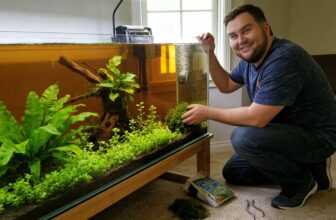
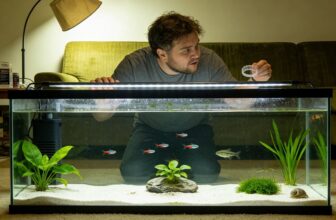
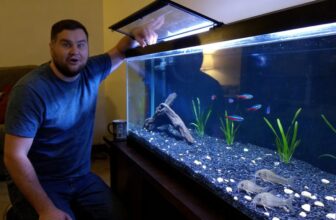
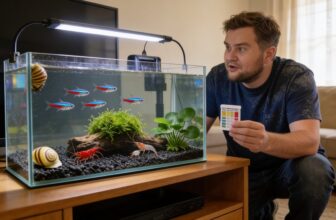
You’ll want soft sand, two to three inches deep, so your snails can burrow like tiny plows through the bottom of their ten-gallon home. Keep the water warm, seventy to seventy-eight degrees, with a neutral pH of seven and enough calcium for strong shells.
They’ll eat leftover fish food and algae, but feed them just a pinch daily or their population explodes—one female can have seventy babies at a time. A gentle sponge filter keeps babies safe, and you’ll know you’ve got too many when their cone-shaped shells coat the glass like sprinkled sesame seeds.
Pick tank mates carefully: corydoras are kind neighbors, but loaches will hunt them. Check your water weekly, change a quarter of it, and watch how they teach you about balance, if you keep going.
At A Glance
- Maintain 70–78 °F water, neutral pH, and 6–15 KH hardness with soft sand substrate.
- Feed sparingly to prevent explosive breeding; remove uneaten food promptly.
- Provide calcium via cuttlebone or crushed coral for strong shell growth.
- Use gentle sponge filtration to protect babies and allow proper burrowing behavior.
- Control population by netting juveniles nightly and quarantining new plants.
Malaysian Trumpet Snails: Species Overview and Aquarium Benefits
When you look at a Malaysian Trumpet Snail for the first time, you’ll notice its shell looks like a tiny ice cream cone made of stone.
You’ll find *Melanoides tuberculata* arrived from Asia and Africa, now comfortable worldwide.
Behavior and Tank Benefits
Snail behavior shows remarkable habitat adaptation. You’ll watch them burrow through sand at daylight, hiding from bright lights, then rise at dusk like quiet ghosts.
This habit protects them and cleans your tank. They aerate the substrate, preventing dangerous gas pockets. You’ll feel grateful for their steady work.
Size and Care
They’re small, reaching half an inch, living about a year.
You’ll appreciate their low demands. For aquarists seeking gentle water spread to reduce stress on delicate organisms, proper flow management complements these snails’ substrate-aerating behavior.
Ideal Water Parameters for Healthy Malaysian Trumpet Snails
A spare plastic thermometer, the kind you stick to an aquarium wall, tells you more about your snails’ comfort than you might expect.
You’ll want to keep the water between 70 and 78 degrees Fahrenheit, which feels like a warm summer day to these creatures.
Cooler water slows them down, and warmer water speeds up breeding. You control this, since breeding affects snail genetics across generations in your tank.
Keep the pH neutral, around 7.0, and hardness at 6 to 15 KH. Hard water gives snails calcium for strong shells.
Test weekly, adjust slowly, watch them thrive.
For accurate weekly testing, a pH precision of 0.01 ensures your neutral pH readings stay reliable, helping you catch shifts before they stress your snails.
Tank Size and Setup Essentials
Though a ten-gallon tank may look modest on your kitchen counter, it holds more than enough room for a lively colony of Malaysian trumpet snails to burrow, breed, and clean.
A ten-gallon tank looks modest, yet holds enough room for a lively colony of snails to burrow, breed, and clean.
You’ll want water between 70 and 78 degrees Fahrenheit, feeling warm like a summer afternoon.
Watch how seasonal color shades shift in your snails’ shells, darker browns appearing when light changes through your window.
Breeding genetics stay hidden until babies emerge, tiny as sand grains, proving nature’s quiet persistence.
A sponge filter protects them from strong currents they can’t fight.
Soft sand waits beneath, crucial for their nightly digging, their small bodies needing that gentle security you too seek in familiar places.
A self-cleaning aquarium with built-in filtration can simplify maintenance while keeping water parameters stable for your snail colony.
Why Sand Substrate Matters (And Gravel Fails)
Your tank’s floor is where these snails live their real lives, not the glass you watch through daily.
They burrow through sand substrate all day, moving grains aside like tiny plows, breathing through siphons that reach upward for oxygen.
Gravel fails because the spaces between stones trap their soft bodies, leaving them exposed and stressed, unable to dig for safety or food. Sharp edges cut their delicate feet.
Fine sand, two to three millimeters deep, lets them tunnel completely underneath, emerging at night to clean algae from plant leaves and glass.
You watch them surface, and you feel calm.
Unlike Malaysian Trumpet Snails, aquascapers often choose natural Seiryu rock to build dramatic hardscape structures that provide stable platforms for plant and coral attachment.
Pick a Filter That Won’t Harm Your Snails
Since water moves through your tank day and night, you must choose a filter that keeps your snails safe instead of pulling them into harm.
Grab a sponge filter, the soft kind that won’t trap baby snails. You’ll feel relieved knowing they’re crawling, not struggling.
Check your filter flow weekly. It should ripple the surface gently, not blast your snails sideways. Think of it like a breeze, not a storm.
Keep it bubble-free where they feed, so they don’t tumble while grazing.
Slow water means happy snails, and seeing them glide brings you quiet satisfaction.
For larger setups requiring hang-on-back filtration, select a model with flow control adjustment to reduce current intensity and protect delicate snails from strong intake suction.
What Do Malaysian Trumpet Snails Eat?
Since these snails work as you sleep, you’ll want to know exactly what fuels their quiet labor.
Fuel for quiet labor: discover what drives your nocturnal cleanup crew while you sleep.
A shellarium snail like the Malaysian Trumpet Snail eats soft algae, dead plant bits, and leftover fish food. You’ll see this snails behavior at night, when they leave the sand to graze.
They’re scavengers, not hunters. They don’t hurt live plants. You might offer algae wafers, boiled zucchini, or sinking pellets. Feed small amounts, about what they finish in two hours.
Remove uneaten food by morning. Overfeeding causes problems faster than you’d expect.
Watch their nighttime appetite. It tells you much about your tank’s health.
Proper filtration with quick-connect fittings ensures their food debris doesn’t compromise water quality in compact aquarium setups.
Calcium Sources for Strong Shell Growth
A snail’s shell is its armor, and calcium is the forge that makes it. You must give your Malaysian trumpet snails the building blocks they need.
Crushed coral, cuttlebone, and calcium-rich vegetables like spinach offer natural minerals. These dissolve slowly, hardening water to 6-15 KH, which snails absorb through their soft tissue.
Shellcium supplements, pressed into disks or powders, provide concentrated doses when natural sources fall short. You can bury mineral blocks in substrate, letting snails find them during nighttime browsing.
Thin, cracked shells mean deficiency. Shell reinforcement takes weeks, so you start early and maintain steady levels. Consistency matters more than quantity.
Aquarium fertilizers with copper-free gel formulas, such as those designed for shrimp tanks, can safely supplement trace minerals without harming sensitive invertebrates like Malaysian trumpet snails.
Common Diseases and Parasite Prevention
The tiny trapdoor on your snail’s shell, called an operculum, is your first warning sign when something’s wrong.
When your snail feels sick, it pulls inside and seals that door tight. You might feel worried, seeing it stay shut for days. That seal means stress, maybe a parasite infection creeping in. These tiny invaders, like worms or flukes, hitch rides on new plants and animals. You must quarantine every newcomer for two weeks, minimum, in a separate tank. Watch for thin shells, slow movement, or sealed doors. Clean water, steady warmth, and patience keep your snails bouncing back. Adding beneficial bacteria treatments with documented CFU counts can improve water quality and support snail recovery by enhancing biological filtration.
| Threat | What You See | How You Help |
|---|---|---|
| Parasite infection | Sealed operculum, thin shell | Quarantine new tankmates |
| Bacterial illness | Sluggish feeding, odd smell | Test water, change weekly |
| Shell damage | Cracks, white spots | Add calcium, check pH |
| Stress response | Hiding, no burrowing | Keep temperature stable |
How Fast Do Malaysian Trumpet Snails Reproduce?
When you spot one tiny snail gliding along your aquarium glass, you’ll soon understand why hobbyists call these creatures “rabbit snails of the aquarium world,” though they’re actually a different species altogether.
These prolific breeders reproduce through livebearing, not eggs, which speeds everything up dramatically.
You’ll witness rapid gestation firsthand, as females produce up to seventy babies per birth, each smaller than a grain of sand.
Within weeks, those babies mature and start breeding themselves.
You can’t stop this cycle once it begins.
You’ll feel surprise, then concern, watching population numbers climb.
Control requires managing food sources, since abundant meals trigger even faster breeding.
Maintaining gentle water flow with a powerhead rated for your tank size helps distribute nutrients evenly and prevents stagnant areas where algae and detritus accumulate, supporting more controlled population growth.
Why These Snails Are So Hard to Get Rid Of
Once you’ve watched a single snail become hundreds, you’ll start to understand why these creatures refuse to leave your tank.
They’re burrowers, you see. By day, they tunnel through your sand, invisible. By night, they surface to feed. You can’t catch what you can’t find.
Their snail genetics make it worse. Females clone themselves through parthenogenesis—no mate required. One becomes dozens, then hundreds, in mere weeks.
Market demand keeps them common, too. Pet stores sell them cheap, often accidentally hidden in plant roots. You bring home decorations, and unwittingly import an invasion.
You’re fighting biology, and biology usually wins.
Unlike fish that can be blocked by polycarbonate canopies or mesh covers, these snails exploit every gap in your defenses—filter intakes, substrate crevices, even the smallest openings in your aquarium setup.
Signs Your Tank Has Too Many Malaysian Trumpet Snails
Signs of Overpopulation
Snails multiplying beneath your sand, clustering at feeding time, racing through daylight—your tank’s peaceful rhythm slowly tipping beyond comfort.
If you’ve lifted a rock in your tank lately and watched it seem to move on its own, you’ve already met the first sign.
You’ll notice visual clues everywhere, shells coating your glass like scattered pebbles, dozens clustering at feeding time, small cones filling your filter intake. These sights feel overwhelming since they multiply quietly beneath your sand.
Your behavioral indicators come next: snails racing across surfaces during daylight hours, an unusual thing since they prefer darkness. They’re hungry, competing fiercely, signaling imbalance. The tank breathes differently, feels crowded, loses its peaceful rhythm. You sense something tipping beyond comfort.
Population Control Methods That Actually Work
Where do you start when the sand itself seems alive with snails? You start with nutrient management, which means you feed less. You drop food in tiny pinches, once daily, watching your fish finish every bite. No leftovers, no snail boom. You additionally follow quarantine protocols for new plants, soaking them in bleach solution first, so you don’t import hitchhikers.
Feeding Less and Manual Removal
| Method | How You Do It | Result You’ll See |
|---|---|---|
| Feed less | Pinch-sized meals, once daily | Fewer babies in 2-3 weeks |
| Remove manually | Net juveniles at night | Immediate reduction |
| Adjust filtration | Use fine sponge | Catches free-swimming young |
| Separate sexes | Isolate males | Stops reproduction entirely |
You check your tank weekly, feeling calm patience, not panic. You act early, and you keep balance.
Compatible Tank Mates (and Natural Predators)
Safe Tank Companions and Natural Predators
A small snail creeps across the glass as you wonder who might share its home without causing harm.
Predator compatibility matters, you’re learning, when you build your community tank.
- Corydoras catfish patrol the bottom without bothering snails, safe companions you can trust.
- Small tetras like neon and cardinal varieties swim above, ignoring your shelled cleaners entirely.
- Shrimp such as cherry or amano species compete peacefully for leftover food.
- Assassin snails eat trumpet snails, natural control you choose deliberately when populations grow too large.
Avoid loaches and pufferfish, you’re deciding now, since they’ll hunt your trumpet snails immediately.
Weekly Care Routine for Healthy Snails
Your little snails will thrive when you give them the same care each week, no matter how busy life gets.
| Task | How Often | What You Check |
|---|---|---|
| Water testing | Every 7 days | Ammonia, nitrite, nitrate, pH |
| Snail behavior | Daily, note weekly | Activity, feeding, burrowing |
| Partial water change | Weekly | 25% with dechlorinated water |
| Substrate cleaning | Weekly | Remove uneaten food, debris |
You’ll use a simple test kit, it’s like checking if milk’s gone bad. Watch your snails move through sand, that’s their nighttime wandering. When water stays clean and steady, they feel safe.
Frequently Asked Questions
Do Malaysian Trumpet Snails Sleep During the Day?
You’ll observe reverse dayurnal activity in these snails, as they burrow into substrate during daylight hours and emerge at night to feed, so you won’t see them active when your tank lights shine brightest.
Can These Snails Survive Total Tank Darkness?
You’ll find these snails possess excellent darkness tolerance because of their nocturnal nature, as they naturally burrow in sand throughout daylight hours. Their light dependence remains minimal, so they’ll thrive without any illumination.
Do Trumpet Snails Clean Glass or Just Substrate?
You’ll find they handle glass cleaning modestly but excel at substrate aeration, as they burrow through sand at night and only graze soft algae on surfaces occasionally. For pristine glass, you’ll need additional cleaners.
Will Assassin Snails Eliminate Every Trumpet Snail?
You won’t see total elimination, but you’ll notice significant reduction. Assassin snails provide pred predator control by hunting trumpet snails actively. Nevertheless, habitat competition and hiding spots let some trumpet sn escape, so complete eradication rarely happens even with persistent assassins.
Can Trumpet Snails Climb Out of Open Tanks?
You’ll rarely find trumpet snails escaping open tanks because of their open behavior—they’re burrowers, not climbers. With proper tank size and water quality, they’ll stay content tunneling through your substrate instead of seeking exits.
Rounding Up
You’ve got the tools now. Start with five or six snails in a ten-gallon tank, watch them work, learn their rhythm. Trust your observations over rigid rules. Remember, you’re building a partnership with living creatures, not managing a problem. Keep water clean, feed lightly, remove excess when needed. You will find balance, not perfection, and that quiet success feels like a small, steady warmth. That’s enough. That’s good.