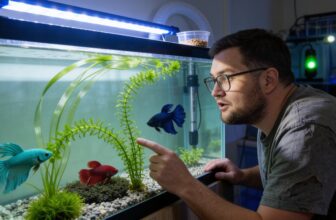
You want a Thai micro crab since you’ve got a 5‑gallon nano tank already. These half‑inch filter‑feeders wave their oversized claws to catch tiny food particles, so you’ll need gentle flow (a $15 sponge filter works).
Feed powdered spirulina or crushed flakes every other day. Keep calm tank mates—red cherry shrimp ($4–$6) or ramshorn snails ($2–$3).
Avoid aggressive fish; they’ll snack on your crab. Solo works fine, but a group of 3–5 is chill.
Stick around for how to set up the perfect lid and plants.
At A Glance
- Thai Micro Crabs filter-feed using their oversized claws, requiring fine powdered foods like spirulina or crushed flakes.
- A fully cycled 5‑gallon tank with a low‑flow sponge filter is essential to prevent suction and enable feeding.
- Water temperature should stay 72‑82°F, pH 6.5‑8.0, with ammonia and nitrite at 0 ppm.
- Compatible tank mates include Neocaridina shrimp, Ramshorn snails, and Pygmy corydoras.
- Avoid goldfish, cichlids, tetras, and large catfish, as they may bully or eat the crab.
What Makes Thai Micro Crabs Suitable for Nano Tanks?
Look at a full‑grown adult Thai micro crab, and you’ll see why they’re the perfect fit for a nano tank.
At just half an inch, they don’t outgrow your 5‑gallon setup—no need to upgrade later.
They’re peaceful, so you won’t stress over tank‑mate drama.
Plus, their tiny claws filter food from the water column, like a shrimp’s, keeping cleanup low.
You want a unique nano inhabitant that won’t wreck your hardscape? This crab’s your guy.
Bottom line: you get a functional, low‑maintenance oddball that belongs in your small aquatic world.
To keep them safe, always use a tight‑fitting lid to prevent any accidental escapes from open tanks.
What Does a Thai Micro Crab Look Like?
What’s a half‑inch crustacean doing with claws that look oversized for its body? You’re looking at a Thai micro crab’s secret weapon—those claws, plus long, spider‑like legs, trap food like a living net. Its gray body shows brown and white markings, and tiny bristles (setae) help it filter particles from the water, just like a bamboo shrimp. Like the Rubbernose Pleco, this crab benefits from gentle water flow to mimic its natural river habitat.
| Feature | Why It Matters |
|---|---|
| Oversized claws | Scavenge and trap food efficiently |
| Long legs | Navigate tight spaces in nano tanks |
| Setae bristles | Filter feed; less competition for food |
| 0.5‑inch size | Fits in any tank—no space hog |
You’ll spot these little guys clinging to driftwood; they’re quirky, not flashy, and that’s exactly why you’ll love them.
How Do You Set Up a 5-Gallon Tank for a Thai Micro Crab?
Why exactly does a 5‑gallon tank work so well for a Thai micro crab? It’s their sweet spot—big enough for stable water, small enough for you to spot their tiny, spider‑like legs. Fully cycle it first, then add a low‑flow sponge filter (about $15) so they don’t get swept away. Plant heavily with Java moss and driftwood; they’re shy, so cover matters. Keep the temp at 72‑82°F with a small heater. A dark substrate, like black sand, helps them feel hidden. You’re creating a cozy cave, not a showroom—and they’ll thank you by thriving. For gentle water movement, a sponge filter is ideal because it provides gentle flow ideal for bettas and shrimp, similar to the filtration found in small betta‑focused tanks.
Why a Tight Lid Is Essential for Thai Micro Crabs
Since Thai micro crabs are escape artists with a talent for vanishing through gaps you didn’t even know existed, a tight‑fitting lid isn’t optional—it’s your first line of defense. They’re tiny, curious, and will climb filter tubing, heater cords, or plant stems to find freedom. Without a sealed lid, you’re just donating crabs to your floorboards. Many aquarium cover options use magnetic strips for a tool‑free, secure seal that eliminates gaps.
| Escape Risk | Why It Matters |
|---|---|
| 0.5‑inch gap | They squeeze through. |
| HOB filter opening | A favorite exit ramp. |
| Loose lid corner | They push it open. |
You’ve put work into this tank. Don’t let a quarter‑inch gap undo it. A snug lid keeps your micro crabs safe and your collection intact.
Best Plants and Hardscape for a Thai Micro Crab Tank
Since your Thai micro crab is basically a tiny arachnid‑adjacent ninja that spends its days skittering over leaves and peeking under rocks, you’ll want a tank that feels like a miniature jungle floor.
Grab some Java moss, it’s cheap ($5) and gives them grip. Indian almond leaves (catappa, they love the tannins) drop in a few, they’ll munch them. Driftwood with cholla wood caves is their hangout. Add three rocks for territory. For a low‑light carpet centerpiece, try a Tiger Lotus Lily that adds vibrant color and doesn’t require high light.
Skip big, messy plants. Your crab’s a explorer, not a gardener. Go dense, low-light stuff: Anubias, Bucephalandra. That’s the look.
Bottom line: Keep it natural, keep it tight. You’re building a playground, not a showroom.
Choosing the Right Filter for a Thai Micro Crab Tank
Not all filters are crab‑safe, so here’s the short version: go with a low‑flow sponge filter or a fine‑mesh‑covered HOB (hang‑on‑back) unit. You’re part of the club that wants to keep those tiny claws safe, not sucked into a gadget.
Sponge filters, like a $10‑$15 Aquarium Co‑Op model, give gentle flow and zero intake risk. They’re the quiet, reliable cousin at the party.
HOBs need a mesh wrap—think $5 DIY media bag over the intake—to stop a crab hitchhiking to the impeller. Avoid powerheads; they’re overkill.
Bottom line: calm water equals calm crabs. Stick to low flow, and you’re golden. For low‑flow builds, look for compact push‑in fittings designed for tight spaces in water filter systems.
Ideal Water Parameters: 72–82°F, pH 6.5–8.0, and Stability Tips
Good filter choice—now let’s talk water. You’re aiming for 72–82°F and pH 6.5–8.0. Stability matters more than perfection. Sudden swings stress your crab, so test weekly and adjust slowly. Here’s your quick reference:
| Parameter | Ideal Range | Why It Matters |
|---|---|---|
| Temperature | 72–82°F | Keeps metabolism steady |
| pH | 6.5–8.0 | Avoids shell damage |
| Ammonia | 0 ppm | Toxic at any level |
| Nitrite | 0 ppm | Blocks oxygen uptake |
| Nitrate | <20 ppm | High levels = stress |
Use a heater with a thermostat, and a thermometer for double‑checking. Change 10–20% water weekly. Keep it stable, and your crab stays chill. You’ve got this. For reliable monitoring, consider using CE ISO certified 7‑in‑1 test strips that provide lab-accurate results within 30 seconds.
How to Cycle a Nano Tank for a Thai Micro Crab in 4–6 Weeks
4–6 weeks might feel like a small eternity when you’re itching to bring home a Thai Micro Crab, but it’s the bare minimum for setting up a safe nano tank.
You’re building a biological filter—a colony of good bacteria that eats toxic ammonia. Add a pinch of fish food or pure ammonia daily. Test your water every few days. When ammonia and nitrite hit zero with some nitrate present, you’re golden. Use an ammonia test kit to ensure levels stay below 0.25 ppm in freshwater, as even small spikes can harm your crab.
Join us in this patient crew—we’ve all waited. That waiting? It’s your ticket to a thriving crab. No shortcuts, just steady wins.
You’ll get that lid sealed and your buddy added soon enough.
What Do Thai Micro Crabs Eat? A Complete Diet Guide
Since the tank’s cycled and you’ve got that tight lid on, it’s time to feed your Thai Micro Crab, and luckily you’re not running a gourmet kitchen here.
You’ll drop in fine powdered foods—repashy, spirulina, or crushed flakes—every other day.
They’re filter feeders, so they don’t hunt; they just snag particles from the water column.
Target‑feed with a pipette near their hangout spots, like driftwood or plants.
Don’t overdo it—leftovers foul water fast, which is why proper rinsing of any gravel you add prevents cloudy tank syndrome.
Keep it simple, and you’re part of the club that keeps these tiny guys thriving.
How Spider-Like Legs and Setae Help Thai Micro Crabs Feed
Since those oversized claws and spindly legs look more like a spider than a crab, right?
Well, that’s exactly how they feed.
You see, those long limbs aren’t for speed—they’re fine‑mesh nets.
Tiny bristles called setae trap floating food particles, just like bamboo shrimp do.
They don’t hunt; they just sit, wave their legs, and let the current bring dinner.
It’s lazy, efficient, and honestly, you’ve gotta respect that.
Your tank’s flow should be gentle, though—too strong, and they’ll struggle.
That weird spider‑crab hybrid? A master filter‑feeder, pure and simple.
Using a magnetic aquarium cleaner prevents disturbance to gentle water flow during maintenance.
Best Tank Mates: Shrimp, Snails, and Nano Fish for Thai Micro Crabs
Since Thai micro crabs are peaceful filter‑feeders, you’ve gotta pick tank mates that won’t bully or outcompete them for scraps. You want shrimp, snails, and nano fish that share their chill vibe.
Choose tank mates that won’t bully or outcompete your peaceful Thai micro crabs for scraps.
- Neocaridina shrimp (like Red Cherry) cost around $4–$6 each; they’re too small to intimidate your crab.
- Ramshorn snails ($2–$3) scavenge without hogging food, and their hard shells add safety.
- Pygmy corydoras ($5–$7) stay under an inch, school tight, and ignore your crab’s tiny claws.
You’re building a community where everyone belongs—gentle, quirky, and unbothered. Stick with these, and your tank stays harmonious. For any bottom-dwelling tank mates, soft sand substrate helps them forage safely.
Which Tank Mates Should You Avoid for Thai Micro Crabs?
Why would you ruin a perfectly calm nano tank by adding a bull in a china shop? You wouldn’t, so never drop a goldfish, cichlid, or angelfish in with your Thai micro crabs.
These fish see your tiny, 0.5‑inch crustacean as a snack, not a friend. Their big mouths and aggressive feeding behaviors stress your crabs to death.
Likewise skip tetras—they’re nippy and fast.
Large catfish? They bulldoze your plants and hunting grounds.
Your peaceful setup needs calm vibes only.
Consider using a 100% silicone sealant for leak-proof bonds when constructing or repairing their tank to ensure a safe, non-toxic environment.
Bottom line: avoid any fish that could eat your crab or terrorize it. Stick to shrimp and snails for a happy home.
Can You Keep Thai Micro Crabs Alone or in Groups?
So you’re wondering: can you keep Thai micro crabs solo or do they need a crew? You can absolutely keep one alone, but groups of 3–5 really shine. They’re peaceful, not social, so no drama—just more tiny claws waving.
- Solo works fine, one crab won’t be lonely, they’re not pack animals.
- Groups reduce stress, more eyes on lookout, they scavenge together.
- Minimum tank’s 5 gallons, but 10 gallons fits a small colony better.
- Avoid overcrowding, too many crabs means competition for food, stress, and messy water.
- You’ll pay about $8–$12 each, so a small group won’t strain the budget.
Bottom line: single’s safe, but a trio brings real character. Go with three, you won’t regret it.
Breeding Thai Micro Crabs: Why Larvae Rarely Survive in Captivity
You’ve got your trio of Thai micro crabs settled in, waving their oversized claws like tiny, underpaid orchestra conductors—so now you’re probably wondering if you can turn that into a full‑blown family.
Here’s the sobering truth: larvae rarely survive.
Your female might carry 200 eggs under her abdomen, then release tiny larvae. But you won’t see those babies grow. They’re microscopic plankton, drifting helplessly, needing precise food and flow you can’t easily replicate. Most die within days. Tank mates don’t help—they snack on the newborns. Unlike these crabs, breeding success with other species requires stable parameters and low stress for larvae survival.
Bottom line? Don’t expect breeding success yet. Enjoy the adults. They’re still your weird, wonderful little orchestra.
Frequently Asked Questions
How Long Do Thai Micro Crabs Live?
You’re looking at about 1.5 to 2 years for a Thai micro crab, give or take—assuming you don’t accidentally send it on an unscheduled escape adventure.
They’re tough little guys, but water quality is the real boss here; skip the cycling or let ammonia spike, and you’ll shorten that lifespan fast.
A stable tank with a tight lid and low flow? You’ll hit closer to two years.
Bottom line: treat them right, and they’ll stick around long enough to earn their keep.
Can Thai Micro Crabs Climb Out of a Tank?
Yes, they absolutely can—and will.
Think of them as tiny Houdinis with claws.
Your Thai micro crab sees every gap as an escape route, so you’ve got to seal that tank tight.
Use a snug-fitting lid, no holes bigger than a dime.
A jump to dry land means a sad end.
Trust me, you don’t want to find a crispy crab behind your stand.
Bottom line: lid it or lose it.
Do Thai Micro Crabs Need Brackish Water?
No, you don’t need brackish water for Thai micro crabs—freshwater is just fine.
They thrive in neutral pH, warm temps, and low flow, like a lazy river in a nano tank.
Their feeding style? Think bamboo shrimp, minus the hype—they trap food with bristly claws.
Don’t complicate it; heavy planting and a tight lid matter more than salt.
Bottom line: skip the brackish, keep it simple, and they’ll reward you with weird, spider-like charm.
How Many Thai Micro Crabs Fit in a 5-Gallon Tank?
You can comfortably keep 4 to 6 Thai micro crabs in a 5-gallon tank. They’re tiny—only half an inch as adults—and super peaceful, so you won’t need much space.
Stick to 4 if you add shrimp or snails; 6 if they’re the only residents. Just remember: their long legs make them look bigger than they are, so don’t overcrowd.
A planted tank with hiding spots keeps them happy, and you’ll feel like a crab whisperer. Less is more here.
Are Thai Micro Crabs Hard to Find for Purchase?
Yeah, they’re genuinely tough to track down. You won’t find them at big-box pet stores—nope, you’ll need a specialty online retailer or a dedicated local fish shop that orders them in.
They’re not mass-bred, so supply’s spotty. Expect to pay around $8–$15 per crab when you do find them.
If you see a listing, grab ’em fast; they vanish quick. Your best bet? Set up alerts on aquarium forums or order directly from a reputable shrimp dealer.
Rounding Up
So, you’re probably ready for a Thai micro crab. Good call. These tiny, spider-like crustaceans aren’t flashy, but they’re fascinating to watch—and surprisingly low-maintenance, if you follow the rules.
Use a tight lid (they’re escape artists), keep temps around 75°F, and stick with peaceful nano tank mates like Neocaridina shrimp or pygmy corydoras. They’re not aggressive, so avoid anything larger than a ramshorn snail.
Bottom line: for about $8–15 each, you get a unique, gentle scavenger that’ll perch happily on driftwood. Perfect for a five-gallon planted setup. Just don’t expect to breed them—larvae rarely survive. Enjoy the show.