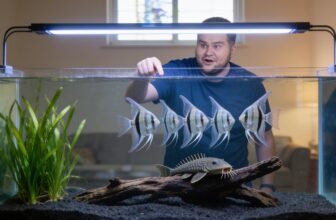
Fairy wrasses need live copepods and zooplankton, frozen mysis, and frequent scatter feedings to thrive. Keep them with peaceful cardinals, gobies, and anthias; avoid aggressive dottybacks and triggers.
Stable water – 72–78°F, tight lids against jumping – prevents ich and fin rot. They’re protogynous hermaphrodites, so females become males when dominance shifts, though captive breeding rarely succeeds.

Maintains stable 72-78°F for healthy fairy wrasse.

Tight-fitting lid prevents jumping and keeps fish safe.

Monitors pH, salinity, and ammonia to prevent disease.
Check discounted items inAquarium Maintenance
Now, a 55-gallon minimum works for one, but harems demand 300+ gallons. There’s more to unpack if you stick around.
At A Glance
- Feed varied zooplankton like copepods, rotifers, and frozen mysis multiple times daily.
- House with peaceful cardinals, gobies, blennies, and anthias; avoid aggressive triggers.
- Maintain stable 72–78°F water with tight lids, as wrasses are prone to jumping.
- Treat fin rot with water changes and antibiotics; quarantine new fish two weeks minimum.
- Captive breeding rarely succeeds due to complex larval needs and harem social structures.
What Is a Fairy Wrasse? Species Overview and Reef Suitability
So what exactly is a Fairy Wrasse? It’s a *Cirrhilabrus*, a reef dweller with double-pupil corneas – think built-in binoculars for spotting snacks – and three sets of canines split between jaws. These fish, four to six inches, live five to eight years, though predators cut that short.
Now, reef habitat matters. They’re Pacific, Indian Ocean, Red Sea natives, diving three to six hundred feet. In tanks, tight lids prevent escape artistry, live rock offers refuge, and lighting varies by depth preference. Maintaining stable water temperatures is crucial for these deep-water fish, and many aquarists rely on digital temperature controllers with submersible probes to prevent the overheating events that can stress or kill sensitive reef species.
Breeding challenges? Severe. Captive success demands massive tanks, one male, multiple females, and patience most aquarists lack. Nature handles the rest.
Fairy Wrasse Colors: Male vs Female Identification
How exactly do you tell a boy Fairy Wrasse from a girl? Look close – the males flash electric reds, dipped greens, crowning magentas that shift, shimmer, practically shout.
- Color morph genetics decides the palette, certainly, but dominance flips the switch. Largest female transforms male when the boss vanishes – nature’s backup plan, no applications needed.
- Seasonal hue shifts mean even confirmed males darken, pale, or stripe-up depending on breeding calendars and mood lighting.
A proper acrylic disk can help reduce water turbulence in breeding tanks, keeping males calm enough to display their full color potential without stress-induced fading.
Now, females wear the muted wardrobe: rosy bases, understated fins. Pretty, but not showing off. And honestly? That’s the whole game – brilliance equals status, always has.
Fairy Wrasse Tank Size and Space Requirements
Several inches of fish, yet they demand real estate like a mid-sized sedan requires a garage – more than you’d guess, anyway. Fairy wrasse tank size matters, I mean, these active swimmers need room to dart, hide, and establish territories without turning fin-nippy. Given their substantial water volume needs, selecting stands with 800 lb top load capacity ensures your setup remains stable and secure for years.
| Setup Type | Minimum Tank Size |
|---|---|
| Single/Pair | 55 gallons |
| Mixed Group | 75–125 gallons |
| Multiple Males | 300+ gallons |
Now, studiestemperature flexibility varies by species – deepwater types prefer cooler, dimmer conditions while reef dwellers want bright warmth. And you’ll need that tight lid. They’re jumpers, every one of them, so plan accordingly.
Compatible Tank Mates for Fairy Wrasse
Once the tank’s footprint is settled – lid clamped tight, rocks stacked for hidey-holes – the question becomes who else gets keys to the place. Fairy wrasse play well with friends who respect their space, their mood, their whole thing.
Now, moss enrichment matters here – grown on rocks, it feeds microfauna they pick at, keeps them busy, feeling at home. And lighting intensity? Tune it to their depth: dimmer for deep-dwellers, brighter for shallow-water show-offs. Too harsh, they hide; too dim, colors dull.
Peaceful tankmates include:
- Cardinals and dartfish, calm, small, keep to themselves
- Gobies and blennies, bottom-dwellers, no turf wars
- Tangs and angelfish, bigger, confident, not nippy
- Clownfish pairs, territorial but drama-contained elsewhere
- Anthias harems, fellow plankton-snackers, energy-matched
Avoid aggressive dottybacks, large triggerfish, or anything that sees wrasse as lunch. Size matters, temperament matters more.
Ensuring proper water surface agitation prevents oil film buildup that can hinder oxygen exchange and stress active swimmers like fairy wrasse.
Can Two Male Fairy Wrasse Live Together?
| Setup Factor | Success Likelihood |
|---|---|
| 300+ gallons | High |
| Abundant rockwork | High |
| Multiple females present | Moderate-High |
| Two males only, 55-100 gallons | Low |
| Identical size, no cover | Very Low |
When managing multiple male fairy wrasse in a shared system, having extended reach tools like 18.9-inch curved aquarium tweezers can help rearrange rockwork or redirect fish without submerging your arms, minimizing stress during territorial disputes.
Fairy Wrasse Water Parameters: Temperature, pH, and Salinity
Even though Fairy Wrasses will soldier through subpar conditions longer than you’d expect – saltwater fish are stoic that way, bless them – they’ll only truly thrive when the water matches their wild homes, or at least gets reasonably close. Temperature water matters: 72–78°F keeps their double-pupil corneas functioning, though honestly, aim mid-range. pH sits best at 8.0–8.4, stable as your Aunt Carol’s personality. Now, salinity trends – specific gravity 1.020–1.025 – mirror reef zones from 3 to 600 feet deep.
Fairy Wrasses thrive when water matches their wild homes: 72–78°F, pH 8.0–8.4, and salinity 1.020–1.025.
Temperature fluctuation impacts? Stress, fin rot, color dulling. Nobody wants a washed-out male.
- Test weekly, not monthly – lazy habits cost fish friends
- Monitor salinity trends after water changes; salt creeps when you’re not looking
- Buffer against temperature fluctuation impacts with reliable heaters and chillers
- Match lighting depth: dim for deep divers, bright for reef shallows
- Join reef clubs; water parameter nerds belong together
While iron rarely spikes dangerously in marine systems, 0.1 mg/L sensitivity testing becomes relevant when running macroalgae refugia or dosing trace elements for decorative sponges.
What Do Fairy Wrasse Eat? Diet in Captivity
Water chemistry sorted, the conversation naturally drifts toward the next practical concern – what exactly goes into these fish.
Fairy wrasse dine above sand, rubble, or open water – anywhere zooplankton drifts past those double-pupil corneas. Their substrate preference isn’t picky; they’re suspension feeders, really, cruising currents with purpose.
Feeding behavior enrichment matters here. Scatter offerings widely, vary delivery timing, let them hunt a little. These fish aren’t grazers, so don’t expect them picking at rocks all afternoon.
They’re accommodating eaters, honestly. Present appropriate marine foods, and they accept. No drama, no finicky protests. Just consistent, varied nutrition – balanced, not boring, and never the same routine twice running.
While planted reef display tanks benefit from copper-free formulas to nourish macroalgae without harming delicate invertebrates, fairy wrasse themselves require protein-rich fare rather than botanical supplements.
Best Foods for Fairy Wrasse: Live, Frozen, and Prepared Options
Stock the freezer, thaw the brine, maybe queue up some live pods – whatever keeps that zooplankton habit sated.
- Live copepods and rotifers trigger that hunting reflex, the double-pupil cornea locking onto twitching prey.
- Live brine shrimp, enriched – because nobody wants a malnourished showpiece – deliver protein with copepod enrichment protocols.
- Frozen mysis and mysis shrimp (thawed, obviously) hit that sweet spot between convenience and nutrition, somewhere around three to five minutes in tank water.
- Krill flakes, micro-worm paste, and algae wafers round the edges; br algae and marine zooplankton supplements keep fins from fraying.
- Flake? Fine. But they’re watching. They know.
For reef aquarists maintaining planted refugiums, chelated iron stability ensures micronutrients remain bioavailable in alkaline water, supporting the live foods that fuel these active swimmers.
Why Is Your Fairy Wrasse Hiding?
So the freezer’s stocked, the pods are breeding in their refugium, and yet the fish – supposedly eating, supposedly thriving – has vanished into a rockwork crevice you didn’t know existed.
Now, don’t panic. Fairy wrasse are expert hiders, diurnal creatures who crave security in crowded rockwork. They secrete a mucus cocoon at night, a kind of nocturnal camouflage that masks their scent from predators. If yours hides by day, check water parameters, aggression from tankmates, or insufficient cover. Provide caves, dim zones, and patience. Sometimes, belonging means letting them disappear until they’re ready to dazzle again. For tanks struggling with suspended particles that reduce visibility in these dim hiding zones, incorporating 100-micron mechanical filtration can restore water clarity without disturbing the delicate microhabitats wrasse prefer.
Fairy Wrasse Fin Rot: Signs and Treatment
Notice the edges first, always the edges – those once-crisp fin membranes going soft, turning milky, maybe taking on a ragged, tissue-paper look that no healthy fish ever wears.
Fin rot usually traces back to bacterial invaders (think *Aeromonas*, *Pseudomonas*) exploiting stressed, crowded, or poorly maintained water, though physical nipping from tankmates starts plenty of cases too.
Now, treatment options aren’t rocket science, but they demand speed: water changes, maybe 25% every other day, plus antibacterial meds – malachite green or nitrofurazone, follow the label, I mean really follow it.
Isolate if possible, or the whole tank suffers.
- Test water parameters daily; ammonia above 0.25 ppm spells trouble
- Remove sharp décor that tears fins and invites infection
- Feed vitamin-enriched foods to boost immune response
- Consider aquarium salt at one tablespoon per five gallons – old school, but it works
- Quarantine new fish for two weeks minimum, no exceptions
For accurate daily ammonia readings, use moisture-proof sealed strips with a 180-second reaction time and store them cool and dark to preserve their 99% accuracy claims.
Preventing Ich and Pop-Eye in Fairy Wrasse
Fin rot handled, water still clear, fish still breathing – good. Now, ich and pop-eye – they’re lurking, always, and the cure? Prevention, rigorously applied.
Water management protocols matter, full stop. Stable temperature – 73–78°F, no sudden swings – and pristine parameters stop parasites cold. Weekly testing, partial changes, and observation that’s almost obsessive, I mean, these fish hide well.
| Task | Frequency | Purpose |
|---|---|---|
| Test ammonia/nitrite | Weekly | Catch spikes early |
| Temperature check | Daily | Prevent stress, ich vulnerability |
| Partial water change | Biweekly | Dilute pathogens |
| Visual inspection | Daily | Spot pop-eye before it blinds |
Stay vigilant, stay connected, keep them thriving.
How to Quarantine New Fairy Wrasse
Quarantine Basics for New Fairy Wrasse
Quarantine, that necessary limbo every new Fairy Wrasse must endure – usually several days, sometimes a week or two if you’re the cautious type, which honestly you probably should be.
Quarantine isn’t optional – it’s the limbo every Fairy Wrasse earns you through, whether you like it or not.
A solid quarantine protocol means observation, not isolation for cruelty’s sake, and stress monitoring becomes your daily ritual, watching for clamped fins or that telltale faded wash.
- Use a bare-bottom tank, no substrate hiding spots for parasites
- Check ammonia daily; wrasse metabolisms don’t mess around
- Dim lighting initially, they’re jumpy enough already
- Offer frozen foods, refusal signals trouble brewing
- Keep a log, I mean, memory’s unreliable and you’ve got time
Fairy Wrasse Sex Change: Protogyny and Harem Structure
Fairy Wrasse Sex Change and Harem Structure
Once the quarantine tank’s been cleared and your new Fairy Wrasse has settled into the display – gills steady, colors flaring – you’ll notice something curious about their social mechanics. They’re born female, every one of them. I mean, nature’s blueprint here is efficient, if not a little ruthless.
The hormonal hierarchy governs everything. Largest female watches, waits. When dominance vacates – death, maybe just disappearance – she transforms. Color‑based dominance makes the new male unmistakable: washed-out blues become electric, reds deepen to something you could spot from across the room.
| The Harem Stage | Visual Signal | Behavioral Shift |
|---|---|---|
| Subordinate female | Dull, mottled tones | Schools loosely, avoids center |
| Transitioning female | Patchwork colors | Spars, tests boundaries |
| Dominant male | Saturated, flashing hues | Claims territory, courts aggressively |
Now, you might think this sounds complicated. It isn’t, really. Just stock one male with multiple females, give them space – think 300 gallons if you’re serious – and let the system self-organize. The group bonds, establishes rhythm. You’ll belong to their world, watching, rather than forcing your own.
Is Captive Fairy Wrasse Breeding Possible?
Captive Breeding Reality
So you’ve got your harem sorted, colors popping, hierarchy humming – now comes the question that stops most keepers cold.
Captive breeding? Technically possible, practically masochistic. Hormonal triggers remain poorly mapped – light cycles, lunar phases, who knows what subtle cues these fish need. Genetic markers for sex differentiation exist, certainly, but good luck funding that aquarium research.
Breeding these fish? Possible in theory, torture in practice – nature’s secrets stay locked without the keys or the cash to find them.
- Requires 300+ gallons, stable as bedrock
- One male, multiple females, zero interlopers
- Simulated dawn spawning triggers (good luck)
- Egg collection? Nearly impossible
- Larval rearing? Let’s not even start
Most breeders stick to admiration. Nothing wrong with that.
Frequently Asked Questions
Do Fairy Wrasse Need Moonlight at Night?
Fairy wrasse do not require moonlight at night.
These fish form mucus cocoons to mask their scent whilst resting, and lunar feeding patterns do not significantly alter their zooplankton-based diet.
Moonlight effects remain minimal; standard aquarium lighting schedules suffice.
A dark night cycle supports their natural diurnal rhythm without stress.
Can Fairy Wrasse Recognize Their Owners?
Fairy wrasse do not exhibit genuine owner recognition in the mammalian sense, though they respond reliably to behavior cues like routine feeding times, vibrations, and shadow approaches near the glass.
Their double-pupil cornea detects movement sharply, creating associative learning rather than social bonding.
Now, fish keepers often mistake this for familiarity, but studies suggest it’s environmental conditioning – still, a wrasse greeting its keeper remains oddly gratifying, scientifically hollow or not.
How Often Do Fairy Wrasse Shed Their Mucus Cocoons?
Mucus shedding frequency in Fairy Wrasse remains poorly documented, though cocoons form nightly.
The process, cocoon formation timing tied to dusk, sees fish secrete a protective envelope repeatedly – each morning, they abandon it to feed.
Observations suggest daily renewal, but no precise studies exist. Owners notice traces floating, proof of another night’s work completed.
Do Fairy Wrasse Need Sand Beds to Sleep?
No sand substrate required. Fairy wrasse sleep in mucus cocoons, burrowed into rockwork, not sand beds – though they might rest near one.
Their nocturnal behavior centers on hiding, substrate-agnostic. Now, thick sand won’t hurt, but rock caves matter more. I mean, they’re adaptable, these fish.
Why Do Fairy Wrasse Flick Their Dorsal Fins Constantly?
Fairy wrasse flick their dorsal fins as territorial signaling, warning rivals to back off without full commitment to conflict.
It’s a low-stakes advertisement, flashy but economical.
This fin-flicking additionally serves as prelude to courtship, a sort of moving billboard that says “occupied, but available to the right applicant.”
When they escalate to final display, colors intensify, dorsal erects fully – then you know the message got serious.

Provides safe haven for fry and reduces stress during breeding.

Easily rearrange rockwork without disturbing fish during disputes.

Triggers natural hunting instinct and boosts nutrition.
See today's best deals onAquarium Breeding