Pet stores profit when your tank fails, selling endless cartridges and bottled fixes you never needed.
Now, here’s the truth: seed your filter with borrowed sponge from a healthy tank— colonies transfer instantly, bacteria already working, no waiting weeks.
Skip disposable cartridges; they trash months of colonization,重置 your cycle, drain your wallet.
Run 3–5 watts per gallon, sized right, verified with a thermometer— cheap heaters work fine, oversized ones cook fish.
Feed once, finish in two minutes, skip a day weekly.
Thick algae? You’re overdoing light, probably eight hours is plenty.
And clean water, I mean actually clean, prevents most diseases before they start— medications become unnecessary hand-wringing.
The real secret sits in understanding bioload: your fish produce waste invisible until night spikes crash everything.
There’s more to unpack if they stick around.
At A Glance
- Borrow used filter media to instantly seed beneficial bacteria and skip weeks of cycling.
- Store-bought “aquarium water” often contains hidden toxins; dechlorinated tap is safer and cheaper.
- Advertised filter ratings mislead; actual waste processing falls short, requiring upgraded capacity.
- Thick algae carpets signal imbalance, not problems, easily managed by reducing light and adding snails.
- Overcrowding tanks stresses immune systems, inviting disease faster than any medication can cure.
Cycle Your Tank in Days: No Bottled Bacteria Needed
Why wait weeks when nature’s already done the heavy lifting? DI cycling, that’s the ticket—borrow filter media from a friend’s established tank, maybe squeeze some gunk from their sponge into yours, and you’ve got bacterial colonies ready to roll.
Borrow a filter pad, skip the weeks-long wait—nature’s already built your bacteria colony.
Now, rapid nitrogen conversion isn’t magic, it’s just… biology, already happening somewhere else. Cheap, effective, and honestly? Better than those bottles promising instant cycles that smell, suspiciously, like pond water.
I mean, patience still matters—test your ammonia, nitrite, nitrates—but this shortcut puts you in the club without the wallet drain. Belonging, it turns out, transfers on a borrowed filter pad.
Once your cycle is established, having a transparent quarantine tank ready—like the acrylic boxes with suction-cup mounting mentioned in breeder setups—lets you observe sick fish without the stress of opaque walls, making isolation and treatment far more effective.
How Filter Cartridges Kill Your Cycle (And Budget)
So the bacteria are finally colonizing, the cycle’s humming along, and someone’s about to tell you to rip it all out.
Those disposable cartridges? They’re the insider’s secret for tank failure. Every month—poof—your biological filter hits the trash, decades of colonization gone, and you’re buying replacements forever. Smart keepers know better.
- Filter clogging tricks beginners into panic-replacement
- Media lifespan for sponges? Years, not weeks
Swap in simple foam or ceramic rings. Rinse them in tank water, never tap. Your colony stays put, your wallet stays fat, and the club recognizes another member who actually reads past the packaging. 40 PPI sponge traps fine debris without the monthly replacement trap, making it ideal for shrimp or delicate species tanks where stability matters most.
Cheap Heater Wattage Math That Prevents Fish Deaths
How much juice does a box of water really need? More than you’d guess, less than stores peddle.
Basic heater sizing runs 3-5 watts per gallon—no PhD required. A 20-gallon tank? 100 watts, minimum, maybe 150 if your house chills overnight. Power calculation isn’t rocket surgery: multiply gallons, add room-temperature margin, done.
Now, cheap heaters work fine. Really. The math matters more than the brand. Stick a reliable thermometer beside it—those dial thermometers lie, I mean, *creatively*.
Undersized units strain, overheat, cook fish. Oversized cycles on-off, stresses them anyway.
Get the numbers right. Your fish belong to a stable tank.
For tanks over 100 gallons, consider models with dual temperature sensors like the Fluval VueTech or Fluval E series, which provide redundancy against sensor failure and prevent temperature swings that can shock your fish.
Grow Dense Plants With Cheap Bulbs: No CO₂ Required
You nailed the temperature, kept the fish alive. Now the store wants you buying CO₂ canisters, fancy fixtures, the whole expensive show.
Forget that.
- Java fern, Anubias, moss—these plants don’t care about your budget lightstream CO₂ dreams
- A budget LED spectrum, something around 6500K, maybe $15 floating around online, grows carpets thick enough to lose shrimp in
- Eight hours daily, that’s plenty
No compressed gas. No weekly reservoir refills. Just dense green jungles, fish weaving through leaves, your wallet staying fat.
Pair your budget lighting with a copper‑free plant gel designed for shrimp tanks to deliver essential macro‑ and micronutrients without stressing your invertebrates.
The secret’s out.
The Hidden Toxins in Store-Bought Aquarium Water
Why trust water you didn’t mix yourself? Store-bought aquarium water carries risks the hobbyist community quietly acknowledges.
Retailers often use chlorination levels that fluctuate wildly, sometimes double what your municipal tap delivers.
Now, those chemicals don’t just vanish, they linger, burning delicate gills as you pay premium prices for the privilege.
I mean, the real kicker? Mineral leaching from plastic containers adds mystery compounds nobody tests for.
Your fish didn’t evolve for that cocktail.
Smart keepers dechlorinate their own tap water, match parameters gradually, and join the ranks who’ve learned: control matters more than convenience.
Even planted tank enthusiasts recognize that hard water conditions at high pH can bind essential nutrients, making self-prepared water with known parameters far superior for maintaining both fish health and aquatic plant vitality.
Ditch Digital Gadgets: Cheap Tools for Stable Water
So where does a keeper turn when every forum insists stability demands two hundred dollars in digital probes, Bluetooth-enabled dosers, and apps that ping your phone about pH swings at three in the morning?
The old guard, mostly.
DIY test kits—liquid drops, color wheels, maybe five dollars—tell you everything that matters. Ammonia, nitrite, nitrate, pH. Done.
- Pick up a basic siphon.
- Grab a five-gallon bucket.
- Schedule budget substrate cleaning for Saturday mornings—gravel vac, water change, fifteen minutes.
Fish thrive on consistency, not connectivity. Simple tools, used weekly, outperform thousand-dollar dashboards every time.
A pinch-activate siphon ball gives you instant flow control without batteries or blowing into tubes, making weekly water changes even simpler.
The Feeding Mistake Behind 80% of Beginner Tank Crashes
How often does a well-meaning newcomer, armed with test strips and good intentions, peer into a tank gone cloudy and wonder what invisible force turned their aquatic paradise into pea soup?
Now, here’s the secret nobody at the counter whispers: overfeeding. Not the food itself—fish flakes aren’t villains—but the overportion timing, that generous hand sprinkling “just a little extra” three times daily. Uneaten flakes rot, ammonia spikes, and suddenly everyone’s gasping at the surface.
When troubleshooting these crashes, experienced aquarists know to test iron at least weekly alongside standard parameters, as elevated waste levels can leach unexpected minerals from decaying matter and substrate.
The fix? Pinch small. Feed once, maybe twice. Watch them finish in two minutes. And skip a day weekly—honestly, they won’t starve. Your bacterial colony, though? It’ll thank you.
Why “Community Tank” Rules Cause Overcrowding Disasters
Three neon tetras dart through a 10-gallon tank, and somewhere a store clerk smiles, knowing the customer will return for “just a few more” to complete the picture.
The hobbyist seeks harmony, community, that living-room ecosystem everyone admires. But “community” rules—one inch per gallon, peaceful mixes, endless compatibility charts—ignore over dynamics entirely. Fish need territory, not just water volume. Biofilm balance crashes when too many mouths graze invisible surfaces. The tank looks full, feels alive, yet bacteria suffocate beneath the load.
- Crowding suppresses immune systems through chronic stress
- Filter capacity rarely matches advertised bioload limits
- Visible swimming space misleads about invisible waste processing
- “Peaceful” species develop aggression in cramped quarters
Now, the cycle wobbles. Ammonia spikes at midnight. I mean, who tests water at parties? The disaster was seeded that first smile, that gentle nudge toward “just a few more.” Smart prevention starts with automated water quality monitoring systems that track temperature and chemical shifts before visible symptoms appear, alerting owners to dangerous shifts even when no one is watching.
When Algae Means Your Tank Is Healthy (Or You’re Overdoing Light)
Why does every new aquarist panic at the first streak of green?
It’s practically a rite of passage, really—spotting that faint film on glass and assuming catastrophe.
But here’s the thing: algae balance is water’s way of murmuring, *life finds a way*.
A thin dusting? Your tank breathes.
Thick carpets, though—now that’s Light timing screaming for attention.
Eight, maybe ten hours, no more.
Dial it back, watch green retreat.
Snails help.
Patience helps more.
The secret no one shares? Algae belongs. Fear doesn’t.
Just as balanced bioload matching keeps water stable in advanced setups, algae signals when your ecosystem finds its rhythm.
Treat Fish Diseases With Clean Water: No Medications Needed
Even though the pharmacy aisle gleams with bottles promising miracle cures, most fish ailments resolve not through chemistry but through patience and clean water.
Those in the know understand this truth: disease prevention lives in maintenance, not medicine cabinets. Now, the path forward—
- Perform 25–30% water changes weekly, maybe twice if fin rot lingers
- Test ammonia and nitrite weekly; zero tolerance, always
- Quarantine new fish in separate tanks for two to four weeks
- Remove carbon filters before any rare medication, though you likely won’t need it
Clean water heals. The rest is noise, expensive noise. For reliable ammonia detection, choose moisture-proof sealed containers to preserve strip accuracy between tests.
Frequently Asked Questions
How Often Should I Replace Filter Sponge Media?
Replace sponge media every 6–12 months, though filter lifespan varies with bioload and water hardness.
Rinse sponges monthly in tank water, never tap—sponge cleaning preserves bacteria colonies.
Replace when pores clog permanently or structure crumbles.
Mechanical breakdown signals replacement more than calendar dates.
Well-maintained sponges last years.
Neglected ones fail months.
Watch water flow, not the clock.
Can I Use Rainwater in My Aquarium Safely?
Rainwater testing matters first. Chemical balance depends on location—roof runoff, air pollution, local acidity.
Pure rainwater reads soft, near-neutral, but rarely stays that way. Collect after initial rainfall clears debris.
Test pH, ammonia, nitrites, maybe heavy metals if near industry.
Adjust with buffers if needed. Some aquarists swear by it, others play it safe. Research your species’ tolerance.
And always, always treat it like borrowed water—suspicious, until proven otherwise.
What Size Quarantine Tank Do I Need?
Quarantine tank capacity depends on the fish, but ten gallons works for most small species. Minimum dimensions? Roughly twenty inches long, ten inches wide, maybe twelve tall—enough swimming room, less stress.
Larger fish need bigger, obviously. Now, stability matters more than spaciousness here, since sick fish hide anyway.
Keep it simple: heater, filter, no gravel. And I mean *no* gravel—cleaning’s already annoying enough.
How Do I Acclimate Fish Without Store Water?
Fish arrive stressed, so temp-matching matters. Float the bag fifteen, twenty minutes—no rush. Then snip, pour fish through a net, discard store water entirely. Acclimate with drip method or small cups, adding tank water gradually over half an hour.
- Float bag 15-20 minutes
- Net fish, ditch store water
- Drip-acclimate 30 minutes
DIY décor like driftwood or terra-cotta caves helps fish feel home, and proper water cycling before arrival prevents shock.
Which Fish Eat Algae but Stay Small?
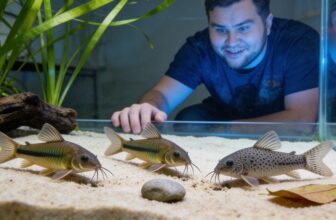
Small algae grazers like Otocinclus catfish, dwarf species such as pygmy Corydoras, and certain snails—nerites, ramshorns—fit most tanks. Cherry shrimp work too, maybe 1–2 centimeters, though exact size varies.
- Otocinclus: 3–5 cm, peaceful, needs groups
- Dwarf Corydoras: ~3 cm, bottom-dwellers
- Nerite snails: algae specialists, don’t reproduce in freshwater
But remember, algae control starts with light balance, not just livestock.