Oxygenation kills fish faster than pH crashes or nitrate spikes—minutes versus hours or days.
Warm water holds less dissolved oxygen, and every degree of heat cranks up your fish’s metabolism as bacteria guzzle what’s left.
Now, keeping them alive without chemicals means working with physics: angle your filter outlet up to splash the surface, drop the water level an inch for better air entrainment, or position air stones low and opposite for cross-flow.
Lowering the thermostat 2–3°C buys breathing room instantly, no gadgets required.
Thermal stratification is the silent killer here—still water layers itself, trapping oxygen at the top as your bottom-dwellers suffocate.
Plants flip from oxygen factories to competitors after dark, so surface agitation matters most between 2 and 4 a.m. when respiration peaks.
Daily checks?
Watch for lazy bubbles, glassy surfaces, fish hovering at the top—these clues cost nothing.
Portable battery aerators run 4–8 hours on AAs when power fails, though honestly, most people forget to test them until it’s too late.
And if your fish are already gasping, pure oxygen beats medication every time—stressed gills heal faster when they’re not fighting for air.
The tricks ahead get surprisingly specific, and some of them involve kitchen utensils.
At A Glance
- Oxygen sustains fish respiration and prevents hypoxia that kills within minutes of pump failure.
- Aeration without chemicals uses surface agitation from angled filters, spray bars, or air stones.
- Nighttime plant and algae respiration creates pre-dawn oxygen crashes requiring mechanical solutions.
- Lowering temperature 2-3°C increases dissolved oxygen capacity and reduces metabolic demand.
- Backup battery-powered aerators ensure oxygenation during power outages when pumps stop.
Why Your Fish Suffocate Faster Than pH or Nitrate Crashes
When the lights go out or the filter sputters, oxygen doesn’t negotiate—it vanishes.
And that’s the thing fellow keepers forget, I mean really forget, until they’re staring at floating guppies. pH crashes? Hours, maybe days of warning. Nitrate spikes? Weeks. But oxygen? Minutes, maybe.
Now, here’s the math—sort of. Your oxygen pump fails at midnight, and by dawn you’ve got fish stress so severe they’re gulp-gasping at the surface like desperate things.
The gills work, or they don’t. No buffer, no gradual decline. Just… silence. And that silence? It’s collective. Your whole tank, suffocating together—community in the worst way.
That’s why selecting a ≤ 25 dB ultra‑quiet skimmer, like the AQQA Hang‑On Aquarium Filter with Surface Skimmer, becomes critical for bedrooms or offices where you might not hear a louder pump fail until it’s too late.
How Summer Heat Steals Oxygen From Tank Water
Summer heat doesn’t knock politely—it barges in, slams the door, and starts rearranging your tank’s chemistry before you’ve even noticed the thermostat creep.
Warm water holds less oxygen; that’s temperature solubility, plain physics. Every degree climbed steals capacity, and your fish feel it first—gasping, sluggish, wondering where the good stuff went. A submersible pump with adjustable flow can help restore circulation and break thermal stratification without the noise that disrupts your home’s quiet.
| Problem | What Actually Happens |
|---|---|
| Heat doubles down | Oxygen loss accelerates, metabolic demand spikes |
| Thermal stratification kicks in | Convection currents stall, surface tension traps gas |
| Solar heating + poor tank insulation | Heat shock looms, evaporative cooling fails when ambient humidity climbs |
Now, diurnal variation makes it worse—nights don’t cool enough. Heat exchange struggles. Seasonal cycle or not, summer doesn’t care about your backup plan.
The Overfeeding Mistake That Starves Your Fish of Oxygen
Heat isn’t the only thief.
Overfeeding stress creeps in, quiet, almost polite at first. You think generosity, they see oxygen depletion.
Here’s the chain: extra food becomes extra waste, bacteria bloom, and those microbes? They’re breathing your fish’s share. Classic overfeeding stress, really. The tank’s small society, already crowded, now gasping.
Now, oxygen depletion hits faster than you’d expect—hours, not days. Fish surface, listless, wondering where the party went.
Adjustable flow valves can help mitigate this by fine-tuning water movement and surface agitation to boost oxygen exchange during critical periods.
I mean, feed less. It’s awkward, saying no to those expectant faces. But survival beats popularity, every time.
Why Algae Blooms Cause Nighttime Oxygen Emergencies
Green water crashes the party around day four, maybe five—nobody’s counting, until suddenly everyone is. I mean, that pea-soup bloom looks almost cool at first, like your tank joined a fraternity.
Now here’s the thing: algae respiration flips the script when lights go out. Those same green machines pumping oxygen all day? They reverse course at sundown, sucking dissolved oxygen like straws in a milkshake.
The result is nighttime hypoxia, a silent suffocation that hits between 2 and 4 a.m., maybe 3, who really knows. Your fish wake up dead, or something close to it.
Belonging means checking before breakfast.
A well-balanced calcium-to-phosphorus ratio of 3:1 in your aquatic ecosystem supports overall biological stability, helping buffer against the cascading effects of oxygen depletion.
How to Spot Oxygen Starvation Before Fish Gasp at the Surface
Though most aquarists picture gasping fish as their first warning sign, the body throws subtler alarms long before that desperate performance begins. Behavior behavior early—that’s your mantra here.
Watch fish linger near filter outlets, flocking to oxygen micro-habitats like crowds at a concert bar. Note the sluggish swimming, the dull colors, the sudden finicky appetite. These aren’t personality quirks; they’re distress signals.
Now, the quiet ones matter too. Bottom-dwellers abandoning their posts, shrimp climbing stems—they’re seeking better water. Check these signs. Your tank’s talking. You just need to listen before the gasping starts.
Consider pairing your observations with an automatic top‑off system that includes water‑level sensors to ensure consistent surface agitation and prevent oxygen crashes from evaporation changes.
Quick Fixes: Boost Oxygen With Surface Agitation Alone
Crank up the surface, and oxygen follows—that’s the whole trick, really.
When tanks gasp, the fast answer lives right there, rippling. Surface flow breaks that mirror-flat tension, letting atmosphere dissolve downward where fins wait. Water turnover matters more than gadgets—moving volumes, not just bubbles.
Now, four moves that work:
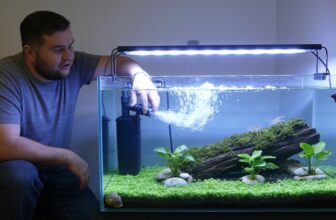
- Angle your filter outlet upward, half-inch below the line, so it chops and splashes
- Drop the water level an inch; falling water pulls air in, physics does the rest
- Add a powerhead near the surface, pointing up—cheap, loud, effective
- Stir manually: cup and pour, five minutes, emergency bought
Simple, immediate, no receipts needed.
A magnetic mounting powerhead lets you position surface agitation exactly where your tank needs it most, with easy repositioning as conditions change.
Where to Place Air Stones for Maximum Oxygen Uptake
Surface agitation works, definitely, but eventually bubbles win—measured, relentless, bottom-to-top oxygen delivery that surface tricks can’t match.
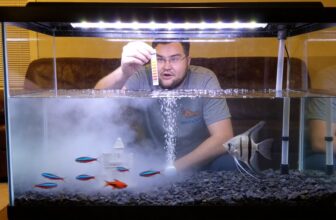
For maximum uptake, ideal placement means one thing: opposite corners, low, where water is stalest. Flow optimization follows, spacing stones to create circulation patterns that reach every driftwood cave and plant thicket.
Avoid clustering stones—dead zones persist, gasping fish huddle regardless of your effort.
Now, depth matters slightly more than you’d think, maybe three inches off substrate, though tank dimensions vary.
One stone per ten gallons, roughly; undershoot rather than crowd.
Position beneath filter outflow, let rising bubbles merge currents.
And remember—bubbles breaking surface, that’s where oxygen actually enters. Everything else is just delivery.
Many HOB filters like the Cascade 300 incorporate Bio-Falls oxygenation through cascading water returns that naturally boost dissolved oxygen levels without additional equipment.
Emergency Aeration for Power Outages and Transport
Losing power mid-summer is every tank keeper’s quiet dread—one minute the hum of filters, the next, silence, warmth, and fish starting to drift toward the surface like question marks. Now, portable aerators and battery batteries become your lifeline, not luxuries. I mean, you planned for everything except the grid failing, right?
- Keep a battery-powered air pump charged and within arm’s reach of your tank
- Stock D-cell batteries or rechargeable packs—test them monthly, since dead backup is no backup
- For transport, clip-on portable aerators run four to eight hours on two AAs
- Practice the drill once, awkward fumbling beats funeral flushes
For longer outages, a 24V DC pump with controller can run off battery banks to maintain circulation and gas exchange until main power returns.
Why Relying on Live Plants Can Backfire at Night
Battery pumps keep fish breathing through blackouts, certainly, but they’re a stopgap, not a strategy.
Battery pumps keep fish breathing through blackouts, certainly, but they’re a stopgap, not a strategy.
Now, some aquarists swear by live plants as their oxygen solution—photosynthesis by day, problem solved, right? Not quite.
Here’s the catch: plant respiration reverses after dark. While fish sleep, those same plants become oxygen competitors, pulling dissolved O₂ for their own metabolic needs.
Alone, this creates night time hypoxia—those pre-dawn hours when tanks hit their lowest oxygen levels.
Plants help, sure, but they’re not a standalone safety net.
Surface agitation from a properly fitted aquarium cover net becomes critical during these vulnerable hours, ensuring gas exchange continues even when plant photosynthesis halts.
Filter Tweaks That Distribute Oxygen More Evenly
Positioning your filter outlet, that humble tube most people jam against the glass and forget, determines whether oxygen gets crammed into one corner or spread like butter across the whole tank.
Smart aquarists know better. They tweak, they adjust, they belong to the club of people whose fish don’t gasp.
- Angle the outlet toward the surface—break that tension, let air crash in
- Position opposite your filter intake—circular flow, no dead zones
- Add a spray bar—diffusion over distance, gentle but thorough
- Install a flow diffuser—turbulence control for skittish swimmers
The Fluval spray bar kit distributes return water across the sump surface like rain, preventing turbulence while protecting delicate organisms. Dial that filter flow until the whole tank breathes together.
Lower the Temperature First: The Easiest Oxygen Fix
Why fumble with gadgets when the thermostat already holds the answer?
Temperature cooling transforms tank maintenance from frantic gear-shopping into something almost elegant, almost lazy.
Tank maintenance becomes elegant when you stop shopping and start thinking.
Warm water hoards less oxygen—basic physics, really, nothing fancy.
Drop the temperature two, maybe three degrees, and solubility jumps.
Now your fish breathe easier without new pumps, without bubbling contraptions cluttering the glass.
But here’s the trick: pair that cooling with surface agitation.
Nothing dramatic, just disturbed water, breaking the tension where gas exchange happens.
I mean, you’re already checking the heater, right?
Two birds. One stone. Zero chemicals.
Which Aquarium Chemicals Secretly Deplete Oxygen Levels
Depleting Oxygen in Disguise
Cooling the tank helps, definitely, but it only solves half the puzzle.
Hidden culprits lurk in well-meaning treatments. Every chemical added starts a chain reaction, and that hidden oxygen you counted on starts vanishing—poof—faster than you’d think.
- Algae treatments oxidize organic matter, consuming dissolved oxygen as they work
- Medications for parasites suppress gill function and trigger hidden respiration in stressed fish
- pH adjusters alter water chemistry, reducing oxygen stability at the molecular level
- Water clarifiers bind fine particles, then bacterial breakdown of those clumps steals your reserves
Why Oxygenation Beats Medication for Sick Fish Recovery
Reach for the medicine cabinet, and you might be reaching right past the real cure.
Oxygen therapy addresses root causes, not symptoms. Medications often deplete dissolved oxygen further—now that’s adding insult to injury. Stress reduction happens naturally when fish breathe easy, their immune systems strengthen, wounds heal faster, and essential returns without chemical side effects.
| Approach | Oxygen Impact | Recovery Speed |
|---|---|---|
| Oxygenation | Increases dissolved O₂ | Hours to days |
| Antibiotics | Often lowers O₂ | Days to weeks |
| Antifungals | Moderate depletion | Variable |
| Parasiticides | Significant reduction | Hit-or-miss |
| “Watch and wait” | Unchanged or worsens | Unpredictable |
I mean, you can’t overdose air. And belonging to a community that knows this? Priceless.
Check Oxygen Levels Daily Without Buying a Meter
Monitoring dissolved oxygen needn’t drain the wallet or clutter the cabinet with gadgets.
- Watch the ripple dance. Every aquarist knows their bubble count by heart—those steady streams from airstones or filter outlets. When numbers drop, or bubbles cluster lazily, water turnover suffers.
- Clock the current. A filter pushing thirty gallons hourly through a twenty-gallon tank hits that sweet spot of roughly one-and-a-half times turnover. Slower? Fish pace, gills working overtime.
- Read the room. Surface skimmers, gasping, listlessness—these fish speak plainly. No translation app required.
- Move, feel, respond. Adjust flow, add surface splash, nudge temperature down. The tank answers back.
Stay connected.
Frequently Asked Questions
Can Too Much Oxygen Harm My Fish?
Excessive oxygen rarely harms fish directly—oxygen supersaturation from intense aeration or temperature spikes can cause gas bubble disease, though this remains uncommon in home aquariums.
The real danger? Overcompensating creates turbulence stress, and neglected tanks face hypoxia risk when equipment fails.
Now, balance matters. Aim for gentle surface rippling, not boiling whitewater. Most fish thrive at 6-8 ppm dissolved oxygen, and your tank likely hits that naturally.
I mean, except you’re running airstone Overdrive™ mode.
Do Saltwater Tanks Need More Oxygen Than Freshwater?
Saltwater generally holds less dissolved oxygen than freshwater—that salinity impact means marine setups work harder for the same gas.
Warmer reefs compound this, since temperature variance reduces solubility further.
Should I Run Air Pumps 24/7 or Only at Night?
Run them 24/7, honestly. Night pump scheduling seems clever—plants stop photosynthesizing, so nighttime aeration feels urgent—but here’s the thing: debris, bacteria, and your fish never clock out. Oxygen crashes don’t check your planner first.
And indeed, some enthusiasts swap to night-only setups, but that’s gambling with stability.
Now, constant bubbling means zero guesswork, backup if the filter chokes, and honestly? The hum becomes white noise. Sleep through it.
How Do Corals Affect Oxygen Levels in Reef Tanks?
Corals shift oxygen levels through a delicate tug-of-war: by day, their zooxanthellae generate photosynthetic oxygen, sometimes supersaturating water; by night, coral respiration flips the script, consuming oxygen and releasing CO₂.
Now, crowded reefs amplify this swing—dense colonies can deplete nighttime reserves faster than circulation replenishes them.
I mean, it’s basically plant logic with a twist.
Stable flow matters more than you’d think, probably 10–15× tank volume hourly, though who’s really measuring?
Can Oxygen Tablets Replace Aeration Devices?
No, oxygen tablets cannot replace aeration devices.
- Tablet efficacy remains limited—chemical release adds temporary bubbles, not sustained gas exchange. Surface agitation beats dissolving additives every time.
- Oxygen tablet cost adds up fast; air stones and powerheads pay for themselves in reliability.
For a thriving tank community, mechanical oxygenation wins. Chemical shortcuts dissolve, but true belonging comes from stable, self-regulating systems—no fizz required.