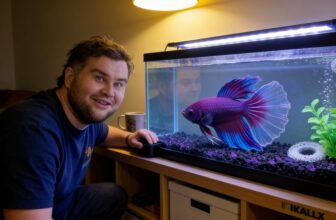
You’re cupping a living stained-glass window when you hold a Crowntail Betta, its finger-like fin rays catching light beyond the webbing.
These fish come from Thailand’s shallow waters and live two to three years with good care, growing to two-and-a-half inches with fins three times their body length.
They need ten gallons minimum, soft water with gentle flow, temperatures of seventy-six to eighty degrees, and protein-rich food twice daily.
Watch their belly—slightly rounded means full, swollen means stop.
Sharp decorations tear their delicate fins, so use silk plants and smooth caves.
Male Crowntails flare at mirrors, shadows, and flowing fins, unable to tell reflection from rival.
Keep going and you’ll uncover how to spot a healthy fish, treat fin rot, and set up the perfect tank.
At A Glance
- Crowntail Bettas originate from Thailand’s shallow waters and live 2–3 years with excellent care.
- Their distinctive fins feature extended rays beyond reduced webbing, creating a finger-like crown appearance.
- Males require 10-gallon tanks with gentle filtration and low-flow environments to protect delicate fins.
- Ideal water conditions include 76–80°F temperature, 6.4–7.0 pH, and soft 2–5 dKH hardness.
- Feed protein-rich foods twice daily for two minutes, and monitor for common issues like fin rot or ich.
What Is a Crowntail Betta?
Before you fall for those spiky, crown-shaped fins, you need to know what you’re actually looking at.
You’re seeing a Betta splendens, a fish from Thailand’s shallow waters. The crown shape comes from fin morphology—each ray extends beyond the webbing between, like fingers spread wide. This pattern repeats along every fin edge.
A living Betta splendens from Thailand’s shallow waters, its crown rays extending beyond webbing like fingers spread wide.
Betta genetics control this trait. Breeders select parents showing reduced webbing, and offspring inherit spikier fins. It takes generations.
You might notice males flash fins three times their body length. Bodies stay small, two and a half inches, but those crown rays dominate.
You’re holding living genetics in your hands.
These fish thrive in low-flow filtration environments that won’t stress their delicate, flowing fins.
Crowntail Betta Colors and Varieties
Pick up a crowntail betta, and you’ll notice the color hits you first, before you even spot the spiky fins.
The color genetics work like paint mixing—you’ll see deep blues, cherry reds, emerald greens, and even copper shimmers, all layered in scales no bigger than sesame seeds. Your fish’s fin anatomy makes these colors move; the reduced webbing between rays lets light pierce through, creating a stained-glass glow when your betta fans his tail. Adding a floating cave hideout to the surface of your tank gives your crowntail a rest station where his colors can truly shimmer under direct light.
Four Common Types
- Solid colors—one bold shade from nose to tailtip.
- Butterfly patterns—pale edges ring darker centers, like petals.
- Marble varieties—patches shift as your fish matures.
- Metallic dragons—thick, armor-like scales in gleaming steel or gold.
Where to Buy a Healthy Crowntail Betta
Now that you know what colors to look for, you’ll need to find a fish that’s actually worth bringing home. Start by visiting local fish stores where you can watch the fish swim, check for clear eyes and undamaged fins. Ask the staff about Betta genetics, since healthy parents often mean stronger babies.
Skip cups with dirty water or fish lying at the bottom—these fish feel scared and sick. Market pricing varies widely; expect to pay five to thirty dollars depending on fin quality and color rarity. Online breeders offer more choices, but you can’t see the fish first. Trust your eyes, ask questions, and pick a fish that swims toward you with curiosity. For bettas specifically, consider housing them in a 2-gallon low-iron silica tank with a gentle sponge filter to match their preference for calm, low-flow environments.
Crowntail Betta Lifespan: What to Expect?
You can expect two to three years with your Crowntale Betta, though excellent care can stretch that window. Poor breeding genetics sometimes shorten this, meaning you’ll want to source fish from reputable breeders who prioritize healthy lineages.
Fin-damage prevention matters enormously here—torn, infected fins drain energy your fish needs for longevity. You’ll safeguard his future by choosing smooth décor, avoiding sharp plastic plants, and keeping water pristine.
Four pillars support a long life together:
- Test water weekly with a reliable kit, keeping pH near 6.8.
- Feed small meals twice daily, never more than he’ll eat in two minutes.
- Select smooth, rounded tank decorations exclusively.
- Quarantine new plants and tank mates for fourteen days minimum.
Consider adding iron detection to your weekly testing routine, as iron levels above 0.5 mg/L can stress delicate bettas and compromise their immune systems over time.
Male or Female? Crowntail Betta Sexing Guide
When you peer into the tank, you’ll notice the males first—they’re the ones wearing those dramatic, spiky fins that flare out like crowns, sometimes stretching three inches past their bodies.
Whereas the females keep shorter, stubbier fins that barely reach past their tails.
You’ll want to check Betta fin symmetry too; males display even, balanced rays on both sides, while females show slight irregularities.
Their color pattern genetics tell another story—males burst with vivid blues, reds, and metallics, but females wear softer, muted tones.
You’ll spot a small white dot on her belly, the ovipositor, meaning she’s ready to lay eggs.
If you need to isolate a sick or breeding crowntail, a compact quarantine setup with transparent observation windows reduces stress and allows easy monitoring without disturbing their delicate fins.
What Tank Size Does a Crowntail Betta Need?
Once you’ve learned to spot a healthy male by his flowing fins, you’ll want to give him a proper home where those delicate rays won’t tear against rough walls or cramped corners.
A 10-gallon tank serves as your foundation for proper fin care maintenance, though 5 gallons works in a pinch.
Breeding patterns demand even more space, since bubble nests need stable, undisturbed surfaces.
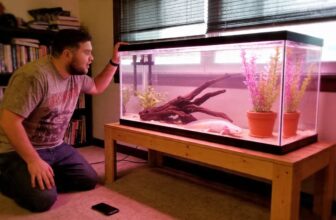
Shallow, longer tanks suit Crowntails better than tall ones, letting him glide without exhausting those heavy fins against the current.
- Choose 10 gallons minimum for comfortable swimming room.
- Pick horizontal layouts over vertical depths.
- Add smooth, rounded decorations only.
- Maintain gentle filtration to protect fragile fin extensions.
For a 10-gallon setup, choose a filter rated ~80 GPH such as the NICREW Internal Filter or Tetra Whisper, which provide adequate circulation while keeping water movement slow enough for those heavy fins.
Ideal Water Temperature, pH, and Hardness
To keep your Crowntail Betta feeling safe and healthy, you’ll want to pay close attention to the invisible stuff inside his tank—things you can’t see but he feels with every breath.
Keep his water warm, between 76 and 80 degrees Fahrenheit, using a small heater that clicks on when needed.
Test his water weekly with strips you dip and read.
His pH should stay between 6.4 and 7.0, which means slightly acidic to neutral.
Hardness adjustment matters too—aim for 2 to 5 dKH, soft water like his home streams.
You’ll need ideal lighting, gentle and subdued, so he doesn’t stress or hide.
Test, adjust, and watch him thrive.
For pH stability in this range without phosphate-induced algae, consider using Acid Buffer which lowers pH quickly and converts excess hardness to CO₂ for soft-water conditions.
Setting Up Your First Crowntail Betta Tank
Where does a fish feel most at home? You create that place, carefully, like building a cozy bedroom.
A DIY tank starts with a 10-gallon glass box, shallow and long, so your Crowntail’s flowing fins don’t tire. You’ll add smooth gravel, no sharp edges to tear his crown-like tail.
Filtration basics matter: gentle flow, baffled output, since strong currents exhaust these rice-paddy natives. A sponge filter works beautifully, bubbling softly. For optimal mechanical filtration without stressing your betta’s delicate fins, choose 40 PPI sponge material that traps fine debris while maintaining gentle water movement.
Now, the four things you need:
- A heater holding 78-80°F, steady as a promise
- Silk or live plants for hiding, resting, dreaming
- A lid—bettas jump when startled, seeking air
- Water conditioner, removing chlorine before he swims
Test weekly. Watch him investigate. You’ve built safety.
Crowntail Betta Diet: Foods, Schedule, and Portion Sizes
Since your Crowntail Betta‘s stomach is tiny—barely bigger than his eye—you’re feeding a creature that gets full fast, hungry often, and confused by too much food at once.
Betta genetics shape his carnivorous appetite, so offer protein-rich meals: bloodworms, brine shrimp, or quality pellets.
Your feeding frequency matters deeply. Feed him two to three small meals daily, each lasting only two minutes.
Remove uneaten food immediately; it fouls the water and hurts his digestion.
Watch his belly—slightly rounded means satisfied, swollen means stop.
You’re building trust through consistency, learning his rhythms, honoring his small needs.
For an alternative protein source, consider slow-sinking micro-granules rich in insect protein like black soldier fly larvae, which offer high protein content that enhances color and supports immune health in tropical freshwater fish.
Can Crowntail Bettas Have Tank Mates?
Once you’ve learned to read your Betta’s belly, you’ll start noticing his temper, too. Betta genetics—the inherited traits passed down from parent fish—make Crowntails naturally solitary and territorial. You’re wondering if he needs company, but he’s wired to guard his space, not share it.
Tank decoration helps when you try neighbors. Ample hiding spots, like caves and plants, give everyone escape routes.
Here are four truths to hold:
- Tank size matters most—you’ll need 20 gallons, not 10, for any companion.
- Choose fast, small fish—Neon Tetras outswim nips.
- Watch shrimp carefully—Ghost Shrimp usually survive; Cherry Shrimp become snacks.
- Accept failure gracefully—you’ll remove newcomers if fins flare.
He’s happier alone, and that’s okay.
If you ever upgrade to a larger community setup, consider how sump baffle chambers can help maintain stable water conditions through adjustable flow sections.
Understanding Crowntail Betta Aggression and Territorial Behavior
Crowntail Betta Aggression and Territory
Place a small mirror flat against your aquarium glass, and you’ll watch your Crowntail Betta puff his gills like a tiny fan, spread his webbed fins into a crown of spikes, and flare his body to twice its normal size.
That display isn’t anger, exactly—it’s territorial instinct, hardwired through centuries of shallow-water survival. Your Betta performs constant fin space mapping, memorizing every plant, stone, and corner he owns. He notices movement instantly.
Common fin aggression triggers include sudden shadows, unfamiliar colors, or any fish with flowing fins that resemble rivals. He can’t distinguish threat from reflection. He simply defends his patch since that vigilance kept his wild ancestors alive.
Spotting and Treating Common Crowntail Betta Illnesses
Common Crowntail Betta Illnesses
When you lift the tank lid each morning, you’re really checking a small underwater neighborhood where trouble can hide in plain sight.
- Disease prevention starts with weekly water quality testing; you’re hunting ammonia, nitrites, and pH shifts before they hurt your fish.
- Ich looks like tiny white salt grains; raise water to 86°F for three days and add proper medication.
- Fin rot shows gray, ragged edges; treat with aquarium salt and clean water immediately.
- Constipation causes a swollen belly; fast your Betta two days, then feed a peeled, cooked pea.
You’re building a habit, like checking a friend’s breathing. Trust water quality testing—it tells you secrets your eyes miss.
Fin Damage in Crowntail Bettas: Causes and Prevention
Since those spiky, crown-shaped fins are the very thing that makes your Betta beautiful, they’re similarly the first place you’ll spot trouble.
Your Crowntail’s fin genetics make those webbed rays delicate, like thin ribbons catching on every rough edge.
Crowntail fins: thin ribbons of webbed rays, catching, tearing on every sharp edge they meet.
You’ll examine your tank for sharp decorations, pointy plastic plants, anything that snags.
Strong water flow pushes your Betta against objects, tearing those precious membranes.
You need gentle filtration, barely rippling the surface.
You’re checking ammonia weekly, keeping it zero, since dirty water softens fin edges, inviting rot.
You’re noticing tears early, feeling worried but capable.
You’re adjusting, protecting, learning your fish’s fragile architecture.
Breeding Crowntail Bettas: A Step-by-Step Guide
Start with a 20-gallon tank, nothing smaller—crowded space turns your fish cruel and rushed.
Condition your pair with live foods for two weeks, watching the male begin his bubble nest beneath floating leaves.
Your breeding techniques must honor their timing: introduce the female slowly, let the male’s display persuade her, then retreat her after eggs drop to protect her from his guarding rage.
Fry survival demands your patience—tiny mouths need infusoria, then brine shrimp, with daily water changes keeping fungus away.
- Condition with protein-rich foods for 14 days
- Provide floating plants for nest anchor and fry cover
- Remove female post-spawning; male tends eggs 2–3 days
- Feed fry progressively: infusoria, then microworms, then shrimp
Frequently Asked Questions
Do Crowntail Bettas Recognize Their Owners?
Yes, your crowntail betta recognizes you through owner bonding and visual cues. You’ll notice it swims to the glass when you approach, responding to your movement and the routine you’ve established during feeding times.
Can Crowntail Bettas Jump Out of Tanks?
Yes, you’ll find your crowntail can jump surprisingly high when exploring tank behavior, especially in smaller tank sizes. Maintain proper diet preferences to reduce stress, and watch breeding cues like nest-building that signal restless, jump-prone activity.
How Often Should I Change My Betta’s Water?
You should change 25–30% of your betta’s water weekly, adjusting frequency based on your tank size and water temperature stability. Smaller tanks need more frequent changes to maintain proper conditions for your fish’s health.
Do Crowntail Bettas Need a Heater in Summer?
Yes, you’ll need a heater for summer selection stability. Seasonal temperature swings above 80°F harm water chemistry, so you’ll monitor your tank size and use a thermostat to maintain consistent 76–80°F conditions.
Can Crowntail Bettas See in the Dark?
Your betta’s vision perception weakens in darkness, so you’re limiting its ability to admire its own dramatic fin coloration or navigate effectively. You’ll want to provide a dim night light or maintain consistent day cycles.
Rounding Up
Your Crowntail Betta, with its spiky crown fins and bright colors, will reward your careful attention with years of quiet company. Keep its water warm, around 78 to 80 degrees, feed it small meals twice daily, and never house two males together. You will feel pride watching it flare at your approach, a living jewel you have nurtured. Patience brings beauty here. Begin today.