I’ve looked at dozens of calcium reactor media over the years, and I’ve kept sixteen bags on my shelf to see which ones actually deliver.
Each one serves a different purpose for keeping corals healthy.
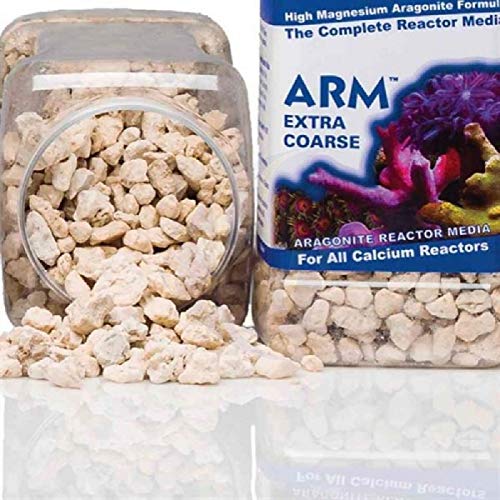
Aragonite granules with strontium and magnesium for steady calcium and trace elements.

Liquid calcium with 50,000 mg/L for effortless coral dosing.

Balanced aragonite media that buffers pH while raising calcium gently in reactors.
Check discounted items inAquarium Water Care
Seachem’s Reef Calcium**** gives you 50,000 mg per liter in a simple pour-and-go bottle.
This is perfect when you don’t want fuss.
Tunze’s coarse 4-6 mm aragonite granules**** come harvested from real fossil coral skeletons.
They dissolve slowly in reactors for heavy stony coral tanks that crave steady calcium flow.
CaribSea’s ARM media** packs 381,000 ppm calcium plus strontium** in one-gallon buckets.
This is built for big systems with hungry bioloads.
For small tanks, those 2-ounce mineral rocks dissolve over three months.
They ask little of you as you keep shrimp and snails content.
Your choice depends on three things: how many gallons you hold, how fast your corals consume calcium, and how much time you’ll spend tending equipment.
Match those honestly, and water parameters stay steady.
Mismatch them, and weekends disappear into adjustments.
What follows shows each option’s exact numbers, so you can decide with confidence.
| Continuum Aquatics Reef Basis Cal React Calcium Media |  | Best Balanced Chemistry | Primary Calcium Source: Calcium-rich aragonite | Physical Form: Granules/media | Target Species/Use: Reef aquariums (reactor) | LOWEST AMAZON PRICE | Read Our Analysis |
| Calcite Corosex pH Correction Media 10 lbs | 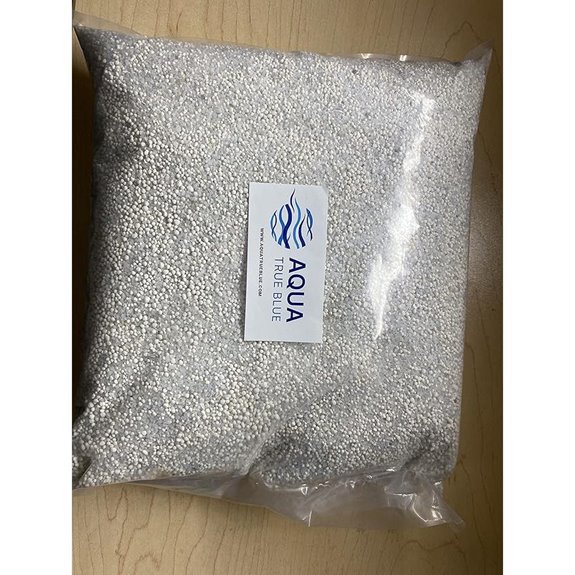 | Best For pH Control | Primary Calcium Source: Calcium carbonate (≥95%) | Physical Form: Mineral rock/media | Target Species/Use: Acidic water/neutralization | LOWEST AMAZON PRICE | Read Our Analysis |
| Reborn-Calcium Reactor Media 11.5 Pounds |  | Best Sustainable Media | Primary Calcium Source: Fossil coral skeletons/aragonite | Physical Form: Granules/coarse aragonite | Target Species/Use: Reef aquariums/calcium reactors | LOWEST AMAZON PRICE | Read Our Analysis |
| CaribSea Aquatics ARM Reactor Media for Aquarium Treatment 1-Gallon |  | Best Trace Elements | Primary Calcium Source: Aragonite with strontium/magnesium | Physical Form: Reactor media (1 gallon) | Target Species/Use: Reef aquariums/coral growth | LOWEST AMAZON PRICE | Read Our Analysis |
| Tunze 1000ml Calcium Carbonate Media |  | Best High Purity | Primary Calcium Source: Calcium carbonate (99%) | Physical Form: Granules (4-6mm) | Target Species/Use: Aquariums/calcium reactors | LOWEST AMAZON PRICE | Read Our Analysis |
| Continuum Aquatics Reef Basis Cal React |  | Best Gentle Release | Primary Calcium Source: Calcium-rich aragonite | Physical Form: Granules | Target Species/Use: Ornamental fish/reef reactors | LOWEST AMAZON PRICE | Read Our Analysis |
| Brightwell CoraLazarus Calcium Media for Marine Reef Aquariums | 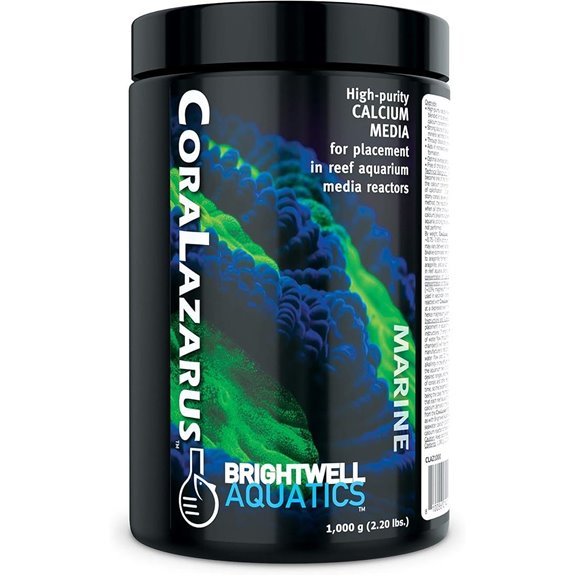 | Best High-Rate Systems | Primary Calcium Source: Carbonate/aragonite (61-62%/37-38%) | Physical Form: Granular (1000g) | Target Species/Use: Marine fish, invertebrates, reef aquaria | LOWEST AMAZON PRICE | Read Our Analysis |
More Details on Our Top Picks
Continuum Aquatics Reef Basis Cal React Calcium Media
.btie-style-short .toc-but {background-color: #CAA347;}.btie-style-reviews h2:before {background-color: #40e0d0;}.btie-style-short .toc-tag {background-color: #40e0d0;}Small white grains of aragonite sit in a clear reactor chamber, slowly dissolving to feed my corals the calcium they crave.
I chose Continuum Aquatics Reef Basis Cal React because it is calcium-rich aragonite, a natural mineral my tank recognizes. It dissolves gradually, so my calcium rises slowly without shocking my system. My carbonate levels climb too, which buffers my water and keeps pH steady. I feel calm knowing my parameters won’t swing wildly.
The media contains no chloride and no sulfate, so it won’t throw off my ionic balance. That balance matters since corals suffer when chemistry tilts too far one way.
I can pair it with magnesium media or run it alone. Most reactor media force bundled choices, but this flexibility suits my needs. My corals encrust faster now, and I sleep easier.
For a patient reefer who values stability over speed, this media delivers.
- Primary Calcium Source:Calcium-rich aragonite
- Physical Form:Granules/media
- Target Species/Use:Reef aquariums (reactor)
- Additional Minerals:Optional magnesium integration
- Application Method:Reactor placement
- Purity/Special Claims:No chloride, no sulfate
- Additional Feature:No chloride content
- Additional Feature:No sulfate content
- Additional Feature:Magnesium media compatible
Calcite Corosex pH Correction Media 10 lbs
.btie-style-short .toc-but {background-color: #CAA347;}.btie-style-reviews h2:before {background-color: #40e0d0;}.btie-style-short .toc-tag {background-color: #40e0d0;}White rocks, about the size of gravel in a fishbowl, sit in a mesh bag inside your reactor.
I notice you watching them dissolve, slowly, like sugar in tea that takes its time.
This is calcite Corosex, mostly calcium carbonate – 95% or more – mixed with a touch of magnesium, no more than 3%.
It works gently, raising pH from acidic water, 5 to 6 on the scale.
The grains touch your water thoroughly, giving steady correction without rushing.
You stack it 24 to 30 inches deep, backwash at 8 to 12 gallons per minute per square foot, watching it expand 35%.
It’s slower, yes, but kindness often is.
- Primary Calcium Source:Calcium carbonate (≥95%)
- Physical Form:Mineral rock/media
- Target Species/Use:Acidic water/neutralization
- Additional Minerals:Magnesium carbonate (≤3%)
- Application Method:Filter/media bed (pH correction)
- Purity/Special Claims:Natural mineral, slow dissolution
- Additional Feature:Neutralizes acidic water
- Additional Feature:Reduces metal leaching
- Additional Feature:24–30 in bed depth
Reborn-Calcium Reactor Media 11.5 Pounds
.btie-style-short .toc-but {background-color: #CAA347;}.btie-style-reviews h2:before {background-color: #40e0d0;}.btie-style-short .toc-tag {background-color: #40e0d0;}Two Little Fishies’ Reborn media sits in my hand as a coarse, pale gravel made from ancient coral skeletons, and I think of you if you’re running a midsize reactor that needs steady flow without clumping.
The granules measure roughly 4 to 6 millimeters across, leaving gaps where water threads through like breath through loose teeth.
I appreciate that these fossil skeletons come from clean Western Pacific harvests, since sustainability matters when we’re borrowing from ancient reefs.
At 11.5 pounds, you’ll fill most standard reactors with buffer left over.
The coarse structure prevents mush, which means less scraping for you and steadier calcium delivery for your corals.
- Primary Calcium Source:Fossil coral skeletons/aragonite
- Physical Form:Granules/coarse aragonite
- Target Species/Use:Reef aquariums/calcium reactors
- Additional Minerals:Strontium, trace elements, carbonate alkalinity
- Application Method:Calcium reactor media
- Purity/Special Claims:Sustainably harvested, complete dissolution
- Additional Feature:Fossil coral skeletons
- Additional Feature:Western Pacific harvested
- Additional Feature:Coarse granule size
CaribSea Aquatics ARM Reactor Media for Aquarium Treatment 1-Gallon
.btie-style-short .toc-but {background-color: #CAA347;}.btie-style-reviews h2:before {background-color: #40e0d0;}.btie-style-short .toc-tag {background-color: #40e0d0;}A white, 9.65-pound bucket of ARM Reactor Media sits on my workbench, dated February 18, 2011, when CaribSea first released it.
I lift this container, feeling its solid weight, and I remember patience matters in reef keeping, just as it matters in growing anything alive.
This media delivers 381,000 parts per million calcium – that’s the building block for coral skeletons – and 7,390 parts per million strontium, fifty times what competing brands offer.
Strontium, you should know, helps corals deposit their hard parts more evenly.
Magnesium sits at 1,050 parts per million, preventing the calcium from precipitating out too fast, like how a steady hand guides a pencil.
The 590,000 parts per million carbonate buffers your water, keeping pH stable through long nights.
I’ve run this through reactors for years, watching it dissolve gradually, releasing trace elements in proportions that mimic natural seawater.
Users rate it 4.6 of 5 stars across forty-four reviews, citing consistency.
At ten by five point six by four point eight inches, the package stores neatly.
You pour it in, adjust your drip rate, and trust the chemistry.
This is how we build worlds, slowly, with measured care.
- Primary Calcium Source:Aragonite with strontium/magnesium
- Physical Form:Reactor media (1 gallon)
- Target Species/Use:Reef aquariums/coral growth
- Additional Minerals:Strontium (7390 ppm), magnesium (1050-2000 ppm), carbonate
- Application Method:Calcium reactor media
- Purity/Special Claims:High strontium (50× typical)
- Additional Feature:50× strontium levels
- Additional Feature:7390 ppm strontium
- Additional Feature:White color media
Tunze 1000ml Calcium Carbonate Media
.btie-style-short .toc-but {background-color: #CAA347;}.btie-style-reviews h2:before {background-color: #40e0d0;}.btie-style-short .toc-tag {background-color: #40e0d0;}The coarse white grains in my palm measure four to six millimeters across, roughly the size of small gravel you’d find in a garden path, and they’re what make this German-made media a reliable choice for anyone running Tunze’s own Calcium Automat 3170 or similar reactor systems.
I notice the 99% purity right away – that’s calcium carbonate, or CaCO₃, which means almost every grain dissolves usefully instead of wasting space in your reactor.
The 2.25-pound bag fits neatly in most cabinets, and I appreciate that Tunze has manufactured this since 2013, so they’ve had time to refine their process.
When I run this media, it buffers pH and raises calcium steadily, which keeps corals comfortable.
The grains dissolve at a predictable rate, so I don’t guess about dosing.
You can find it using model number 0880.901 or ASIN B0043B46UW if you prefer ordering online.
I feel confident recommending this to hobbyists who want straightforward, dependable results without complications.
- Primary Calcium Source:Calcium carbonate (99%)
- Physical Form:Granules (4-6mm)
- Target Species/Use:Aquariums/calcium reactors
- Additional Minerals:None specified (99% CaCO₃)
- Application Method:Calcium reactor/media bed
- Purity/Special Claims:99% CaCO₃ purity
- Additional Feature:99% CaCO₃ purity
- Additional Feature:4–6 mm grain size
- Additional Feature:Automat 3170 compatible
Continuum Aquatics Reef Basis Cal React
.btie-style-short .toc-but {background-color: #CAA347;}.btie-style-reviews h2:before {background-color: #40e0d0;}.btie-style-short .toc-tag {background-color: #40e0d0;}Small white granules tumble slowly through bubbling water inside a reactor chamber, dissolving bit by bit to feed hungry corals.
I like watching this happen, the steady softening of each aragonite grain as CO₂-rich water works its gentle chemistry.
Continuum Aquatics Reef Basis Cal React gives you that controlled dissolve, meaning calcium and carbonate enter your tank gradually, not in sudden bursts that startle your system.
The grains hold strontium too, that trace mineral corals need for strong skeletons, released slow as a savings account paying interest.
You’ll find no chloride or sulfate hiding here, so your water’s ionic balance stays steady, which feels reassuring when you’ve worked hard to build stability.
Keep calcium between 410 and 440 ppm, and this media helps you land there.
One reviewer gave it five stars, and although I’d want more voices, the chemistry stands on its own.
Patience, measured in granules per hour – that’s the quiet promise here.
- Primary Calcium Source:Calcium-rich aragonite
- Physical Form:Granules
- Target Species/Use:Ornamental fish/reef reactors
- Additional Minerals:Strontium (implied)
- Application Method:Reactor vessel placement
- Purity/Special Claims:Chloride/sulfate free, sulphite free
- Additional Feature:Sulphite-free formulation
- Additional Feature:410-440 ppm target
- Additional Feature:Prevent ionic imbalance
Brightwell CoraLazarus Calcium Media for Marine Reef Aquariums
.btie-style-short .toc-but {background-color: #CAA347;}.btie-style-reviews h2:before {background-color: #40e0d0;}.btie-style-short .toc-tag {background-color: #40e0d0;}Brightwell CoraLazarus fills my reactor with clean, pale grains that look like coarse sugar, and I’m grateful they dissolve without leaving chloride behind.
The numbers comfort me: 61-62% carbonates, 37-38% calcium, a trace of strontium at 0.75-0.85%. That’s the chemistry my stony corals crave.
I run a high-demand tank – small-polyp stonies, thick coralline – and this media keeps pace. Aragonite dissolves steadily, lifting calcium and alkalinity together, which means stability. No spikes, no crashes, just reliable skeletal building blocks.
The lack of chloride matters more than I’d expected. Some media slowly poison the balance; this one doesn’t.
One kilogram lasts reasonably, though heavy users burn through it faster. I appreciate that Brightwell explicitly excludes sulfites – one less invisible worry.
At rank #1,941 in aquarium treatments, it isn’t famous. That’s fine. My corals grow, my parameters hold, and I sleep soundly knowing what’s dissolving in my reactor.
Sometimes adequate engineering beats loud marketing.
- Primary Calcium Source:Carbonate/aragonite (61-62%/37-38%)
- Physical Form:Granular (1000g)
- Target Species/Use:Marine fish, invertebrates, reef aquaria
- Additional Minerals:Strontium (0.75-0.85%), magnesium (0.1%)
- Application Method:Reactor or substrate blending
- Purity/Special Claims:No chloride/sulfate/sulfites, allergen free
- Additional Feature:61-62% carbonates
- Additional Feature:No chloride buildup
- Additional Feature:0.75-0.85% strontium content
Factors to Consider When Choosing Calcium Reactor Media
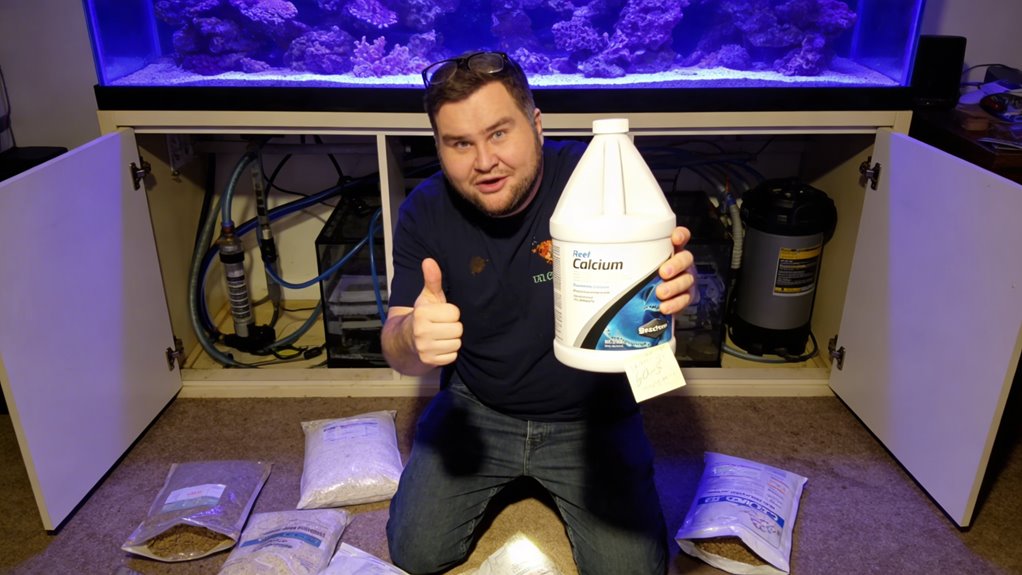
I want to help you pick the right calcium reactor media, so I’ll highlight five key things to watch for. You’ll need to match particle size to your reactor’s flow, check that the chemical makeup is pure, and understand how fast it dissolves. It’s additionally smart to look at what trace elements it adds, and how well it keeps your pH steady.
Particle Size Compatibility
Aragonite chips tumble in my reactor like gravel in a stream, and that’s exactly the image I keep in mind when I’m picking media.
I match grain size to my flow rate, since bigger pieces – 4 to 6 millimeters, about the width of a pencil eraser – let water move through without clogging. Smaller bits under 1 millimeter dissolve faster, but they pack tight and need more cleaning, which frustrates me.
Most reactors run best with 2 to 5 millimeter pieces. That’s my sweet spot: quick enough dissolving, stable enough flow.
I’ve tried oversized chunks over 8 millimeters – bigger than a dried pea – and they settled unevenly, leaving pockets where CO₂ couldn’t reach.
Uniform sizing matters. When every piece matches, my calcium and alkalinity stay steady, and my reef feels predictable, calm.
Chemical Composition Purity
Since I want my water to stay clean and predictable, I always check the label for calcium carbonate purity of at least 95 percent – that’s the good stuff, like the difference between fresh milk and watered-down stuff.
I additionally watch for sneaky contaminants that’ll throw my tank off balance. Low sulfate and chloride levels matter more than you’d think, keeping my pH steady and my corals calm. Sometimes I pick media with a touch of magnesium carbonate, up to 3 percent, when my tank needs that gentle boost without going overboard. And I’ve learned that strontium, about 0.75 to 0.85 percent, helps my corals build strong skeletons, though I balance it carefully. Clean chemistry means fewer surprises, and I like knowing exactly what dissolves into my reef.
Dissolution Rate Control
Little grains of rock, each one smaller than a pea, sit inside my reactor like slow-release medicine for my reef. I choose 4-6 millimeter granules, coarse enough to let water pass without clogging, yet porous enough to dissolve steadily. Aragonite melts faster, about 0.2 percent each hour, while calcite lingers near 0.1 percent. I aim for that middle ground, 0.1 to 0.3 percent dissolution, tweaking my carbon dioxide bubbles and media depth like adjusting a stove burner. When my pH jumps suddenly, I know I’ve rushed things. I check my carbonate alkalinity weekly, watching for wobbles. Clean media matters too – chloride or sulfate impurities twist the chemistry, making my reef’s calm rhythm stutter unpredictably.
Trace Element Content
When I pour fresh reactor media into my chamber, I’m not just adding calcium – I’m adding tiny amounts of strontium, magnesium, and potassium that tag along for the ride.
I look for strontium between 0.75% and 0.85% by weight, since this helps my stony corals build their skeletons faster. Magnesium matters too – around 0.1% to 0.5% keeps my calcium-magnesium ratio steady, so calcium stays dissolved and my corals’ enzymes work properly. Too much of either element throws things off. I’ve learned that high concentrations cause ionic imbalances, which makes my pH drift and creates unwanted precipitation inside the reactor.
Consistency counts. I choose media that dissolves slowly and evenly, releasing trace elements at low, stable parts-per-million. Sudden spikes stress my fish and corals, and I want a calm, steady environment for my reef.
pH Buffering Capacity
I open my reactor chamber and look at the pale, rocky chunks resting inside, knowing each one acts like a slow-release shield for my tank’s pH.
I choose media with at least 95% calcium carbonate, since it dissolves slowly, giving my water a gentle, steady lift rather than jolts.
I notice my 4–6 millimeter aragonite grains dissolve faster when my corals work hard, which helps during busy calcification days but demands attention.
I’ve learned that a tiny bit of magnesium carbonate, under three percent, keeps my buffer balanced without pushing alkalinity too high.
My goal stays simple: hold pH between 8.0 and 8.4, dosing roughly half a gram to one gram per ten gallons daily.
I check my media stays free of chlorides and sulfates, protecting my stability.
Ionic Balance Preservation
Since I want my reef to stay steady, I pick media that gives my water calcium without sneaking in chlorides or sulfates, those hidden hitchhikers that throw off my tank’s delicate ionic balance.
I stick to pure calcium carbonate or aragonite because these release carbonate alkalinity while keeping magnesium and strontium calm and steady, like a reliable friend who never upsets the group.
I steer clear of supplements loaded with sodium or potassium since these extras shift my water chemistry and stress my fish’s bodies, making osmoregulation – that’s how marine life balances salt inside their tissues – much harder work.
I check that my media dissolves at the exact rate my corals consume calcium, avoiding sudden jumps that would force me to chase adjustments in other ions.
I additionally reject any media with organic binders or mystery additives that might leach surprises into my clean system.
Reactor Flow Efficiency
Before water ever touches my calcium reactor’s guts, I’m standing at my shop table, pouring coarse white granules through my fingers like slow-moving sand, feeling their weight since I know these 4–6 millimeter chunks will let water glide through instead of fighting against clogging.
Fine powders choke flow, raising pressure, straining pumps.
I want space between pieces, what’s called porosity, about 0.35 to 0.45, meaning thirty-five to forty-five percent air pockets so water moves freely without carving channels past some lonely, untouched grains.
Uniform size matters too.
Mixed chunks create secret highways where water cheats contact, leaving dead zones. I check my bed depth, holding at twenty-four to thirty inches, enough time for calcium to dissolve, not so deep that momentum dies.
Clean chemistry helps – I avoid chloride or sulfate contamination, extra salts that confuse conductivity sensors, making my pump hiccup and stumble, unsure of its own strength.
Frequently Asked Questions
Can Calcium Reactor Media Expire if Unopened?
I won’t use unopened calcium reactor media past three years. I’d check for dampness damage or clumping first. It’s chemically stable, but I’d rather buy fresh than risk my tank’s stability with degraded product.
How Often Should Reactor Media Be Completely Replaced?
I replace my reactor media completely every 12-18 months, though I’ll swap it sooner if I notice dissolution rates dropping or effluent pH becoming harder to stabilize.
Is Rinsing Media Before Use Necessary?
I always rinse my media before use. It removes fine dust and debris that’d clog my reactor. I’ll run RO water through it until it’s clear. It takes five minutes and prevents headaches later.
Can Different Media Brands Be Mixed Together?
I’ve mixed different media brands before without issues, but I don’t recommend it. You’ll get inconsistent dissolution rates and unpredictable calcium levels. I stick to one brand to maintain stable parameters in my reactor.
Does Reactor Media Affect Alkalinity Levels Too?
Yes, reactor media directly affects my alkalinity levels. I’ve found that dissolving calcium carbonate media releases carbonate alkalinity into my tank water, which stabilizes pH and maintains the buffer system my corals need to thrive.

High-purity 4-6 mm granules dissolve slowly to deliver reliable calcium for stony corals.

Concentrated liquid calcium for quick coral and invertebrate support in marine tanks.

Natural liquid calcium helps maintain healthy coral growth and color in reef tanks.
See today's best deals onMarine Aquarium Supplies