A glass bowl sits on a windowsill, and inside swims a single orange fish that most people call a “goldfish,” but that word hides a world of difference. The squat, bubble-eyed creature with fluid-filled sacs wobbling beneath its gaze cannot survive where a sleek, torpedo-shaped Comet thrives, and a beginner who chooses wrong feels quiet disappointment when their pet sickens or dies. Each body type—single-tail or fancy, round or elongated—carries specific needs for space, filtration, and gentle handling that determine survival. The question isn’t which goldfish looks prettiest, but which one matches the keeper’s skill, time, and tank size.
At A Glance
- Single-tail goldfish (Comet, Common, Shubunkin) swim fast and need 40-gallon tanks minimum.
- Fancy varieties (Fantail, Ryukin, Oranda) feature unique shapes and require gentler tank mates.
- Bubble Eye and Pearlscale goldfish demand expert care with soft décor and stable water.
- Beginners should choose hardy Comets or Commons; experts handle delicate Bubble Eyes.
- All goldfish produce heavy waste, needing filtration rated at 10 gph per 10 gallons.
Body Types 101: Single-Tail vs. Fancy Goldfish
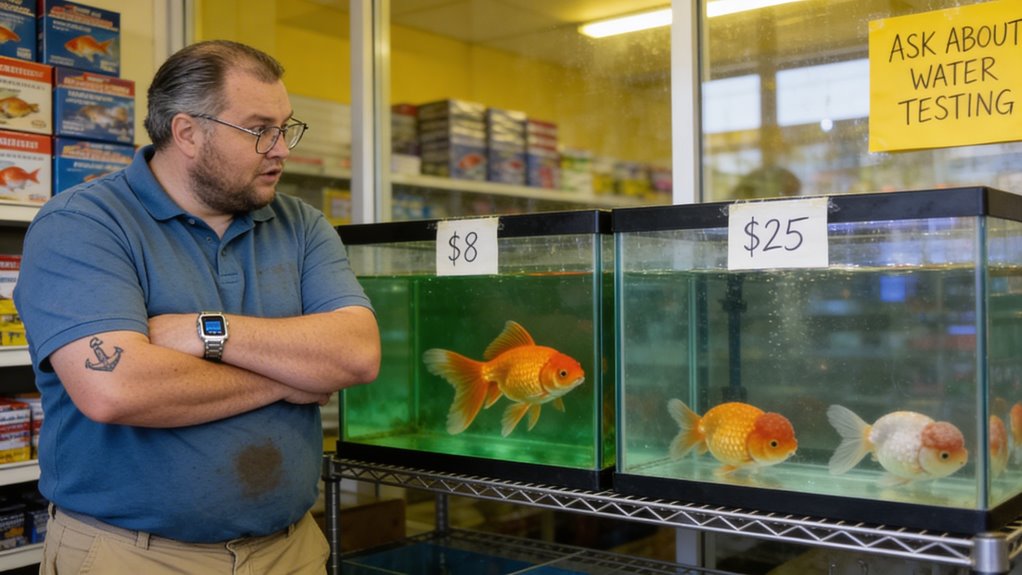
A single orange-red fish slips through the water with a tail like a fluttering ribbon, and that simple sight tells you most of what you need to know about goldfish body types.
Tail length divides goldfish into two families you’ll want to understand before joining any tank community. Single-tail varieties keep the streamlined body shape of their carp ancestors, with tails that extend straight back like a painter’s brushstroke. Fancy goldfish carry shorter, divided tails that fan outward like underwater peonies.
Single-tail goldfish stream like brushstrokes; fancy varieties bloom like underwater peonies.
Scale texture offers another map to belonging. Most goldfish wear flat, smooth scales, but Pearlscales grow small domes across their bodies, each scale rounded like a bead pressed into skin.
Body shape signals swimming speed and care needs. Slim bodies slice through water, while deep, egg-shaped tummies slow a fish down.
Color genetics paint each variety’s welcome. Reds and oranges dominate, but calico patches or pure white bodies mark different breeds you’ll learn to name.
Comet, Common, Shubunkin: Hardy Beginner Goldfish
Even though some goldfish demand special care like fragile ornaments, three breeds endure where others struggle, making them trusted first companions for new keepers.
The Common goldfish swims with orange confidence, its body shaped like the wild carp from long ago.
The Comet flashes a colortail feeding display, its forked fin stretching nearly as long as its sleek body, catching light like underwater glass.
The Shubunkin wears calico spots beneath its scales, not painted on top, creating depth that draws the eye closer.
These three forgive mistakes in water temperature, thriving between 65 and 78 degrees Fahrenheit.
They welcome newcomers into a hobby where patience builds belonging, one splash at a time.
Wakin and Watonai: Rare Double-Tailed Goldfish
Since most goldfish carry one tail fin like a simple flag, two varieties whisper a different story through their paired tails.
The Wakin swims with two caudal fins and two anal fins, a quirk of doubletail genetics that sets it apart from common pond fish. Its red-white patches glow like koi, though it remains a true goldfish. The Watonai carries this same fin arrangement but stretches into a longer, comet-like body. Market rarity makes both prized finds, collectors feel delighted when they locate healthy specimens.
- Two tail fins fluttering like paired curtains in slow current
- Red head patches glowing against midnight black scales
- Fins spreading wide, then folding, spreading wide, then folding
These buddies suit ponds and large tanks, their swimming needs space to feel right. Belonging starts with understanding what makes them different, not difficult.
Fantail and Ryukin: Popular Fancy Goldfish Starters
Goldfish keepers often point beginners toward two sturdy favorites that bridge the gap between plain pond fish and delicate show varieties.
The Fantail spreads its tail like a Japanese hand fan, four inches wide in mature adults.
Fancy breeding developed this shape over centuries, selecting fish with split caudal fins that never fully close.
Color genetics determine the orange, calico, or metallic scales shimmering beneath aquarium lights.
The Ryukin carries a pronounced shoulder hump, resembling a small camel’s back, earned through Japanese breeders’ careful selection starting in the 1700s.
Both varieties forgive small mistakes in water quality, eating eagerly, growing eight inches in two years.
They swim slowly together, creating gentle ripples readers recognize as peaceful companionship.
Oranda: The Brain-Like Wen Everyone Notices
A rounded head covered in soft, rippling folds draws every eye in the tank.
The Oranda wears its wen like a crown, a fleshy, brain-like growth that develops slowly over two to three years.
This feature ties directly to Wen genetics, a heritable trait breeders have refined since the 1500s in China where Oranda symbolism first flourished.
Chinese keepers saw the wen as prosperity made visible, a living ornament for scholars and merchants alike.
- Blooming red folds catching afternoon light like underwater roses
- Gentle, searching movements through the water column
- A community gatherer, drawing the shyest fish from hiding
Tankmates with similar slow swimming speeds help everyone feel they belong.
Veiltail: Managing Those Dramatic Flowing Fins
One Veiltail’s fins can stretch twice its body length, trailing behind like silk ribbons caught in a gentle breeze. These fish move slowly, drifting through water with a calm that invites quiet watching.
Strong fin‑care techniques keep those delicate ribbons whole. Keep tank water clean, still, and free of sharp decorations that snag fin tissue.
Veiltail breeding demands patience. Breeders select fish with symmetrical, lengthy fins, pairing them across generations to preserve that flowing shape. Offspring inherit the trait roughly seventy percent of the time, with full fin development taking eight months.
Owners who commit feel pride, seeing their fish glide like living art.
Black Moor: The Telescope-Eyed Classic
What does a fish see when its own eyes grow too large to fit inside its skull? The Black Moor, a Telescope Eyes breed, views the world through twin globes that protrude like dark marbles, giving it a gentle, searching gaze.
- Velvet-black scales absorbing light like deep water at midnight
- Delicate fins fanning outward in slow, deliberate arcs
- Round eyes reflecting overhead lamps like wet obsidian
Historical Breeding in sixteenth-century China produced these fish for nobility who prized oddity. Color Genetics fixed their midnight hue, though juveniles often show bronze before true black emerges. They belong in calm tanks with smooth décor, where their limited sight won’t bring harm.
Bubble Eye and Celestial Eye: Ethical Care for Delicate Eyes
Those dark marbles of the Black Moor seem sturdy compared to what comes next.
Bubble Eye goldfish carry fluid-filled sacs beneath their eyes, each bladder as fragile as a grape’s skin. One brush against a sharp edge, and they burst—not unlike a popped balloon.
Their eye sacs burst at a touch—grape-skin thin, balloon-fragile, doomed by the slightest sharp edge.
Celestial Eyes face upward, their gaze fixed on heaven, blind to what’s ahead. They bump into things, helpless as a person walking backward through a crowded room.
These breeds raise serious eye regulations ethics questions. Their limited eye health demands special tanks: soft décor, gentle filtration, no aggressive tankmates. They belong only with keepers who’ll rearrange their world for safety.
Pearlscale: Keeping This Bumpy Beauty Healthy
Since a Pearlscale’s body looks like it swallowed a handful of marbles, this goldfish turns heads in any tank.
Its Pearlscale diet needs sinking pellets, not flakes, since it can’t swim fast enough to snag food from above.
Enthusiasts who try Pearlscale breeding find it tricky, since the parents sometimes munch their own eggs, so they remove eggs quickly to a separate container.
- Round scales catch light like tiny, raised pearls across plump sides
- Wobbling swimmers drift past plants like slow-motion marbles underwater
- Gentle mouths nudge gravel, searching, as quicker tank mates sprint by
Clean, steady water keeps this bumpy friend feeling safe, and seen.
Tank Mates: Which Goldfish Can Live Together?
A small glass bowl sits empty on a table, waiting.
Goldfish need companions who match their speed and body type, like finding friends who walk at your pace. Compatible tank compatibility means pairing single-tails—Comets, Shubunkins, Commons—together, and keeping Fancies like Orandas, Ryukins, and Fantails in their own group. Water filtration must handle heavy waste loads, since goldfish produce lots of ammonia, and pumps should cycle ten gallons per hour for every ten gallons of tank space. Mixing fast swimmers with slow, round-bodied types causes stress, as the quick ones steal all the food. Belonging starts with choosing wisely, so everyone thrives.
Choose by Skill Level: Beginner to Expert Goldfish
An empty net hangs on a hook beside the bathtub, ready for its first catch.
Skill grading helps aquarists find their place in this welcoming community. Beginners thrive with Common or Comet goldfish, their orange-yellow color genetics forgiving mistakes in water care. Intermediate keepers adopt Fantails, balancing beauty with manageable needs. Experts cultivate Bubble Eyes or Pearlscales, delicate varieties demanding precise attention.
Goldfish mastery begins with forgiving Comets and ends with the delicate art of Bubble Eyes.
- A child’s first Comet darts like a flame through glass, tail streaming behind.
- Rust-colored Wen folds grow slowly, brain-like, on an Oranda’s crown.
- Translucent fins of a Veiltail trail like ribbons in still water.
Color genetics reward patience with living art.
Space Needs: How Much Room Each Goldfish Requires
Water, unlike air, holds no fixed shape, so a goldfish must carry its own boundary, a skin‑thin wall between self and world. Each fish needs room to swim, to feel safe, to belong.
Here is how much space different goldfish require:
| Goldfish Type | Minimum Gallons Needed |
|---|---|
| Single‑Tailed (Common, Comet) | 40 gallons, plus 20 per extra fish |
| Fancy (Fantail, Ryukin) | 20 gallons, plus 10 per extra fish |
| Oranda | 30 gallons, plus 15 per extra fish |
| Bubble Eye, Celestial Eye | 20 gallons, clear tank decoration only |
| Pearlscale | 30 gallons, stable water chemistry crucial |
Crowding causes stress, weakens fish, disrupts water chemistry. Choose tank decoration with care—sharp edges wound delicate fins. Give each goldfish space, and they’ll thrive together.
Frequently Asked Questions
Do Goldfish Recognize Their Owners?
Goldfish recognize their owners through visual recognition, remembering faces and routines for months. They’ll swim to the glass when a familiar person approaches, proving an owner bond memory exists. This memory spans three to five months, researchers found in 2019. Goldfish distinguish shapes, colors, and movement patterns, associating their keeper with food and safety. They won’t greet strangers the same way, showing true preference.
Can Goldfish Live in Outdoor Ponds Year-Round?
Goldfish can thrive in outdoor season ponds year-round with proper preparation. Hardy varieties, like Comet and Shubunkin, adapt to temperature shifts as water naturally insulates against extreme cold. Seasonal feeding matches their slowing metabolism in winter, stopping food when temperatures drop below 50°F. Ponds deeper than three feet prevent complete freezing, creating safe zones. They’ll feel secure knowing their fish find shelter, building trust through patient, attentive care each season.
How Long Do Different Goldfish Varieties Typically Live?
Goldfish typically live 10 to 15 years, though some reach 20 or more with proper care.
Longevity genetics play a big role—single-tailed varieties like Commons and Comets often survive longest as breeding standards kept them closer to wild carp, preserving hardy traits.
Fancy types such as Bubble Eyes and Pearlscales usually live shorter lives, 5 to 10 years, since selective breeding for special features weakened their bodies. Water quality, tank space, and diet matter too. Good care helps every goldfish thrive longer.
What Vegetables Are Safe to Feed Goldfish?
Leafy greens, peas, and zucchini top the list of safe vegetables for goldfish.
These foods add vegetable nutrition that dry flakes can’t match, supporting digestion and bright colors.
Feeding frequency matters: offer small vegetable pieces two to three times weekly, removing uneaten bits after four hours to keep water clean.
Blanching hard vegetables softens them, making them easier for goldfish to chew and enjoy.
Why Do Goldfish Change Color as They Age?
Goldfish change color as they age since of color development genetics and diet impact working together across time. Young fish hold pale pigment that deepens, shifts, or fades based on which genes awaken. Cells called chromatophores spread, shrink, or disappear inside the skin. A carotenoid-rich diet—think spirulina, krill, or color flakes—fires up reds, oranges, and yellows. Poor nutrition dulls brilliance. Owners notice these gentle transformations and feel quiet wonder, like watching a friend grow into themselves. Patience rewards the observant keeper.
Rounding Up
A glass fishbowl sits empty on a shelf, too small for any goldfish to thrive, and that lesson stays with you. You’ve learned that Comet’s sleek body needs twenty gallons, as Oranda’s wen demands gentle water flow. Choose your fish like you’d choose a friend, matching their needs to your care. With patience, clear water, and room to swim, you’ll build a home where goldfish truly shine.