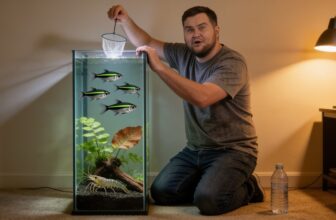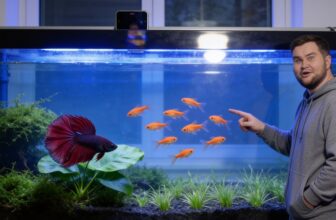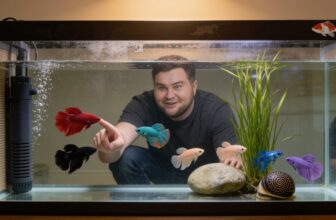
A 20-gallon tank fits roughly 15 to 18 nano fish—think neon tetras or pygmy corydoras—if you plan your stock with care.
But add one six-inch pleco and that number crashes to zero. The inch-per-gallon rule? It almost never works.
Adult size, waste loads, and behavior shape what your tank can handle. Stock slowly, cycle first, and test weekly.
Get the ratio right from the start. Build a plan that keeps your fish thriving, not just surviving.
At A Glance
- Cycle tank for 4–6 weeks until ammonia and nitrite read zero.
- Stock nano fish like neon tetras, guppies, and pygmy cory catfish.
- Include hiding spots and break sightlines to reduce territorial aggression.
- Maintain 3 females per 1 male for guppies or mollies to prevent conflict.
- Account for decor displacement, reducing real swimming volume by 1–3 gallons.
How Many Fish Can You Actually Fit in a 20-Gallon Tank?
A 20‑gallon tank is a fine starter box — it’s the aquatic equivalent of a studio apartment. You can actually fit a dozen guppies, a betta, or a school of tetras. But first, patience. Tank cycling takes weeks, not hours, to build good bacteria. Skip water testing and you get sick fish. That’s the fast track to heartache. The real number isn’t about space; it’s about time. Wait for stable ammonia and nitrite readings — zero on both — before adding fish. Start with hardy species. Beginners should prioritize reliable temperature and quiet filtration over fancy lighting options when selecting a starter setup. A filter operating at ≤30 dB ensures the tank stays peaceful without disturbing your home. Bottom line: Go slow, test often, and your 20-gallon tank will feel like a community.
Why Tank Size Alone Doesn’t Tell the Whole Story
Water volume, after all, is only half the equation.
Fish biology dictates that some species need to dart, others to hide.
Rocks and plants shrink the swim lane dramatically, turning a spacious tank into a cramped studio.
That filter? It can’t keep up with waste if you treat the 20‑gallon number like a hard limit.
Belonging means respecting your fish’s real estate. A tank’s promise is only as good as what you put—and don’t put—inside it.
Choosing a substrate like Aqua Natural Prairie Sand can accelerate the nitrogen cycle, helping the filter manage waste more effectively in a smaller volume.
Gravel with a high surface area promotes beneficial bacterial colonization, which further stabilizes water quality in a stocked 20‑gallon tank.
The One Rule That Changes Everything: Adult Size Matters
The one rule that changes everything is adult size, and it’s the easiest thing to overlook. You see a tiny, two-inch fish at the store? Congrats, you’ve adopted a future six-inch tank bully. That little guy will outgrow your 20-gallon, stress out its tank mates, and wreck your careful algae control plans.
Adult size dictates filtration maintenance loads, too—larger fish produce more waste. If you can’t find the adult size online, ask the store. It’s the difference between a peaceful, well-stocked community and a cramped, messy disaster. Bottom line: always check adult length first. For larger setups, choose pre‑treated root driftwood to avoid tannin leaching and save preparation time. For a natural look that also supports beneficial bacteria, consider natural driftwood pieces from a set that fits a 20-gallon or larger tank.
Why the Inch-Per-Gallon Rule Almost Never Works
Clarity sounds nice, but the inch-per-gallon rule is one of those shortcuts that looks tidy on paper and falls apart in practice.
This fish volume misconception ignores how much space a fat-bodied goldfish or a territorial cichlid actually needs versus a slender tetra. The inch per gallon fallacy treats all fish like identical rulers, forgetting they poop, swim, and fight differently.
- A six-inch pleco produces more waste than ten one-inch neon tetras.
- Tall-bodied fish, like angelfish, need swimming height, not just length.
- Behavior matters: schooling fish require groups, not solitary inches.
Stop using a tape measure for your tank, and start thinking about real volume needs.
For example, a single goldfish requires minimum 20 gallons to accommodate its heavy bioload and healthy growth.
A bottom-feeder like a pleco also benefits from a sinking wafer diet to ensure it gets proper nutrition without clouding the water.
Best Nano Fish for a 20-Gallon Tank
Forget the inch-per-gallon rule—it’s a trap. For a 20-gallon tank, nano fish are your ticket to a thriving community. Think tiny tetras, sparkling gouramis, or pygmy corydoras.
Forget the inch-per-gallon rule—nano fish make a 20-gallon tank truly thrive.
Breeding control is critical with livebearers; keep more females than males to avoid overpopulation. For a saltwater species option, consider a small clownfish or a firefish, but cap it at six or seven fish under four inches.
You want a tank that feels lively, not cramped. Choose peaceful, small fish that share space well.
Bottom line: Stick with nano fish, manage breeding, and your 20-gallon will feel like home.
Guppies, Tetras, and Mollies: Stocking Numbers for Livebearers and Schoolers
Guppies, tetras, and mollies offer a colorful path to stocking a 20-gallon tank, but each comes with its own headcount rules.
For livebearers, a safe starting point is 10–12 guppies, or 3–4 mollies (with three females per male).
Schooling tetras thrive at 18–19 tiny fish.
Stocking relies heavily on aquarium dimensions and water parameters; long tanks provide more swimming room than tall ones. For a 20-gallon tank, a rimless ultra-clear design can enhance visibility and aquascaping appeal.
Keep these points in mind:
- Guppies: 10–12, more females than males
- Tetras: up to 18–19, always in schools
- Mollies: 3–4, with strict female-to-male ratios
Always account for additional weight from substrate and decorations when calculating total tank load.
The bottom line? Respect their social needs, and your tank feels like a community.
Can You Mix Bettas With Other Fish in a 20-Gallon Tank?
Bettas are the prima donnas of the fish world—beautiful, dramatic, and prone to starting fights over personal space. Yes, you can mix them with other fish in a 20-gallon tank, but only if you choose wisely. A proper tank cycle is critical before adding any tank mates. If a betta needs to be isolated for health reasons, a Floating Breeding Box can provide a secure temporary quarantine within the main tank. These isolation boxes often feature mesh walls for water flow, preventing stagnant corners and waste buildup while keeping the fry clean and oxygenated.
| Suitable Tank Mates | Why They Work |
|---|---|
| Pygmy Cory Catfish | Peaceful bottom dwellers, ignore bettas |
| Neon Tetras | Small, fast schoolers, stay mid-water |
| Ghost Shrimp | Invisible cleaners, rarely provoke |
| Mystery Snails | Calm algae eaters, no fin nipping |
| Ember Tetras | Tiny, gentle, need groups of 6–8 |
Betta behavior means no flashy, fin-nipping fish. Stick with peaceful, small species, give plenty of hiding spots, and run a full tank cycle first. It’s a tightrope, but it works.
How to Handle Territorial Fish Like Barbs and Cichlids
Territory mapping is essential, you must rearrange decor to break sightlines.
Territory mapping is essential—rearrange decor to break sightlines and prevent conflict.
Behavioral triggers like feeding time or a new decoration can spark conflict.
- Limit barbs to a single school of six, no exceptions.
- For dwarf cichlids, keep just one pair or a single male.
- Add dither fish (peaceful, fast swimmers) to diffuse aggression.
Bottom line: think of your tank as a tiny, wet kingdom. Overstocking is asking for a coup. Keep it lean, keep it peaceful.
For long-term clarity, using a Premium Build Acrylic Stand for your skimmer can help maintain stable water conditions essential for managing aggressive fish. A low-noise pump like the Pawfly 550 GPH wave maker can further reduce stress by providing quiet, adjustable water flow.
The Right Male-to-Female Ratio Prevents Overcrowding
Getting the right mix of males and females isn’t just about playing matchmaker—it’s the single best way to keep your 20-gallon tank from turning into a fishy frat house.
A proper gender ratio, like three females per male for guppies or mollies, cuts down on constant chasing and stress.
It’s breeding control that works, preventing surprise fry from overcrowding your space.
Stick to these ratios, and your fish will swim peacefully together.
You’ll enjoy a balanced community without the chaos.
The key is simple: give your fish friends, not a party they’ll regret.
How Decorations and Plants Reduce Your Effective Tank Capacity
Though a 20-gallon tank looks spacious when empty, every decoration, plant, and piece of driftwood you steal adds some of that precious water volume.
Each rock, castle, or moss ball actually displaces water, so your fish end up with less swimming room than advertised.
This is why tank layout matters more than raw gallon numbers; you’re designing fish zones, not just decor.
Consider these space thieves:
- A large piece of driftwood can take up to 2 gallons of space.
- Dense plant groupings steal 1–3 gallons from your total volume.
- Ornaments like caves or hides steal up to 1 gallon each.
Calculate your real water—then stock accordingly.
For example, using inert ceramic rings or porous volcanic rock weights as plant anchors barely reduces water volume while providing stable root support.
Using curved wave‑shaped scissors for trimming dense plant groupings minimizes tissue damage and preserves more of your plant mass, reducing the volume they occupy.
Fish You Should Never Put in a 20-Gallon Tank
So now that you’ve mapped out how much water your decor actually eats up, it’s time to talk about the fish that have no business being in a 20-gallon tank at all.
Avoid predator prey mixing—a cichlid will snack on your tetras, not befriend them.
Additionally, waste overload prevention matters; a single pleco can produce more waste than six guppies combined, crashing water quality fast.
Stick with species that stay under three inches as adults.
Stick with species that stay under three inches as adults.
Big fish, territorial fish, or messy eaters? Hard pass.
Your tank stays stable, your fish stay happy, and you skip daily water changes.
For smaller setups, a compact hang-on-back filter rated 150-200 GPH provides gentle flow without stressing nano fish.
Look for models featuring adjustable flow to further reduce current for delicate species.
Bottom line: don’t force a square peg into a round hole.
Why Saltwater Stocking Limits Are Different
A 20-gallon saltwater tank is like a tiny ocean in a box—only six or seven fish under four inches can call it home. Saltwater fish need more space as a result of higher oxygen demands and territorial behavior.
Nano fish compatibility is critical; choose species like clownfish or gobies that stay small. Tank cycling basics take longer in saltwater, often six to eight weeks, since beneficial bacteria grow slower.
- Saltwater fish produce more waste per inch than freshwater species.
- Live rock and coral reduce swimming room, lowering fish capacity.
- Stable salinity requires careful stocking to avoid stress.
You’re joining a community that values patience over impulse.
Using a product like Fritz Aquatics FritzZyme 7 can accelerate the cycling process to roughly 10 days instead of the typical six to eight weeks.
To maximize limited space, consider adding a free‑standing resin ornament that provides hiding spots without using adhesives or anchors.
Signs Your 20-Gallon Tank Is Already Overcrowded
How do you know when your 20-gallon tank has crossed the line from cozy community to cramped condo? The water quality tells the tale first. When ammonia spikes appear weekly *notwithstanding* regular changes, that’s a clear warning. While ammonia binding conditioners can detoxify spikes temporarily, they are not a substitute for reducing fish numbers. Fish behavior shifts too—nervous darting, fin-nipping, or constant hiding signals stress. You’ll notice the pygmy corys hugging the glass, tetras gasping at the surface. Even peaceful guppies start squabbling. Your tank becomes a tiny, troubled studio. Bottom line? If weekly maintenance feels like crisis management, you’ve exceeded the fish limit. No judgment—it happens to the best of us. Scale back fast. For reference, ammonia levels above 0.25 ppm in freshwater are considered unsafe and will stress fish.
How to Avoid Common 20-Gallon Tank Mistakes
Even before the water touches the glass, the most common 20-gallon tank mistakes are rooted in picking the wrong fish first, then trying to force a setup around them.
That backward approach leads to overcrowding, poor health, and constant headaches.
You belong to a community that plans smarter, not harder.
- Overwhelm filtration capacity by adding too many fish too fast—always cycle your tank fully before any fish.
- Neglect aquascaping design that accounts for territorial needs; leave open swimming lanes and hiding spots.
- Ignore fish adult sizes; that cute inch-long tetra may double, squeezing friends out.
A multi-stage filtration system like a canister filter can handle the higher bioload of a fully stocked 20-gallon tank. For example, a canister filter with UV sterilization effectively controls green water while managing heavy bioloads in densely populated tanks.
A Simple Step-by-Step Plan to Stock Your 20-Gallon Tank
The previous section covered what to avoid, so now it’s about what to actually do. First, complete tank cycling—that’s running your filter for four to six weeks until ammonia and nitrite hit zero. Test water chemistry weekly; stable pH around 7.0 suits most community fish. Use 7-in-1 test strips to monitor pH, ammonia, nitrite, and other key parameters in seconds. For reliable weekly monitoring, consider API Pond 5-in-1 Test Strips which offer a high 4.6-star rating from over 1,800 reviewers.
Start with six pygmy cory catfish, peaceful bottom dwellers. Add eight neon tetras next, then three guppies (two females, one male). Wait two weeks between additions. Skip aggressive barbs or large cichlids.
This plan keeps everyone happy, swimming, and alive. Bottom line: cycle first, test often, stock slowly. Your tank becomes a thriving little world.
Frequently Asked Questions
Can I Keep a Single Goldfish in a 20-Gallon Tank?
No, a single goldfish cannot thrive in a 20-gallon tank. Goldfish size is the issue—common goldfish grow over 12 inches, needing 30+ gallons. Even fancy goldfish require 20 gallons for one, plus extra for waste.
Tank cycling is critical; goldfish produce heavy waste, quickly spiking ammonia. A 20-gallon tank works for nano fish like tetras or guppies, not goldfish.
Bottom line: skip the goldfish for this tank size.
How Often Should I Clean a 20-Gallon Tank?
A 20-gallon tank needs cleaning every one to two weeks. Coincidentally, that schedule aligns with when most people start noticing film on the glass.
Perform weekly water changes, replacing 25–30% with dechlorinated water, and do gravel vacuuming to remove waste from the substrate.
Skip a week? That’s fine; just don’t push it to three. Your fish will forgive you, but the algae won’t. Stick with the routine, and your tank stays crisp.
Do I Need a Filter for a 20-Gallon Tank?
Yes, a filter is needed. A 20-gallon tank without one quickly turns toxic; fish waste builds up fast.
A filterless tank demands constant water changes, which is exhausting. Most keepers choose a sponge filter—it’s quiet, cheap (around $10), and gentle for small fish like tetras. It additionally adds oxygen and surface area for good bacteria.
You can skip a filter only if you’re a dedicated planted-tank expert, but for everyone else, just get one. Your fish will actually swim, not gasp.
Can I Use Tap Water in My 20-Gallon Tank?
Tap water is not ready for a 20-gallon tank until it’s treated for chlorine removal. Tap water safety hinges on neutralizing chlorine and chloramines, which harm fish. A simple water conditioner does this—priced around $5 to $10 per bottle.
- Dechlorinate immediately before adding water.
- Test regularly with a kit ($15–$25) for peace of mind.
Without treatment, fish suffer. It’s a small step that keeps everyone swimming happily. Skip this, and you’ll learn the hard way.
What Is the Best Heater Size for a 20-Gallon Tank?
For a 20-gallon tank, a 75- or 100-watt heater with an adjustable thermostat is best. Pick one with submersible placement for even heat, keeping water stable between 76–80°F.
- Adjust the thermostat to dial in the perfect temperature.
- Submersible heaters sit fully underwater, avoiding glass cracks.
- Expect to spend $20–$40; brands like Eheim and Fluval work well.
Bottom line: stable heat equals happy fish, and a budget pick saves tank-swapping headaches.
Rounding Up
In the end, a 20-gallon tank holds fewer fish than you’d think—roughly six to eight nano-sized adults, if you’re lucky and careful. Coincidentally, that’s about the same number of corydoras it takes to trigger a spontaneous cleaning frenzy. So, skip the gamble, aim low, and let your fish swim, not survive. Bottom line: stock slowly, test water weekly, and accept that less is, regrettably, more.