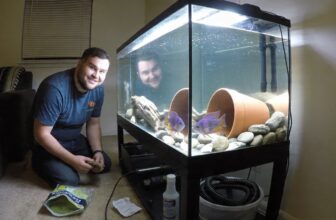
Tiger barb care is easier than you think—these striped bandits actually thrive in basic setups when their social needs are met. A tight-knit school of six (minimum!) in a 20-gallon keeps the peace, though a 40-gallon for twelve virtually eliminates the infamous fin-nipping.
Dial your heater to 77–82°F, keep pH slightly acidic at 6.0–7.0, and plant heavily with Java Fern to break sightlines. Skip the angelfish—long fins are asking for trouble—and lock down that lid; these guys launch when spooked.
Run your filter at double the rated GPH and feed a varied menu weekly. Ready to keep this scaly street gang from turning your tank into a mosh pit?
At A Glance
- Keep six or more tiger barbs to reduce nipping and distribute aggression.
- Use a 20-gallon tank minimum, but 40 gallons offers happier, calmer fish.
- Decorate with live plants, driftwood, and a tight lid to prevent jumping.
- Maintain water temperature at 77-82°F and pH between 6.0-7.0.
- Feed high-quality flakes, pellets, and weekly live or frozen treats.
Why Tiger Barbs Are Perfect for Beginner Aquarists
Since tiger barbs are famously hardy, they make an ideal entry point for new aquarists. These fish tolerate a wide pH range and temperature swings, forgiving beginner mistakes.
Their notorious Tiger Barb aggression is actually manageable in groups of six or more, where they focus on each other instead of tank mates. The fin nipping behavior becomes a playful spectacle, not a problem. Many starter kits include a preset heater that maintains a stable 78°F environment for tropical species.
You’ll belong to the club of owners who watch a darting, jostling school, not a quiet, boring tank. It is a rite of passage, a friendly lesson in fish dynamics.
Bottom line: they teach you without punishing you. For optimal success, choose a larger tank to reduce stress and maintenance frequency.
What You’ll Pay and the Tank Size You Really Need
A 20-gallon tank is the absolute minimum for a group of six tiger barbs, but if you can swing a 40-gallon, your fish will be noticeably happier.
A 20-gallon tank is the bare minimum, but a 40-gallon will make your barbs truly thrive.
The upfront fish cost is just $4.99 each, but tank size is where your wallet feels it—budget for the bigger setup except you enjoy chasing nippy, cramped fish.
- Six fish, 20-gallon tank: $30 fish cost, but expect more squabbling and fin nipping; they’ll survive, not thrive.
- Eight to ten fish, 30-gallon tank: $40–$50 fish cost; a sweet spot for a peaceful, playful school.
- Twelve fish, 40-gallon tank: $60 fish cost; maximum swimming room, minimal aggression, truly happy barbs.
Bottom line: spring for the 40-gallon; your barbs will thank you by not terrorizing each other.
Goldfish produce a heavy bioload requiring strong filtration, which is equally critical for a heavily stocked barb tank to prevent rapid ammonia buildup. For heavier stocking, a filter with a flow rate over 200 GPH helps maintain water quality without stressing sensitive species like neon tetras.
Setting Up a Tank Your Tiger Barbs Will Love
You’ve picked out a tank big enough to keep the peace—now it’s time to turn it into a tiger barb playground. These fish are hyperactive toddlers with stripes, so give them stuff to do.
Start with live plants like Java Fern or Anubias, which are forgiving for beginners. Add a driftwood centerpiece or rock cave for tank decoration. They’ll dart through leaves, chase each other, and claim spots. Skip plastic plants—they’re not fooling anyone.
A tight lid stops jumpers mid-air, whereas a solid filter keeps the water clean. For larger tanks, a pre‑treated root can provide instant hiding spots without tedious boiling. For a dark, dramatic backdrop that enhances their colors, try CaribSea Super Natural Midnight River Sand as a substrate option.
Bottom line: fill it with cover and chaos, and your barbs will thrive.
Ideal Water Temperature, pH, and Hardness for Tiger Barbs
Keeping tiger barbs happy means nailing the water chemistry, since nobody thrives in a swamp.
You want a stable, tropical paradise—not something that slides into chaos.
- Temperature: Keep it between 77–82°F. A heater is non-negotiable; your barbs need warmth, not a cold shoulder.
- pH: Aim for 6.0–7.0. Slightly acidic water mimics their Southeast Asian home, reducing stress and fin-nipping.
- Hardness: Stick to 5–19 dGH. Soft to moderately hard water works fine, but sudden swings? That’s the real villain.
For a breeding tank setup, match these numbers precisely, then dust off the fry diet of baby brine shrimp.
Consistency is your ticket to tiny, striped chaos.
Select a heater with automatic shut‑off to maintain stable temperature and prevent overheating.
Many modern aquarium heaters include dry‑burn prevention to stop heating if water levels drop too low, protecting both the device and your fish.
Heaters and Filters: Essential Gear for Tiger Barbs
Why does gear matter so much for tiger barbs? These fish are like tiny aquatic toddlers—they need stable warmth and clean water to thrive. A submersible heater, 100–200 watts for a 20‑gallon tank, keeps the temperature at 77–82°F. For filtration, a hang‑on‑back model rated for twice your tank volume handles their messy appetites. But here’s the twist: seasoned keepers sometimes use filterless tank setups for breeding, relying on daily water changes. And heaterless breeding tanks work if your room stays above 75°F. Gear isn’t optional, but you can improvise when you know the rules. For precise temperature stability, consider using a digital temperature controller like the Inkbird ITC‑308, which offers remote monitoring and alarms. A motion-sensor thermometer with high-low alarms provides audible alerts if the tank drifts outside the safe range.
| Component | Why It Matters for Tiger Barbs |
|---|---|
| Heater (50–300W) | Maintains 77–82°F; prevents stress and ich outbreaks. |
| HOB Filter | Handles 2x tank volume; keeps water crystal clear. |
| Filterless Setup | Used by pros for breeding; requires daily water changes. |
| Heaterless Breeding Tank | Only works in warm rooms (75°F+); risky for beginners. |
Best Diet: What to Feed (and What to Avoid)
Feed a tiger barb like it’s a tiny, perpetually hungry teenager. These omnivores need variety, not just flakes. Balance is key.
- Staple flakes or pellets daily—high-quality tropical formulas meet basic needs. Feed twice in small amounts, what they eat in 2 minutes. No leftovers. Use an automatic feeder with precision portion control to ensure exactly the right amount is dispensed each time.
- Live or frozen treats weekly—brine shrimp, bloodworms, or daphnia boost color and health. They go nuts for these.
- Plant based supplements—blanched zucchini, spinach, or lettuce twice weekly for fiber. Avoid iceberg; it’s trash.
Use a feeding schedule to prevent overfeeding. Skip long-finned fish snacks (bad tank mates). Stick to this, and they thrive. For a high-quality protein option, consider Fluval Bug Bites tropical fish food for growth and immune support.
How Many Tiger Barbs Should You Keep Together?
Tiger barbs are social fish—they need a posse, not a solo gig. Keep a minimum of six to allow proper aggression management. A larger group size of 10 or more spreads out nippy tendencies and creates a calmer hierarchy.
| Tank Size | Group Size | Aggression Level |
|---|---|---|
| 20 gallons | 6 barbs | Moderate |
| 30 gallons | 8-10 barbs | Low |
| 40 gallons | 10-12 barbs | Very Low |
| 55 gallons | 12-15 barbs | Minimal |
| 75+ gallons | 15+ barbs | Almost none |
Bigger groups mean less picking on each other. It’s like a crowded bus—more seats, fewer fights. Stick with at least eight for the best peace. They’ll school tighter and nip less. Your tank becomes their tribe, not a boxing ring. For a small scale setup, a rimless 10 gallon tank can create a stunning aquascaped home for a small tiger barb school. You will need gentle flow to keep shrimp compatible with the setup.
Tank Mates for Tiger Barbs
Once you’ve got your tiger barb squad of six or more settled in, the next question is who gets to move into the neighborhood with them.
Tank compatibility is key for happiness, and aggression prevention means avoiding fish with long, flowing fins—those become nipping targets.
- Corydoras catfish – Peaceful bottom-dwellers; they keep to themselves, tidy up scraps, and won’t provoke your barbs.
- Zebra danios – Fast and active; their speed lets them dodge any playful chases, matching your barbs’ energy.
- Harlequin rasboras – Small and calm; they stick together in schools, blending into the midwater without drama.
Pick these crew members, and your tank stays a lively, stress-free community.
Using a controller with over‑temperature and sensor‑fault alarms can further protect your delicate community from heater malfunctions.
Always rinse any new gravel thoroughly (at least twice) before adding it to the tank to prevent cloudy tank syndrome and maintain water clarity.
How to Stop Tiger Barb Fin Nipping
Nipping is the tiger barb’s favorite hobby, right up there with darting through plants and bullying slow-moving fish. To stop it, keep a group of at least six—ideally ten or more. This distributes aggression, so no single fish gets picked on.
Provide plenty of hiding spots with plants like Java Fern or Amazon Sword. A breeding setup with dense vegetation mimics their natural environment, reducing stress.
Feed a varied fry diet of live foods and veggies twice daily; hungry barbs nip more. Avoid long-finned tank mates like angelfish. For added protection, consider using a magnetic isolation box to separate aggressive individuals during feeding times.
Bottom line: a large group, ample cover, and consistent feeding curb the nipping habit. Additionally, using a copper-free gel formula like Brightwell Aquatics Shrimp Florin ensures safe nutrient supplementation for plants without harming sensitive invertebrates in the tank.
Tiger Barb Male vs. Female: How to Tell Them Apart
Distinguishing male from female tiger barbs is easier than convincing a solo barb not to nip. Look for these three clues:
- Shape: Females are plumper, rounder—especially when carrying eggs—while males stay slimmer and more streamlined. Think of a torpedo vs. a mini football.
- Color: Males boast brighter orange and deeper red stripes. Females are duller, blending into hiding spots or near algae eaters for safety.
- Fins: Males sport longer, pointier dorsal fins. Females’ fins are shorter and rounded—less showy, but just as hardy.
Use a fine nylon mesh net to safely handle tiger barbs without damaging their delicate fins during transfer. For precise handling during tank maintenance, consider stainless steel aquarium tweezers to avoid hand fatigue while repositioning plants or feeding.
Tiger Barb Lifespan: Key Influences
A lucky tiger barb can clock seven years in a well-kept tank—that’s a solid retirement if you ask them. But lifespan isn’t guaranteed; it’s a three‑legged stool. Genetic factors lay the foundation—some fish are just born tougher.
Then, diet quality steps up; feed them cheap flakes, and you’re robbing years. High‑quality pellets, plus weekly brine shrimp or blanched zucchini, keep them thriving.
Stable water and a 20‑gallon minimum for a six‑fish shoal seal the deal. Skip any leg, and that seven‑year dream becomes a three‑year cautionary tale. Adding a product like FritzZyme 7 can help maintain stable water by converting toxic ammonia into safer compounds, supporting the biological filtration in your tank. To ensure water quality, routine monitoring with ammonia test kits is recommended at least twice weekly for healthy fishkeeping.
Common Diseases: Ich, Fin Rot, Velvet, and Swim Bladder
When your tiger barbs suddenly look like they’ve been rolling in powdered sugar, that’s ich—a parasitic nightmare that’s as common as it is treatable. Spotting these diseases early keeps your school thriving.
- Ich: Tiny white dots, frantic scratching, and loss of appetite—crank up the heat and add meds; your barbs will bounce back.
- Fin Rot: Frayed, discolored fins paired with lethargy and behavioral changes—clean water and API Fin & Body Cure do the trick.
- Swim Bladder: Floating sideways or sinking like a rock—fast for a day, then feed blanched peas; genetic variations can make some fish prone.
Catch these early, and your crew stays tight.
For precise monitoring during treatment, regular testing with ±5% lab-grade precision helps catch nitrate spikes before they stress your fish.
Do Tiger Barbs Need Warm Water or a Bubbler?
Since tiger barbs are tropical fish, heating isn’t optional—it’s a survival need, not just a comfort feature. They thrive in warm water between 77-82°F, mimicking their Southeast Asian home. Stray outside that range, and expect sluggish, stressed fish. Adding a quartz sleeve ensures a heater’s safety shield prevents accidental burns or temperature spikes.
An air bubbler? Not strictly required, but highly recommended. It boosts oxygen levels, especially in a stocked 20-gallon tank where these active swimmers zoom around. Think of a bubbler as insurance against low oxygen, not a luxury.
For a happy school of six or more, budget $15-30 for a reliable heater and $10 for a simple air bubbler. Keep parameters stable, your barbs will reward you. A quality light riser like the Fluval 3D-printed model provides uniform illumination to support healthy plant growth and reduce algae alongside your heater and bubbler.
How to Breed Tiger Barbs in Your Home Aquarium
Breeding tiger barbs at home is like hosting a chaotic family reunion—unpredictable but oddly rewarding.
You’ll need a separate 30-gallon tank with fine-leaved plants, like Java moss, for egg scattering. Keep water at 78°F and pH 6.5. The adults will eat the eggs, so remove them after spawning. Adding Water Spangles as floating plants can create natural shade and reduce algae in the breeding tank.
- Set up a spawning mop—a bundle of yarn or plants—to catch the eggs.
- Feed the fry a specialized fry diet of infusoria or liquid food for the first week.
- Switch to baby brine shrimp after they’re free-swimming, feeding small amounts five times daily.
To support fry development, adding a Cryptocoryne Parva tissue culture cup provides a sterile foreground plant that tolerates low light in the breeding tank.
Why You Shouldn’t Keep a Single Tiger Barb
A single tiger barb’s stress levels will spike faster than a cheap thermometer in a heatwave. Keeping a single barb isn’t just lonely; it’s a recipe for solitary stress. These fish rely on group dynamics—it’s a social necessity. Without their school, they become anxious, nippy, and unhealthy.
A 20‑gallon tank fits six, costing about $30 total. Watch them dart together, establishing hierarchy, and you’ll see why a solo fish sulks. Skip the solo act. Get at least six; your tank stays calmer, your wallet stays lighter, and your barb stays sane.
Bottom line: a lone barb is a stressed barb—don’t do it. For optimal water quality in a school of six, choose a filter with adequate flow like the VILLNO 130 GPH model. This filter’s adjustable flow via a knob allows you to fine-tune circulation for your school’s comfort.
Frequently Asked Questions
Do Tiger Barbs Jump Out of the Tank?
Yes, tiger barbs do jump, so a tank lid is non‑negotiable. They’re active swimmers that sometimes launch themselves at the water surface during feeding or play.
A tight‑fitting lid prevents escape and injury.
- 20‑gallon minimum? Still needs a secure cover.
- Hinged or sliding lid works, just seal gaps.
No lid means risky business—literally. Keep the top covered, your water surface contained, and your fish safe. Easy fix, big peace of mind.
How Fast Do Tiger Barbs Grow?
Tiger barbs grow at a steady, unremarkable pace. Picture a new fish, one inch long, taking a full two years to reach its maximum size of three inches. This growth rate depends on water quality, diet, and tank size.
These fish rarely exceed that size potential, so don’t expect a monster. A 20-gallon tank, well-maintained, supports their slow, predictable growth. It’s a calm, gradual process; they won’t outgrow your setup overnight.
Can Tiger Barbs Breed in a Community Tank?
Yes, but it’s risky. Tiger barbs can breed in a community tank, but egg survival plummets. Breeding triggers like temperature shifts and frequent water changes encourage spawning, but adults and other fish see eggs as a snack. Without a separate breeding tank, most eggs vanish fast.
- Low egg survival in a community setup.
- Other fish eat eggs and fry.
- Breeding triggers easier in a dedicated tank.
Bottom line: A 30-gallon breeding tank with plants boosts success. For a casual try, expect losses. For real results, isolate the spawners.
What Vegetables Are Safe to Feed Tiger Barbs?
Yes, tiger barbs enjoy several safe vegetables. Offer blanched spinach, softened first in hot water—think of it as veggie sushi for fish.
They’ll additionally graze on green algae wafers, a solid staple for their omnivore diets. Other hits include zucchini and cucumber slices.
Prep them soft, sink them in, and watch the crew devour them within minutes. Remove leftovers to keep the tank clean.
Simple, nutritious, and a great way to bond with your school. Stick with blanched veggies for easy, healthy treats.
Do Tiger Barbs Sleep at the Bottom of the Tank?
Yes, tiger barbs do sleep at the bottom of the tank—or in sheltered spots near tank decorations.
They lack eyelids, so it’s subtle; they just rest, becoming less active.
Stable water parameters (77-82°F, pH 6.0-7.0) help them relax safely.
You want a peaceful, tight-knit school? Provide hiding plants and a quiet corner. It’s their recharge mode, not a cause for alarm.
Bottom line: expect this normal behavior, and your barbs will feel like part of the crew.
Rounding Up
Keeping them is like hosting a party for rowdy toddlers—they need numbers to behave. A single barb turns into a fin-nipping terror. So, grab five friends for your three-inch torpedo, drop $40 on a 20-gallon tank, and call it done.
They’re forgiving, cheap, and active. Just don’t slack on water changes, or ich bites back.