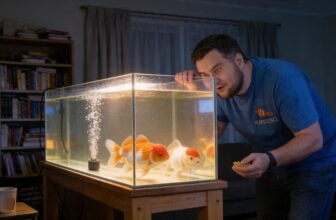
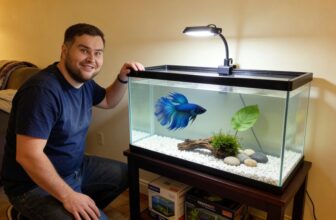
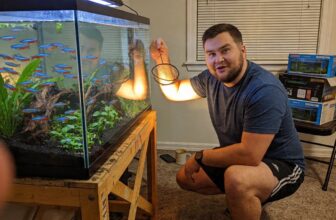
Ember tetra care is straightforward, but getting the basics right separates thriving schools from dull, stressed fish. These tiny flame-colored swimmers are hardy, peaceful, and forgiving—ideal for beginners testing their first planted tank.
A 10-gallon setup ($30–$50) comfortably houses six to ten ember tetras. Never keep fewer; lone fish fade and hide, losing that brilliant orange glow that makes them special.
Stable water matters more than chasing perfect numbers. Aim for pH around 6.5, temperature near 78°F, and ammonia below 0.25 ppm. Gentle filtration under 210 GPH, soft sand substrate, and driftwood complete their preferred blackwater aesthetic.
Feed quality flakes supplemented with daphnia twice weekly. With proper care, expect 2–3 years of active schooling behavior.
Master these fundamentals first. The deeper nuances—breeding triggers, tankmate compatibility, and aquascaping—follow naturally once your embers settle in.
At A Glance
- Keep a school of 6–10 ember tetras to prevent stress and faded colors.
- Use a 10-gallon tank minimum with a gentle filter and 78°F heater.
- Mimic blackwater with driftwood and Indian almond leaves for pH 6.0–7.0.
- Feed varied diet: quality flakes, live daphnia, and spirulina wafers twice daily.
- Add a separate breeding tank with Java moss and two males per female.
Why Are These Tiny Fish Perfect for Beginners?
Ember Tetras are widely considered one of the best starter fish for a reason: they’re nearly impossible to mess up.
Their behavior patterns are refreshingly simple—they glide in loose, peaceful shoals, never schooling tightly.
You’ll spot stress signs quickly: faded colors, hiding constantly, or frantic darting. But with a clean, planted tank and six buddies, that’s rare.
These tiny fish just want calm water, warm temps, and gentle company.
If you can avoid overfeeding and do weekly water changes, you’re in.
Seriously, they’re the starter fish that actually let you feel like you know what you’re doing.
A 10-gallon tank with dimensions of 20 × 10 × 12 inches provides an ideal stable environment for a small shoal of these fish.
For optimal visibility and plant growth, choose a tank with ultra-clear glass to enhance their natural coloration.
Tank Size, Cost, and Lifespan: What to Know Before Buying
Before you even think about bringing home a school of these fiery little jewels, you need to square away the three practical starting points: tank size, cost, and lifespan. A 10-gallon tank is the minimum for a group of six to eight, costing around $30–$50. Each fish runs $3–$5, and they live two to three years. That’s a modest investment for a vivid payoff. To maintain clear water and stable conditions, pair your setup with a filter rated for around 80 GPH of flow. Selecting a model with dual‑sided mesh helps capture debris before it recirculates.
| Aspect | Key Detail |
|---|---|
| Tank Size | 10 gallons minimum, horizontal shape |
| Cost | $3–$5 per fish, tank $30–$50 |
| Lifespan | 2–3 years with stable care |
For Community Tank Ideas, pair them with peaceful species. Follow Feeding Schedule Tips: small portions twice daily. Get the basics right, and you’re part of the club.
Set Up the Ideal 10-Gallon Tank for Ember Tetras
A 10-gallon tank is the right starting line for a small school of Ember Tetras—think of it as a studio apartment for six to eight fish, offering just enough room to swim without feeling cramped.
A 10-gallon tank is a studio apartment for six to eight Ember Tetras, offering just enough room.
For ideal filtration, choose a gentle hang-on-back or sponge filter to avoid strong currents, as these models use dense foam to trap debris and support beneficial bacteria without sucking in fry or delicate shrimp. For tanks with live plants, a fine pore density pad like the Pawfly option captures microscopic particles and enhances water clarity without reducing beneficial bacteria.
- Add a 50-watt heater near the filter for even warmth.
- Use soft gravel or sand, at least one inch deep.
- Include live plants like Java Moss for hiding spots.
- Perform weekly 25% water changes for nitrate control.
Keep ammonia and nitrite at zero.
You’ve got this.
Recreate Blackwater With Driftwood and Soft Plants
Blackwater isn’t just a fancy aquarium term—it’s the natural jungle juice these fish evolved in, and replicating it takes two key ingredients: driftwood and soft plants. For nano setups, small‑tank driftwood like flat pieces under 3 inches prevents overwhelming the scape while allowing biofilm growth. Driftwood slowly releases tannins, staining the water that amber hue whilst lowering pH. Aim for at least one inch of substrate depth—sand works best—to anchor your plant selection. Choose soft, low-light species like Java Moss or Anubias; they thrive without CO2 injection. For a gentle background foliage option, consider Java Fern which thrives under 20‑40 lux light. This setup mimics their wild home, reducing stress and boosting color. Your embers will thank you by schooling confidently, not hiding nervously.
Best Plants and Decor for a Thriving Ember Tetra Aquarium
The finest decoration strategy for Ember Tetras combines dense, soft-leaved plants with smooth, tannin-rich driftwood—their natural habitat boiled down to aquarium fundamentals.
A brilliant color display happens when you create shade zones for them.
- Java Moss: Cheap carpet or wall cover, great for hiding.
- Anubias: Broad leaves for resting; tie it to wood.
- Java Fern: Tough, low-light, long leaves to swim through.
- Driftwood: Adds tannins, creates caves and shade zones.
These choices make your tank both a home and a stage.
Stick to soft, smooth materials—no sharp edges that catch delicate fins.
Your tetras will thank you by glowing.
For example, natural driftwood also supports beneficial bacteria and adds realistic texture to the aquascape.
A background featuring a realistic seaweed scene can enhance their natural hiding behavior by providing visual depth and shade zones.
Water Parameters: The Exact Numbers They Need
Set the heater to 78°F, keep the pH at 6.5, and watch your Ember Tetras glow. They come from Blackwater specifics—soft, acidic water stained by leaves. Your mission, should you choose to accept it: stable temps and low hardness. Use a quality conditioner that handles chlorine and chloramine reliably to protect their delicate slime coats during water changes.
| Parameter | Ideal Range | Why It Matters |
|---|---|---|
| Temperature | 73–84°F | Active metabolism, immune support |
| pH | 6.0–7.0 | Mimics native Amazon streams |
| Hardness | 3–15 dGH | Prevents stress and fin damage |
For pH buffering, driftwood and almond leaves do the trick—no fancy chemicals needed. If you need to raise pH for a different setup, Seachem Acid Buffer can lower pH quickly for soft-water environments. These numbers aren’t just guidelines; they’re your ticket to a thriving, glowing school. No fuss, just consistency.
How to Cycle and Keep Water Clean
Before that heater goes in and those fish hit the water, there’s a mandatory step most beginners skip: cycling the tank. This builds beneficial bacteria to break down waste.
- Add an ammonia source daily (fish food or pure ammonia) to feed bacteria. Ammonia control is crucial.
- Test water weekly for ammonia, nitrite, and nitrate using a liquid kit (API Master, around $35). You’re waiting for zero ammonia and nitrite. Use CE ISO certified 7-in-1 test strips for broader daily parameter checks if you prefer a faster method.
- Use plants like Java Moss for natural filtration and Substrate cycling bacteria help via gravel. Adding a drop checker helps visually confirm when CO₂ levels are balanced for plant growth.
- After 4-6 weeks, add your Ember Tetras once parameters are stable.
Bottom line: cycle first, or you’ll kill fish. It’s boring but mandatory.
Pick the Right Filter and Heater for a Small Aquarium
For a 10- to 20-gallon Ember Tetra tank, the filter choice boils down to two solid options: a hang-on-back (HOB) like the Aqueon QuietFlow 10 LED PRO (around $25) or a sponge filter for gentler flow in breeding setups.
You want a filter flow rate that doesn’t blow these tiny fish around—they’re delicate swimmers. The HOB is your default; it’s reliable and easy. Many HOBs under 210 GPH, like the NICREW Slim, feature adjustable flow knobs to fine-tune current for delicate swimmers. For quieter operation, models like the Tetra Whisper IQ operate below 30 dB at arm’s length.
For heater placement, put a 50-watt unit (like the Tetra HT) near the filter’s outflow. This spreads warmth evenly, preventing cold spots and stressed fish.
Bottom line: stick with the HOB for daily tanks, but the sponge filter wins for breeding—less current, more safety.
Ember Tetra Diet: What to Feed and How Often
Once the tank is filtered and heated right, the next question is what to put in the fish. Ember Tetras are easygoing omnivores, so feeding them is simple—just don’t overcomplicate it.
- Staple flake: High-quality tropical flakes cover their protein and plant needs.
- Flake alternatives: Offer freeze-dried daphnia or bloodworms for variety; they go crazy for these.
- Algae supplement: Add spirulina-based wafers or pellets; it mimics their wild plant intake and boosts color.
- Frequency: Feed once or twice daily, only what they eat in two minutes. Overfeeding dirties water fast.
Keep it consistent, and they’ll reward you with fiery activity. You’ve got this.
For example, TetraColor Tropical Fish Food Flakes provide antioxidants and prebiotics for immune health and natural color vibrancy. For planted tanks raising dwarf shrimp, Seachem Flourish supplies iron and trace elements to support plant health and proper shrimp molting.
How to Tell Males and Females Apart
Spot the difference between an Ember Tetra boy and girl—it’s not as tricky as finding a decent parking spot.
Males flaunt brighter, deep red-orange colors, sleek bodies, and slightly larger Fin size. They’re active, darting around in Male courtship displays to impress females.
Females appear paler, with rounder bellies for carrying eggs, and their Female behavior is calmer, swimming peacefully.
Watch for these clues: males show off, females chill out. It’s that simple—no guesswork needed. You’ll spot the pair quickly, feeling like part of the know.
Breeding Ember Tetras: Step-by-Step for Home Aquarists
Breeding Ember Tetras is easier than convincing a cat to take a bath—but it does require some setup.
You’ll need a separate breeding tank, softly filtered, with a consistent Lighting schedule to simulate dawn and dusk—12 hours on, 12 off. Keep water hardness low, around 3 dGH, and pH at 6.0–6.5. Using a timer like the Hygger 24-hour natural cycle can automate these phases for consistent daily rhythm. For reliable spectral control, an option like the FZONE Bluetooth avoids dropouts in challenging locations.
Here’s your step‑by‑step:
- Condition breeders with live brine shrimp for a week.
- Introduce two males per female into the spawning tank.
- Provide Java Moss for egg deposition.
- Remove adults after spawning; eggs hatch in three days.
You’ve got this—your future fry will thank you.
Best Tank Mates for a Peaceful Community
If your breeding project succeeds, you’ll have a tank full of tiny embers that need friends—not fry, but adult tank mates.
For a peaceful community, think nano stocking: pygmy corydoras, otocinclus, or chili rasboras. They’re small, calm, and won’t bully your embers.
For a peaceful community, think nano stocking: pygmy corydoras, otocinclus, or chili rasboras.
Floating plants, like frogbit or water lettuce, break sightlines and reduce stress. Avoid big fish; a bristlenose pleco works if you have a 20-gallon.
Guppies and neon tetras are fine, but watch for fin-nipping.
Bottom line: keep it small, keep it planted, and your embers will thrive.
Adding FijiCube baffles to your sump helps maintain steady flow and reduces noise for a more peaceful community tank. Using soft PVC leaves in your setup prevents fin damage and keeps the aquarium safe for delicate species.
Common Diseases and Prevention Tips
Albeit hardy little fish can get sick, most issues come from stress or poor water. Keep their home stable and they’ll reward you.
- Maintain stable water parameters – Test weekly for ammonia, nitrite, and nitrate. Sudden swings in Water hardness or pH stress them, inviting disease. Using a kit designed for weekly pond monitoring helps catch shifts before they cause harm.
- Quarantine new fish – Always isolate newcomers for two weeks. It’s a boring chore, but beats a tank wipeout.
- Feed a varied diet – Mix flakes with live brine shrimp or daphnia. Healthy fish fight off infections better.
- Match the Breeding group ratio – Two males per female reduces aggression and breeding stress, keeping the group calm and resilient.
Bottom line: Clean water and smart group management prevent most problems.
For accurate readings, test at least twice per week using a high-count strip kit to ensure ammonia stays below 0.25 ppm and avoid temperature-related drift.
Why Do They Need a Group of 6 to 10 (or More)?
Schooling fish like Ember Tetras don’t do well alone, no matter how nice their tank looks.
In shoals of six to ten or more, a natural group hierarchy emerges, reducing stress and bullying; a lone tetra hides constantly, fading to pale orange.
In shoals of six or more, hierarchy emerges, reducing stress and bullying.
Proper shoal spacing lets them swim freely, not clustered in fear—think a dozen at $2.99 each for $35.88 total.
Without that critical mass, nipping and erratic dashes replace calm exploration, causing disease vulnerability.
Tanks under ten gallons deny that space.
Bottom line: bigger groups mean braver, brighter fish, so skip the solo act—buy nine more.
5 Simple Habits for Long-Term Color and Activity
Three simple daily habits—checking, feeding, and trimming—keep Ember Tetras bright orange and darting around.
Replicating their natural habitat, with blackwater conditions from driftwood and leaf litter, is vital.
Wild feeding behavior means variety; don’t rely on just flakes.
- Mimic blackwater conditions using Indian almond leaves to lower pH.
- Feed live or frozen foods like daphnia twice weekly to mirror wild diets.
- Maintain stable water temperature at 78°F with a reliable heater, such as the Fluval E 300W for premium precision and safety. Use digital thermometers to verify the temperature accurately each day.
- Trim plants weekly to prevent dead spots where stress can hide.
These four habits, done daily, keep them active.
Your tank becomes their home.
Frequently Asked Questions
Can Ember Tetras Live in a 5-Gallon Tank?
No, a 5-gallon tank is too small. Ember tetra minimum group size is 6–10 fish for proper social behavior, and they need swimming room.
Nano tank filtration works fine for a 10-gallon setup, but cramming these active swimmers into a 5-gallon is like putting a school bus in a garage—technically possible, but nobody’s happy.
A 10-gallon with a hang-on-back filter and heater is the bare minimum.
Bottom line: skip the 5-gallon for embers; it’s a recipe for stress and nippy fish.
Are Ember Tetras Compatible With Cherry Shrimp?
Like fish and shrimp sharing a peaceful pond, ember tetras and cherry shrimp are compatible tank mates—with caveats. Predation risk exists, as tetras may eat tiny shrimp fry, but adults are usually safe.
Water parameters align perfectly: pH 6.0-7.0, temp 73-84°F. Provide dense plants like Java Moss for shrimp hiding spots.
For a thriving community, a 10-gallon tank with both species works, just avoid hungry tetras during breeding.
Bottom line: yes, it works, but watch for snack-sized shrimp.
Do Ember Tetras Need a Light Cycle in Their Tank?
Yes, ember tetras need a light cycle, about 8-10 hours daily, to mimic their Amazon blackwater habitat. This regulates Ember tetra behavior, encouraging natural activity and rest. A timer (like $15 for a basic model) is cheap insurance.
Light spectrum effects matter, too; avoid intense blues, which stress them, and go for warm, plant-friendly LEDs that boost their reddish-orange glow. Without a cycle, you risk skittish fish and algae blooms—so, set it and forget it.
Bottom line: a consistent, dim schedule keeps them happy.
Can Ember Tetras Jump Out of the Aquarium?
Yes, ember tetras can and do jump out. One surprising fact: a stressed ember tetra can launch itself over three inches—nearly four times its body length.
An aquarium lid is non‑negotiable; it prevents tragic midnight escapes. Additionally consider tank height—shorter tanks increase jump‑out risk since less water dampens their leap.
A snug lid, a little plant cover, and these fiery acrobats stay safe. It’s a simple fix that every group‑keeping hobbyist owes their clan.
How Often Should You Replace Their Filter Media?
Sponge maintenance should happen every 4-6 weeks, but only by rinsing it in tank water you’ve siphoned out.
Carbon replacement is different—that gets swapped every 3-4 weeks, since it stops working once it’s full of gunk.
Filter media isn’t replaced all at once; that crashes the good bacteria.
Just squeeze the sponge, toss the carbon, and call it clean.
Simple, right?
Rounding Up
So, you’ve got your ten-gallon, your driftwood, and a shoal of six to ten. You’re following the five habits. But then—one morning—you’ll notice their color deepening to a near-glowing ember, their tiny bodies flaring in a shimmer you’ve never seen. That’s the quiet payoff. It’s not hype; it’s biology clicking into place. Keep the water soft, the group tight, and the leaves decaying just so. Bottom line: nail the blackwater basics, and these fish will do the rest.