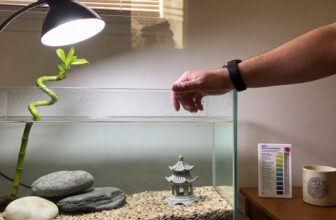
You’re getting a solid “yes, but…” here. Harlequin rasboras forgive pH swings that’d wreck fancier fish, school beautifully in groups of eight to ten, and run about $3 a pop—cheaper than your latte, honestly.
They top out around two inches, live five to eight years (record holders push past that), and need gentle filtration, dim lights, plus a lid those copper-and-black acrobats can’t breach.
Skip the ten-gallon “starter” trap; twenty gallons minimum for proper schooling, thirty if you want community tank drama.
Keep nitrates under 20 ppm, temperature steady at 72–81°F, and you’ll have shimmering copper wedges patrolling your plants for years.
Nail the cycle first—no shortcuts—or you’re just hosting an expensive lesson in water chemistry.
Stick around and you’ll crack the code on everything from fry-raising secrets to why your supposedly “friendly” fish won’t stop playing hide-and-seek.
At A Glance
- Keep six to ten rasboras together to form a confident, colorful school with natural behavior.
- Maintain stable water: pH 6.0–7.8, 72–81°F, gentle flow, and nitrates below 20 ppm.
- Provide dim lighting, dark substrate, and dense plants like Java fern and Cryptocoryne.
- Feed small pinches twice daily, rotating flakes with frozen bloodworms or baby brine shrimp.
- Quarantine new fish four weeks and monitor for Ich, Velvet, and fin rot weekly.
Are Harlequin Rasboras Right for You? 5 Beginner-Friendly Traits
If you’re staring at your empty tank wondering what won’t die on you immediately, Harlequin Rasboras are the fish equivalent of a reliable used car—nothing flashy, but they start every time.
You’ll appreciate their bre coloring—that copper-orange patch with a black wedge—popping against dark tank décor like driftwood and Cryptocoryne. They’re forgiving, tolerating pH swings that’d kill pickier fish. They school when you keep six or more, turning your water into a living shimmer. They eat whatever flakes you grab at the pet store, no gourmet prep required. They also thrive with gentle filtration to avoid stressing them with strong currents.
Bottom line: cheap, pretty, and they won’t judge your beginner mistakes.
How Big Do Harlequin Rasboras Get and How Long Do They Live?
Their reliability is nice, but let’s talk about the actual hardware you’re working with here.
Harlequin rasboras don’t need much space—you’re looking at two inches, max. A male hits that full size size with his sharper markings, whereas females chill around an inch and a half. In a good home? You’ll get five to eight years of life from these little guys. That’s a solid lifespan for a budget fish.
| Trait | What You Get |
|---|---|
| Adult size size (male) | ~2 inches |
| Adult size size (female) | 1–1.5 inches |
| Minimum tank | 10 gallons |
| Typical lifespan | 5–8 years |
| Record keepers’ wins | 8+ years, documented |
They’re small, certainly, but they punch above their weight in staying power—just don’t cram them into a coffee cup, and you’ll be fine. Red eye tetras can leap out of tanks, so a tight-fitting lid is essential for preventing escapes.
Group Size: Why 6 Is the Minimum and 10 Is Ideal
Since Harlequin rasboras evolved as safety-in-numbers kind of fish, you’ll want to skip the lonely impulse buy and commit to at least six from day one—anything less and you’re basically running a fish witness protection program, which, spoiler alert, fails.
School dynamics kick in at six, indeed, but you’ll really see the magic at ten. That’s when they form tight, shimmering formations, darting through plants like synchronized swimmers who actually know their routine. Stress reduction happens naturally—more eyes watching for predators means each fish chills out, colors pop, and nobody hides in corners sulking. Think of it as buying confidence in bulk. When securing plants or decorations for your rasbora tank, always choose reef‑safe adhesives to ensure no harmful chemicals leach into the water.
Bottom line: six keeps them alive, ten lets them thrive.
Tank Size: How Much Space Your School Actually Needs
Ten gallons gets you in the door, but let’s be honest, that’s apartment-living for a school of fish that’d really prefer a backyard. You really want twenty gallons, minimum, for eight to ten rasboras—give them room to weave through Tank décor like driftwood and Cryptocoryne without bumping noses. Water flow matters too: gentle, like their native streams, not a firehose from your filter. Too strong, you’ll stress them; too stagnant, they get sluggish. You can even find 5‑gal mid‑size models with self-cleaning filters and quiet pumps for a separate quarantine tank that won’t disturb the main setup.
| Tank Size | Best For |
|---|---|
| 10 gal | Emergency quarantine, or you’re testing the waters |
| 20 gal | A proper school of 8-10, stable parameters |
| 30+ gal | Community tank, breeding projects, peace of mind |
| 40+ gal | You’re committed, possibly obsessed, and that’s okay |
Bottom line: skip the sardine can, spring for twenty gallons, and watch your rasboras school like they actually enjoy each other’s company.
Water Parameters That Keep Harlequin Rasboras Thriving
Even if you think these little guys could tough out whatever tap water you’ve got, Harlequin Rasboras actually do best when you dial in the details—they’re forgiving, not foolish. You need pH stability in that 6.0–7.8 sweet spot, not wild swings that stress their systems. Watch your hardness range too, keeping it 2–15 dGH, since your p source probably fluctuates more than you’d expect. Here’s your hit list:
Harlequin Rasboras are forgiving, not foolish—dial in pH stability and hardness, or you’ll stress their systems.
- Keep temperature fluctuations minimal, 72–72–81°F steady, or you’ll have sluggish, pale fish
- Monitor nitrate levels weekly—below 20 ppm keeps them lively
- Manage lighting intensity and water flow together; dimmer means less algae control headaches
Substrate dynamics affect chemistry subtly, so don’t ignore that gravel. Skip carbon filtration long-term, it strips minerals they need. For precise monitoring, consider a digital pH meter to catch subtle shifts before they stress your rasboras.
Filters, Heaters, and Lighting: Equipment That Actually Matters
If you’re going to spend money on gear, spend it where it actually changes your fish’s day-to-day, not where it just looks impressive sitting in your cart.
Skip the fancy stuff. Start here.
Filters
- Quiet adjustable flow matters more than gallons-per-hour bragging rights
- You’re cleaning this thing monthly, so don’t make filter maintenance a wrestling match
- Sponge inserts: cheap, effective, toss-and-replace
- For fine particle removal, consider a 100-micron filter pad to polish water to crystal clarity.
Heaters
Heater selection is where rookies sink money into disappointment. Get 5 watts per gallon, minimum. Fifty watts for your ten-gallon. Nothing fancy—nothing fancy, just reliable. Check it with a thermometer weekly because trusting the dial alone is gambling.
Lighting
Dim. Remember, these fish live under tree canopy. Bright lights stress them; you want behavior, not washed-out fish hiding in corners.
Bottom line: Spend smart, not big.
Sand, Plants, and Hiding Spots: Building the Right Bottom Layer
Bottom layer setup makes or breaks your rasbora’s confidence in the tank, so let’s get it right before you’ve got a dozen tiny fish questioning your life choices.
Choose a soft, dark substrate—fine gravel or sand, about $15-20 for a 10-gallon layer. Your harlequins, you see, love sifting through it, hunting stray bits of food like tiny aquatic Roombas.
Plant density matters more than you’d think. Sparse tanks stress these guys, dense jungles thrill them. Aim for moderately heavy coverage. Here’s what works:
- Java Fern and Anubias anchor to rocks, no root tabs needed
- Cryptocoryne fills mid‑ground gaps beautifully
- Java Moss creates perfect spawning carpet, hides fry
Add driftwood, maybe some smooth river stones. You’re building a neighborhood, not a parking lot—give ’em places to dart, lounge, and feel safe. A clear mesh cover helps maintain high light transmission for plants while preventing jumpers. Your rasboras will reward you with tight, shimmering schools, and honestly, that’s the whole point, isn’t it?
Male vs. Female Harlequin Rasboras: Spotting the Difference
How exactly do you tell whether your rasbora’s a dude or a dudette? Sexual dimorphism isn’t dramatic here, but you’ll spot it if you look.
Males hit about two inches, sporting a sharper, larger black wedge and—here’s the kicker—color intensity differences that’ll make you do a double-take. That reddish-orange stripe? It’s practically glowing. They’re also the show-offs, chasing each other like they own the place.
Males max out at two inches with a razor-sharp black wedge and neon-red stripes—true show-offs that chase and flare like they own the tank.
Females stay smaller, around one to one-and-a-half inches, with rounder bellies and a subdued, brownish palette. Calmer, too. They school like pros while the boys posture.
Check those fins during feeding—active males flare, females munch peacefully. Once you know, you can’t unsee it.
These behaviors can be better observed when the fish are kept in a balanced group of five to six individuals, as natural schooling and social dynamics help highlight gender-specific traits.
What to Feed Harlequin Rasboras: Daily Diet and Treats
Let’s get one thing1 straight: these little fish aren’t food snobs, and that’s refreshing in a hobby where some species treat mealtime like a Michelin inspection.
Your feeding frequency needs to hit twice daily—small pinches, two minutes to finish, no buffet leftovers sinking into gravel.
For treat variety, rotate these protein bursts weekly:
- Frozen bloodworms (high-protein, color pop)
- Live baby brine shrimp (hunting instinct activated)
- Blanching vegetables (zucchini coins, once monthly)
Skip the “just flakes” guilt trip. You’ve got this—mix it up, watch them shimmer, and feel like the fishkeeping insider you’re becoming.
Consider that emergency liquid neutralizers can instantly bind ammonia spikes from uneaten food or overstocking.
Common Harlequin Rasbora Diseases and How to Prevent Them
You can’t fatten fish without somewhere for that food to go, and unfortunately, the same tank that turns pellets into energy can turn into a petri dish if you’re not paying attention.
Watch for disease symptoms: Ich, those tiny white salt grains, or Velvet, like someone dusted your fish with gold powder—both love stressed, crowded fish.
Fin rot and Columnaris (fuzzy white patches, basically fish mold) strike when water slips.
Here’s your shield: strict quarantine protocol. New fish? Four weeks minimum, separate tank, no exceptions. Test weekly with a 7-in-1 test kit ($35 kit, cheaper than replacing your whole school). Keep temps steady, 72-81°F, and don’t overfeed—uneaten food rots fast.
Bottom line: Prevention beats cure. Harlequins are hardy, but they’re counting on you.
Tank Mates That Get Along With Harlequin Rasboras
Since you’ve got your water parameters locked down and your harlequins settled in, it’s time to play matchmaker—but not the awkward dinner-party kind, the kind where nobody gets eaten.
You’re building community compatibility, choosing friends who’ll school alongside your harlequins without fin-nipping drama.
Your compatible tank design hinges on peaceful neighbors who share similar water preferences and won’t mistake those coppery triangles for snacks.
Stick to these proven companions:
- Neon tetras – they’ll flash blue-red beside your orange harlequins, like living confetti.
- Corydoras catfish – gentle bottom-dwellers who clean up scraps, zero aggression.
- Cherry shrimp – tiny, colorful cleanup crew, cheap at $2-3 each, plus they’re fun to watch.
Avoid bettas, large cichlids, and anything with a mouth bigger than your harlequin’s body.
You’ve got this.
How to Breed Harlequin Rasboras Successfully
Breeding harlequin rasboras isn’t rocket science, though you’ll need more patience than a parent waiting for their teenager to clean their room.
You’ll want a dedicated 10‑gallon tank, soft substrate, and dense Java moss or Hornwort for egg scattering.
Here is your game plan:
- Conditioning: feed live brine shrimp or daphnia, raise temperature to 78‑80°F
- Breeding strategies: add a mesh mop or spawning mop (think yarn tied to a rock) to protect eggs from hungry parents
- Fry survival: remove adults immediately after spawning, or they’ll snack on their own eggs
Bottom line: these fish spawn at dawn, scatter 6‑12 eggs per batch, and with proper egg protection, you’ll see wrigglers in 2‑3 days.
Skip this step, and you’re just feeding expensive fish food to the parents.
How to Raise Harlequin Rasbora Fry
Once your harlequin rasbora fry hatch, you’re basically running a tiny daycare for fish that can’t see, can’t swim straight, and think breathing is an extreme sport. You’ve earned this, though—successful breeding means commitment.
Running a tiny daycare for fish that can’t see, can’t swim straight, and think breathing is an extreme sport.
Your fry diet makes or breaks survival. Here’s what actually works:
- Start with infusoria or liquid fry food—they’re too small for anything else
- Graduate to microworms or newly hatched brine shrimp after 3-4 days
- Feed 3-4 times daily—tiny stomachs empty fast
Keep water pristine; they’re fragile. Java moss helps them hide and snack on microorganisms.
Bottom line: overfeed slightly rather than starve them.
Why Are My Harlequin Rasboras Hiding? Behavior Troubleshooting
Harlequin rasboras that vanish into the decor like tiny aquatic ninjas usually aren’t being dramatic—they’re telling you something’s off, and you’ve got to play detective before your fish turn into expensive Java moss decorations.
Stress hiding kicks in fast. Check your lighting—too bright triggers their stress response. Aggressive tank mates? That’s a hard no. Food competition pushes timid ones to the margins. Excessive water flow exhausts them, as temperature spikes send them scrambling for cover. Wrong substrate type? They’ll find the darkest corner.
Watch for breeding signals (yes, they hide then, too). But if everyone’s cowering, suspect a disease outbreak brewing.
Frequently Asked Questions
Do Harlequin Rasboras Jump Out of Tanks?
Harlequin rasboras show minimal tank jump behavior, but you’ll still want a secure lid—better safe than fishing your fish off the floor. Their habitat preference leans toward slow, shaded streams, so they’re not built for aerial escape.
Nonetheless, sudden flashes of light or aggressive tankmates can spook them into leaping. Keep water levels slightly lowered, use a snug-fitting hood, and you’ll avoid the classic *oops, where’d he go?* moment.
Peace of mind costs nothing; a lid runs about $10-15. Worth it.
Can Harlequin Rasboras Live Without Live Plants?
Yes, they can live without live plants, like a fishbowl exists without character—functional but forgettable.
You’ll need solid plant diversity strategies to compensate: driftwood, rocks, silk plants, or leaf litter create cover and visual barriers. Substrate selection matters more here—soft sand or fine gravel lets them sift and probe naturally. They won’t sulk in a bare tank, yet they’d definitely notice.
- Silk plants: $8–$15, zero maintenance
- Driftwood: $12–$25, tannins soften water
- Leaf litter: $5, mimics natural streams
Bottom line: skip the plants if you must, but give them something—anything—to break up that empty water column. They’ll thank you with actual schooling behavior, not that sad, scattered drifting fish do when exposed.
Are Harlequin Rasboras Sensitive to Light Changes?
They’re moderately sensitive. Your harlequins show real behavior sensitivity to aquarium lighting—too bright, and they’ll huddle in corners like you forgot the coffee maker.
- Dim lighting mimics their shaded stream homes
- Sudden switches stress them; use timers ($12-15 on Amazon)
- They’re not divas, but they’ll sulk under harsh LEDs
You’ve got options: dimmable fixtures, floating plants, or just don’t blast them with stadium lights. Bottom line: gradual changes, lower intensity, and you’ll see them schooling happily instead of hiding like you told a bad joke at the party.
Do Harlequin Rasboras Recognize Their Owners?
You bet they do. These little swimmers aren’t geniuses, but they’ll figure out who drops the grub.
Harlequin rasboras learn your feeding habits fast—shadow at the tank, lid pops, here comes dinner. That’s owner interaction, fish-style. They won’t fetch your slippers, obviously, but they’ll swarm the glass when *you* approach, not random visitors.
- Recognition: pattern-based, not facial
- Trigger: vibration, silhouette, routine
- Limitation: 3-second memory, basically
Bottom line: they know the food-giver. You’ll feel seen, kind of, in a shady-stream dweller way. Close enough.
Can I Keep Just Two Harlequin Rasboras Together?
Don’t keep just two.
Harlequin rasboras need six or more to express natural schooling behavior, and you’ll want a 10‑gallon minimum tank size for that crew. Two fish stress out, hide constantly, and lose their shimmer—that’s the opposite of tank compatibility goals. Feeding frequency stays modest, twice daily, but lonely pairs often ignore food anyway.
Spend the extra $15‑$20 on four more fish. You didn’t buy a fishtank to watch anxiety, did you?
Rounding Up
You’ve got a solid starter fish here. Harlequin Rasboras won’t demand your spirit, or your paycheck—figure $3-5 each, so a ten-fish school runs maybe forty bucks. They’re forgiving, pretty, and actually use the middle water column instead of parking on the bottom like slackers.
- Hardy enough that your rookie mistakes probably won’t kill them
- Tight schooling = instant “wow” factor for guests who pretend to care
- Small, so you keep, upgrade, or downsize without drama
- Cheap to feed, cheap to house, expensive in patience when breeding—fair trade
Real talk: they hide sometimes. Check your water, add more friends, stop tapping the glass like a caveman. You’ll learn tank-keeping rhythms, or you won’t, and that’s on you.
Bottom line? Buy ten. Plant heavy. Watch them shimmer. You’ll either catch the bug or you won’t, but these little copper wedges are the gentlest gateway drug in the hobby.