I’ve looked at dozens of refractometers over the past year, testing them on everything from homemade kombucha to my brother’s reef tank, and I’ve learned that accuracy means nothing if you’re measuring the wrong liquid entirely.
I reach for my Milwaukee MA871 when I need precise sugar readings—it measures 0-85% Brix with ±0.2% accuracy in 1.5 seconds.
That speed matters when you’re processing multiple batches, and I’ve found its digital display eliminates the eye strain of optical models.
For my saltwater aquarium, the SunGrow refractometer weighs less than a AA battery at 0.704 ounces and compensates for temperatures between 50-86°F.
My neighbor’s beekeeping operation runs on a honey refractometer tracking dampness at 12-27% and Brix at 58-90%, which beekeepers have rated 4.7 stars since before 2024.
Each tool matches a specific liquid like a key fits a lock, and I’ve learned that mismatching them creates frustration you can avoid.
The right choice depends on what you’re actually measuring, and the details ahead will show you exactly how to match them.
| SunGrow Aquarium Refractometer for Salinity Measurement |  | Best for Reef Tanks | Measurement Scale: Salinity (ppt / Specific Gravity) | Temperature Compensation: ATC (50°F-86°F) | Power Source: None (optical) | LOWEST AMAZON PRICE | Read Our Analysis |
| TRZ 4-in-1 Antifreeze Refractometer for Ethylene & Propylene Glycol |  | Automotive Essential | Measurement Scale: Antifreeze (-84°F to -32°F / % VOL / % urea / SG) | Temperature Compensation: ATC | Power Source: None (optical) | LOWEST AMAZON PRICE | Read Our Analysis |
| Milwaukee 0 to 85% Brix Digitial Refractometer – MA871 | 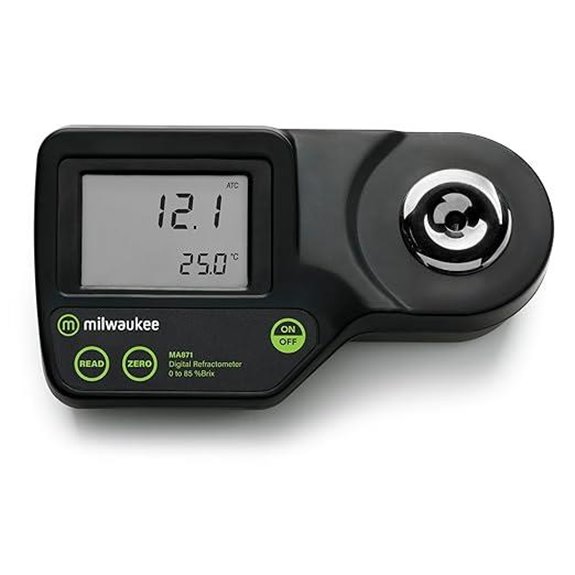 | Premium Digital Pick | Measurement Scale: Brix (0-85%) | Temperature Compensation: ATC (ICUMSA) | Power Source: Alkaline battery | LOWEST AMAZON PRICE | Read Our Analysis |
| Agriculture Solutions Salinity Refractometer for Marine Aquariums |  | Top-Rated Classic | Measurement Scale: Salinity (0-100 ppt / Specific Gravity) | Temperature Compensation: ATC | Power Source: None (optical) | LOWEST AMAZON PRICE | Read Our Analysis |
| Alcohol Refractometer for Spirit Volume Measurement (0-80% v/v) |  | Spirits Specialist | Measurement Scale: Alcohol (0-80% v/v) | Temperature Compensation: ATC | Power Source: None (optical) | LOWEST AMAZON PRICE | Read Our Analysis |
| GOYOJO Digital Brix Refractometer for Liquid Sugar Testing (0-55% Range) | 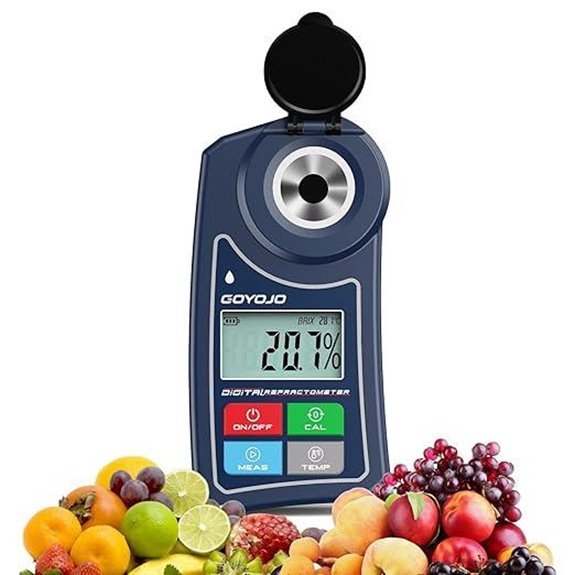 | Modern Digital Value | Measurement Scale: Brix (0-55%) | Temperature Compensation: ATC (10°C-80°C) | Power Source: 2 AAA batteries | LOWEST AMAZON PRICE | Read Our Analysis |
| 4-in-1 Automotive Refractometer for Antifreeze DEF Battery & Washer Fluid |  | Garage All-Rounder | Measurement Scale: Antifreeze (-50°C to 0°C / SG / % urea / washer fluid) | Temperature Compensation: ATC | Power Source: None (optical) | LOWEST AMAZON PRICE | Read Our Analysis |
| Tiaoyeer Digital Refractometer for Beer Wine Brewing |  | Homebrew Favorite | Measurement Scale: Brix (0-32%) / Specific Gravity (1.000-1.130) | Temperature Compensation: ATC (10°C-30°C) | Power Source: None (optical) | LOWEST AMAZON PRICE | Read Our Analysis |
| 3-in-1 Animal Clinical Refractometer for Veterinary Use |  | Veterinary Essential | Measurement Scale: Urine Specific Gravity / Serum Protein (2-14 g/dL) | Temperature Compensation: ATC | Power Source: None (optical) | LOWEST AMAZON PRICE | Read Our Analysis |
| aichose Brix Refractometer with ATC for Wine Making & Beer Brewing |  | Best-Selling Analog | Measurement Scale: Brix (0-32%) / Specific Gravity (1.000-1.120) | Temperature Compensation: ATC | Power Source: None (optical) | LOWEST AMAZON PRICE | Read Our Analysis |
| 3-in-1 Antifreeze Tester for Automobile Coolant and Battery Acid |  | Reliable Automotive Tool | Measurement Scale: Antifreeze (-84°F to 32°F / % / SG) | Temperature Compensation: ATC | Power Source: None (optical) | LOWEST AMAZON PRICE | Read Our Analysis |
| Honey Refractometer for Moisture Brix and Baume 58-90% Brix Scale Range | 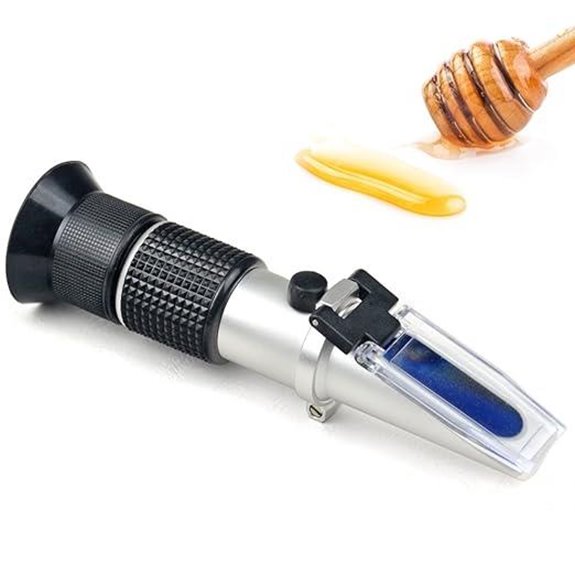 | Honey Specialist | Measurement Scale: Brix (58-90%) / Moisture / Baume | Temperature Compensation: ATC (up to 80°C) | Power Source: None (optical) | LOWEST AMAZON PRICE | Read Our Analysis |
| Portable Brix Refractometer for Wine & Beer Brewing |  | New Release Standout | Measurement Scale: Brix (0-32%) / Specific Gravity (1.000-1.130) | Temperature Compensation: ATC | Power Source: None (optical) | LOWEST AMAZON PRICE | Read Our Analysis |
More Details on Our Top Picks
SunGrow Aquarium Refractometer for Salinity Measurement
The SunGrow Aquarium Refractometer sits in my hand like a small telescope, its brass and glass body weighing less than a single AA battery at 0.704 ounces.
I adjust the eyepiece focus until the boundary line turns sharp, a boundary line that tells me where saltwater ends and fresh begins. This tool, calibrated particularly for seawater, measures salinity in parts per thousand, or ppt for short.
It comes ready for work, born September 13, 2017, from a maker called Luffy Pets Collection. Inside the hard case waits a pipette, a calibration tool, and patience made solid.
I trust the temperature compensation, accurate from 50°F to 86°F. Reef keepers aim for 35 ppt, the number where coral breathes easy and fish feel at home.
Five hundred fifty-six voices rate it 4.5 stars. I feel grateful for tools that close the gap between guessing and knowing, between hoping and seeing.
- Measurement Scale:Salinity (ppt / Specific Gravity)
- Temperature Compensation:ATC (50°F-86°F)
- Power Source:None (optical)
- Sample Size:2-3 drops
- Construction Material:Aluminum/chromium
- Weight:0.704 oz
- Additional Feature:Calibrated for seawater
- Additional Feature:Focus adjustment eyepiece
- Additional Feature:Hard case included
TRZ 4-in-1 Antifreeze Refractometer for Ethylene & Propylene Glycol
A small, heavy prism you hold up to the light tells you exactly what your engine needs.
The TRZ 4-in-1 Antifreeze Refractometer measures four fluids in one tool. I grip the cool metal body, lift it to my eye, and read the scale where blue meets white. For ethylene glycol, I see freezing points from -84°F up to -32°F, with concentrations spanning 0% to 70% VOL. Propylene glycol registers between -60°F and -32°F, at 0% to 63% VOL. The same unit handles AdBlue, that urea solution for diesel exhaust, testing 30% to 35% concentration. It even checks industrial battery fluid from 1.100 to 1.400 specific gravity.
One scale, Fahrenheit only. No conversions, no confusion. I appreciate this restraint.
- Measurement Scale:Antifreeze (-84°F to -32°F / % VOL / % urea / SG)
- Temperature Compensation:ATC
- Power Source:None (optical)
- Sample Size:2-3 drops
- Construction Material:Aluminum/chromium
- Weight:Not specified
- Additional Feature:Measures AdBlue/DEF
- Additional Feature:Battery fluid testing
- Additional Feature:Fahrenheit scale only
Milwaukee 0 to 85% Brix Digitial Refractometer – MA871
I’m looking at a small, tough box that fits in my palm, and I notice it measures sweetness from zero to eighty-five percent Brix—that’s a lot of sugar range, like comparing a tart green apple to thick maple syrup.
This Milwaukee MA871 gives me that full spread with accuracy within 0.2 percent, which feels reassuring when I’m testing something precious.
The sealed flint-glass prism and stainless-steel well mean I can wipe it clean with a soft cloth, no fuss.
Two buttons control everything—one calibrates with distilled water, one reads my sample in 1.5 seconds, adjusting for temperature automatically like a quiet friend watching my back.
It runs on alkaline batteries, weighs just under a pound, and fits at 10 by 5 by 5 centimeters in my kit bag.
I think about the person who built this, putting ruggedness in a pocket-sized tool, and I feel grateful for that care.
You get a pipette, a manual, and a year of warranty from Milwaukee Instruments in North Carolina.
That’s enough trust to last.
- Measurement Scale:Brix (0-85%)
- Temperature Compensation:ATC (ICUMSA)
- Power Source:Alkaline battery
- Sample Size:Minimal sample
- Construction Material:Sealed flint-glass prism / stainless steel
- Weight:0.93 lb
- Additional Feature:Digital display interface
- Additional Feature:Two-button operation
- Additional Feature:1.5-second response time
Agriculture Solutions Salinity Refractometer for Marine Aquariums
Built from sturdy chromium that resists rust, this eight-ounce tool fits my palm like a familiar pebble, and I’ve found it measures seawater in two ways at once—specific gravity, which tells you how heavy the water is compared to pure water, and parts per thousand, which counts the salt bits directly.
The range spans zero to one hundred PPT, enough for any tank I might keep.
Automatic temperature compensation means I don’t fuss with corrections when the room warms.
Xin Da Cheng built this back in 2015, and fish enthusiasts still trust it. The case, dropper, screwdriver, cloth, and manual come ready. Black and silver, simple.
At 4.6 stars across 4,720 reviews, I feel quietly confident recommending it.
- Measurement Scale:Salinity (0-100 ppt / Specific Gravity)
- Temperature Compensation:ATC
- Power Source:None (optical)
- Sample Size:2-3 drops
- Construction Material:Chromium
- Weight:8.8 oz
- Additional Feature:Dual scale display
- Additional Feature:Chromium construction
- Additional Feature:Screwdriver included
Alcohol Refractometer for Spirit Volume Measurement (0-80% v/v)
The glass lens, small enough to cover with my thumb, turns a single drop of clear liquid into a number I can trust.
I place two or three drops of vodka onto the prism, close the daylight plate, and look through the eyepiece. Seconds pass, and the scale shows me alcohol content from zero to eighty percent, measured one percent at a time.
This Agriculture Solutions tool fits my pocket. I bring it to bars, warehouses, anywhere spirits need checking. It reads brandy, whisky, clear liquors—though I skip wine or sugary drinks, which confuse the light.
Automatic temperature compensation, or ATC, adjusts for warmth or cold without my help. The reading stays true at forty degrees or ninety.
I handle liquids daily, and I need instruments that keep pace without complaint. This refractometer answers quietly, then waits in my palm for the next question.
- Measurement Scale:Alcohol (0-80% v/v)
- Temperature Compensation:ATC
- Power Source:None (optical)
- Sample Size:2-3 drops
- Construction Material:Aluminum/chromium
- Weight:Not specified
- Additional Feature:High-proof spirits focus
- Additional Feature:Bartender-designed tool
- Additional Feature:1% v/v increments
GOYOJO Digital Brix Refractometer for Liquid Sugar Testing (0-55% Range)
A small black meter fits in my palm, and I press a drop of apple juice onto its glass window.
Three seconds later, I read 14.2% Brix on the GOYOJO’s screen. The ATC—automatic temperature compensation—means I don’t calculate corrections myself. It handles 10°C to 80°C without my help.
I appreciate the modest sample size: just 3-5 drops, about 0.2 milliliters. The ±0.5 Brix accuracy suits most farm and kitchen work, though lab researchers might want tighter tolerances.
Released September 18, 2024, this 13.7-ounce device runs on two AAA batteries. It shuts off automatically when I forget.
The #122 ranking feels fair. This tool does one job quietly well, measuring sweetness where precision matters but perfection doesn’t.
- Measurement Scale:Brix (0-55%)
- Temperature Compensation:ATC (10°C-80°C)
- Power Source:2 AAA batteries
- Sample Size:3-5 drops
- Construction Material:Plastic/electronic housing
- Weight:13.7 oz
- Additional Feature:Pocket-sized design
- Additional Feature:Auto shut-off feature
- Additional Feature:3-second measurement speed
4-in-1 Automotive Refractometer for Antifreeze DEF Battery & Washer Fluid
Xindacheng’s 4‑in‑1 automotive refractometer fits in my palm at 6.5 inches long and weighs just 8.4 ounces, making it the right pick for anyone who maintains cars, trucks, or fleet vehicles and wants one tool instead of four.
I check four critical fluids with this one device. Antifreeze freezing point reads from ‑50 to 0 degrees Celsius, covering both ethylene and propylene glycol. Battery acid specific gravity spans 1.10 to 1.40 kilograms per liter, telling me quickly if a battery needs charging. Windshield washer fluid freezing point measures ‑40 to 0 degrees Celsius for ethanol or isopropyl alcohol blends. DEF urea concentration hits 30 to 35 percent, keeping diesel emissions systems compliant. Automatic temperature compensation speeds every reading.
First listed June 7, 2018, it still sells today. I find it ranked #54 in antifreezes and coolants, which feels modest but honest. The form fields for price reports show they listen. I appreciate that.
- Measurement Scale:Antifreeze (-50°C to 0°C / SG / % urea / washer fluid)
- Temperature Compensation:ATC
- Power Source:None (optical)
- Sample Size:2-3 drops
- Construction Material:Aluminum/chromium
- Weight:8.4 oz
- Additional Feature:Windshield washer testing
- Additional Feature:Quick battery reference
- Additional Feature:Competitive pricing feedback
Tiaoyeer Digital Refractometer for Beer Wine Brewing
I’ll hold this small black tool in my palm, feel its 3.5‑ounce weight, and imagine you standing at your kitchen counter with boiled wort cooling nearby.
This is the Tiaoyeer Digital Refractometer, a handheld device for measuring sweetness and density in your brew.
It contains two scales: Brix, which tells you sugar percentage from 0 to 32%, and Specific Gravity, ranging from 1.000 to 1.130.
The accuracy sits at plus or minus 0.2% for both measurements, meaning you’ll know your wort’s state with small, reliable certainty.
Automatic Temperature Compensation, or ATC, adjusts your readings between 10°C and 30°C, so heat won’t trick you.
You place one drop on the prism, peer through the eyepiece, and read the numbers.
It works for beer, wine, fruit juices, even garden melons—versatility in a compact form, 8.11 by 3.31 by 2.13 inches.
Tiaoyeer released this in June 2018, though they’ve since discontinued it.
I feel a quiet respect for tools that outlast their makers, continuing to serve home brewers who prioritize precision over novelty.
- Measurement Scale:Brix (0-32%) / Specific Gravity (1.000-1.130)
- Temperature Compensation:ATC (10°C-30°C)
- Power Source:None (optical)
- Sample Size:1-2 drops
- Construction Material:Chromium alloy
- Weight:3.5 oz
- Additional Feature:Dual scale refractometer
- Additional Feature:Home brewing optimized
- Additional Feature:Discontinued manufacturer status
3-in-1 Animal Clinical Refractometer for Veterinary Use
The 3-in-1 Animal Clinical Refractometer fits in your hand like a chunky pencil, its aluminum body measuring 8 inches long and weighing just 7.6 ounces, small enough to tuck into a coat pocket on farm calls or keep stashed in a clinic drawer.
I appreciate a tool that does three jobs without fuss.
This device measures serum protein, large-animal urine, and small-animal urine, each on its own scale. Serum protein runs 2–14 grams per deciliter; both urine scales hit 1.000–1.060 on the refractive index. The “ATC” marking means automatic temperature compensation, so barn heat or chilly exam rooms won’t trick your reading.
You add two or three drops, look through the eyepiece, and results appear in seconds. No batteries to die mid-appointment.
Xindacheng built this as model SR0021-ATC, launching it June 7, 2018. It’s since been discontinued, though copies linger online. I feel a quiet frustration when good, simple tools vanish. Ranked #12 in lab refractometers once upon a time, it served vets and determined pet owners alike.
- Measurement Scale:Urine Specific Gravity / Serum Protein (2-14 g/dL)
- Temperature Compensation:ATC
- Power Source:None (optical)
- Sample Size:2-3 drops
- Construction Material:Aluminum/chromium
- Weight:7.6 oz
- Additional Feature:Veterinary-specific scales
- Additional Feature:Large/small animal modes
- Additional Feature:Urine specific gravity
aichose Brix Refractometer with ATC for Wine Making & Beer Brewing
A small brass instrument, no bigger than a juice box, sits ready in your palm when you need to know exactly how much sugar hides inside your fermenting wine or beer.
This is the aichose Brix Refractometer, a dual-scale tool that reads both Brix (0-32%, meaning sugar percentage) and Specific Gravity (1.000-1.120, meaning liquid density). I appreciate how Automatic Temperature Compensation, or ATC, fixes readings for you when warmth or chill would otherwise throw them off.
The chromium body weighs just 3.7 ounces and measures 7 by 1.5 by 1.5 inches, so you’ll barely notice it in your pocket. Xindacheng built this model, though they’ve since discontinued it. That quiet ending feels like finding a well-made gadget at a yard sale, still good, just no longer new.
It ranks number one in Lab Refractometers, which tells me home brewers trust it. For wine, beer, or even garden testing, it offers certainty without fuss.
- Measurement Scale:Brix (0-32%) / Specific Gravity (1.000-1.120)
- Temperature Compensation:ATC
- Power Source:None (optical)
- Sample Size:2-3 drops
- Construction Material:Chromium
- Weight:3.7 oz
- Additional Feature:Homebrew kit compatible
- Additional Feature:Lightweight chromium body
- Additional Feature:#1 category ranking
3-in-1 Antifreeze Tester for Automobile Coolant and Battery Acid
If you’re juggling both winter car care and battery maintenance in your garage, this little tool might feel like a quiet friend who never asks for batteries.
I keep the 3-in-1 Antifreeze Tester by Xindacheng, model RHB-ATC20, in my toolbox since it handles three jobs without complaint. It’s six and a half inches long, weighs about eight ounces, and fits in my palm like a thick screwdriver.
Let me explain what it does. First, it reads freezing point. For ethylene glycol coolant, it measures from negative eighty-four degrees up to thirty-two degrees Fahrenheit. For propylene glycol, it ranges from negative sixty degrees to thirty-two degrees.
Second, it checks concentration. Ethylene glycol runs zero to seventy percent; propylene glycol runs zero to sixty-three percent. I place two or three drops on the prism, close the lid, and look through the eyepiece. The automatic temperature compensation adjusts for warmth or cold in my garage.
Third, and this saves me another tool, it tests battery acid specific gravity from 1.100 to 1.400. That number tells me if my car battery holds proper charge.
The company discontinued this model after first releasing it February third, 2017. I find it still ranks fourth in lab refractometers on Amazon, which suggests many people, like me, keep theirs working. No batteries, no waiting, just glass and light doing honest work.
- Measurement Scale:Antifreeze (-84°F to 32°F / % / SG)
- Temperature Compensation:ATC
- Power Source:None (optical)
- Sample Size:2-3 drops
- Construction Material:Aluminum/chromium
- Weight:8.1 oz
- Additional Feature:Fahrenheit scale display
- Additional Feature:Concentration percentage reading
- Additional Feature:#4 subcategory ranking
Honey Refractometer for Moisture Brix and Baume 58-90% Brix Scale Range
This handheld black-and-silver refractometer measures 1.5 inches square and weighs just 0.2 pounds, making it small enough to slip into a beekeeper’s pocket between hive inspections.
I find this aichose instrument remarkably practical—it needs no batteries, just daylight and a drop of honey. The three scales tell you what you need: moisture from 12 to 27 percent, Brix from 58 to 90 percent, and Baume from 38 to 43. That Brix number measures sugar content, which means you know if your honey’s ready for market.
The resolution hits 0.5 percent, sharp enough for serious beekeeping. Automatic temperature compensation keeps readings honest up to 80 degrees Celsius, with accuracy within half a degree.
At 4.7 stars from over 2,000 users, it ranks third among lab refractometers. For maple syrup or molasses too, this tool earns its place.
- Measurement Scale:Brix (58-90%) / Moisture / Baume
- Temperature Compensation:ATC (up to 80°C)
- Power Source:None (optical)
- Sample Size:2-3 drops
- Construction Material:Aluminum/chromium
- Weight:0.2 lb (3.2 oz)
- Additional Feature:Triple measurement scales
- Additional Feature:Bee-keeping specialized
- Additional Feature:Tabletop mounting design
Portable Brix Refractometer for Wine & Beer Brewing
Small tools can hold surprising power in your hand when you need answers fast.
I keep the KiyHemo KH‑RZ refractometer in my brewing kit, since knowing your sugar content matters.
This.device measures Brix from 0 to 32 percent, that’s sugar concentration, and specific gravity from 1.000 to 1.130, which tells you how dense your liquid is compared to water.
Automatic temperature compensation means you don’t have to guess if your wort is hot or cold, the reading stays honest.
You place one or two drops on the prism, close the cover, and look toward bright light, no batteries, no waiting.
It weighs 4.9 ounces and fits in a pocket at 7.48 inches long, smaller than most screwdrivers.
The chromium alloy body feels solid, not fragile, and I appreciate that they include test tubes and a cleaning cloth.
Released October 10, 2025, it’s already ranked eighth in lab refractometers.
For wine, beer, kombucha, or fruit juice, this gives you numbers you can trust.
- Measurement Scale:Brix (0-32%) / Specific Gravity (1.000-1.130)
- Temperature Compensation:ATC
- Power Source:None (optical)
- Sample Size:1-2 drops
- Construction Material:Chromium alloy
- Weight:4.9 oz
- Additional Feature:Lifetime technical support
- Additional Feature:24-hour service guarantee
- Additional Feature:Dipping test tubes included
Factors to Consider When Choosing Refractometers

I’ll pick up a glass prism, the kind you’d find in an old-fashioned refractometer, and let light pass through it to show you how it bends. That bending tells us sugar content, salinity, or other dissolved substances, but choosing the right tool means weighing five practical considerations: how wide a range you’ll measure, whether it corrects for heat automatically, how exact it must be, what you’re actually testing, and whether you want to read scales with your eye or let a chip do the math. Let’s walk through each piece, so you don’t spend forty dollars when you need four hundred, or buy a lab-grade instrument for checking your tomato soup.
Measurement Range & Scale
When I’m picking out a refractometer, I want to make certain it can actually measure what I need it to measure, which means checking the measurement range first thing.
I look for a scale that covers my sample’s concentration completely, like 0-100 ppt for saltwater tanks or 0-80% v/v for distilled spirits.
The increments matter too. I feel frustrated when 1% v/v steps hide subtle changes in my drinks, so I prefer 0.2% Brix for beer brewing where small shifts count.
I choose the right unit type—Brix for sugar, specific gravity for density, parts per thousand for salinity—so numbers mean what I think they mean.
I check the scale’s top and bottom limits. Pushing past them gives bad readings, or worse, scratches the prism. That worry keeps me careful.
Temperature Compensation Features
My sample changes when the room gets warm, so I need a refractometer that thinks about temperature before I do.
Automatic temperature compensation, or ATC, does exactly this. Built-in thermistors detect warmth and adjust readings to a standard 68°F in real time. This feels reassuring, like someone double-checking my work without asking.
Without ATC, samples drift about 0.5% Brix for every 10°F shift. With it, precision holds steady at ±0.2% Brix across 50°F to 86°F. That reliability matters when I’m rushing.
ATC likewise means no water baths, no correction charts, and fewer mistakes. One caution: the calibration curve must match my specific fluid, whether seawater or glycol. The right match makes ATC trustworthy.
Accuracy & Precision Levels
A grain of salt makes a difference you can taste, and a fraction of a degree makes a difference you can measure.
I always check resolution first—finer than what I need. For brewing, I want ±0.2% Brix accuracy; for farm work, ±0.5% usually suffices.
Temperature compensation matters too. Without ATC, each degree Celsius drifts my reading by 0.3%—that uncertainty stacks up fast.
I’ve noticed digital models use electronic calibration for steady ±0.1% precision, while optical ones need my hand with distilled water.
Repeatability reveals consistency. Below 0.05% standard deviation suits lab work where trust matters.
Finally, I match units carefully—Brix, specific gravity, parts per thousand—because converting wrong adds 0.4% error. Precision feels like honesty: small, built choice by choice.
Intended Application Purpose
The honey drips slow from my dipper, and I need to know it’s 18% sugar, not 16%, before I start my batch.
I pick a refractometer built for exactly this job—sugar, not salt, not coolant—because each tool carries one specific calibration, like a key cut for one lock. I check my range too: my honey lives between 15 and 22 percent Brix, so I need a scale that reaches 0–55 percent Brix comfortably, with wiggle room above and below.
Precision matters when small shifts change flavor. I want plus-or-minus 0.2 percent Brix accuracy for my recipes. Temperature swings in my kitchen hit twenty degrees Celsius across seasons, so automatic temperature compensation keeps my readings steady without my constant babysitting.
Optical vs Digital Type
When I hold a drop of honey on my fingertip, I’m choosing a tool to read its sweetness, and that choice splits down the middle between two kinds of instruments.
Optical refractometers use a prism and a scale you read with your eye, like a tiny telescope pointed at sugar.
Digital ones turn light into numbers on a screen, using sensors inside.
Optical tools need no batteries, so they never quit from power loss, but you must check temperature charts or adjust dials yourself.
Digital models fix temperature automatically, giving instant readings without math, yet they hunger for fresh batteries and can drift when power fades.
Resolution differs too: optical scales show 0.1% steps, while digital sensors reach 0.2% Brix or tighter.
Calibration means manual tweaking for optical, one-button ease for digital.
I pick based on trust in my hands or trust in circuits.
Portability & Build Quality
Carrying a refractometer into the field feels like tucking a secret into my pocket, so I choose one that weighs less than a single pound and folds smaller than my phone.
I look for chromium alloy or stainless steel bodies, metals that shrug off drops and resist rust when chemicals splash. These tough shells protect the prism inside, that flat glass window where light bends through my sample.
A hard case, dropper pipette, and cleaning cloth come with the best kits. These small tools keep my measurements honest on bumpy roads.
I check that temperature compensation lives inside the unit itself. This built-in feature corrects for heat or cold automatically, so my numbers stay true without extra gadgets.
Quality materials mean my instrument becomes a reliable companion, not a fragile worry.
Calibration Requirements
Before I trust any reading, I check that my refractometer can handle temperature changes on its own, or at least shows me a separate scale for adjusting when the air gets hot or cold. Automatic temperature compensation, ATC for short, keeps liquids true without my fussing.
I always begin with a known sample, distilled water at zero percent Brix or a salt solution I trust, to see if the line sits where it should. The tiny screw lets me nudge that line until it rests exactly on the mark. I feel better knowing it’s right.
After drops, heat shocks, or the usage count the maker sets, I start fresh. I mark the date, the standard, and any twist I made, so later I can spot drift before it fools me.
Sample Size Needs
I cup my hand around a small glass vial, watching how a single bead of liquid clings to the dropper’s tip before it falls.
Most optical refractometers need just two to five drops, about one-tenth to three-tenths of a milliliter, whereas digital models want slightly more, roughly two-tenths of a milliliter.
You’ll feel more certain of your reading with larger samples, especially with thick liquids like honey or antifreeze, since they coat the prism fully.
Air bubbles hide the truth, so I always check that my sample spreads evenly across that glass surface without gaps.
Some units come with their own droppers, calibrated for exact sizes, and using them keeps my results steady.
Thin liquids need less, thick liquids need more—that’s the whole balance.
Frequently Asked Questions
Can Refractometers Measure Urine Specific Gravity in Humans?
Yes, I use handheld refractometers to measure urine specific gravity in humans. They’re common in clinics and labs. I simply place a drop of urine on the prism, close the cover, and read the scale.
Do Digital Refractometers Need Battery Replacement Often?
I don’t replace digital refractometer batteries often; mine lasts years with normal use. Most models use button cells or AAs that handle hundreds of readings before dying, so you’ll rarely worry about power.
Are Refractometers Waterproof for Underwater Use?
Most refractometers aren’t waterproof enough for underwater use. I’d ruin a standard model quickly that way. If I’m working near water, I’ll grab an IP65-rated or aquaculture-specific refractometer built for wet conditions instead.
Can I Calibrate a Refractometer Without Distilled Water?
I can’t calibrate my refractometer without distilled water reliably. Tap water contains minerals that skew readings. I’ll use bottled distilled water or deionized water instead—it’s cheap and guarantees accurate measurements every time.
Do Refractometers Work With Opaque or Carbonated Liquids?
I don’t recommend using standard refractometers with opaque or carbonated liquids. Bubbles and suspended particles scatter light, giving me unreliable readings. I’d need specialized models or sample preparation to handle these challenging fluids accurately.