Green thread clings flat to driftwood, yet moss yearns to rise. The keeper must choose between flat Java or branching Christmas, each a different promise. Mesh waits in drawers, patient as a grandmother’s quilt. Water holds the secret, moving just enough, never shouting. Light, six hours, morning only, measured like medicine. CO₂ breathes only when eyes are open. Growth speeds or slows at human whim, a dial turned with purpose. Shrimp know this place, grazing its velvet. But first, the anchor must hold, and that is where most fail.
At A Glance
- Christmas moss forms stable, dimensional carpets, while Java moss tends to float and tangle.
- Sandwich moss between mesh layers for compact texture that shrimp can graze.
- Position bubble wands six inches above substrate to create gentle, health-promoting currents.
- Provide 4–6 hours of morning 6500 K light daily to encourage density and suppress algae.
- Dose CO₂ only during light periods and adjust temperature to control growth speed.
Why Christmas Moss Beats Java Moss for Carpets
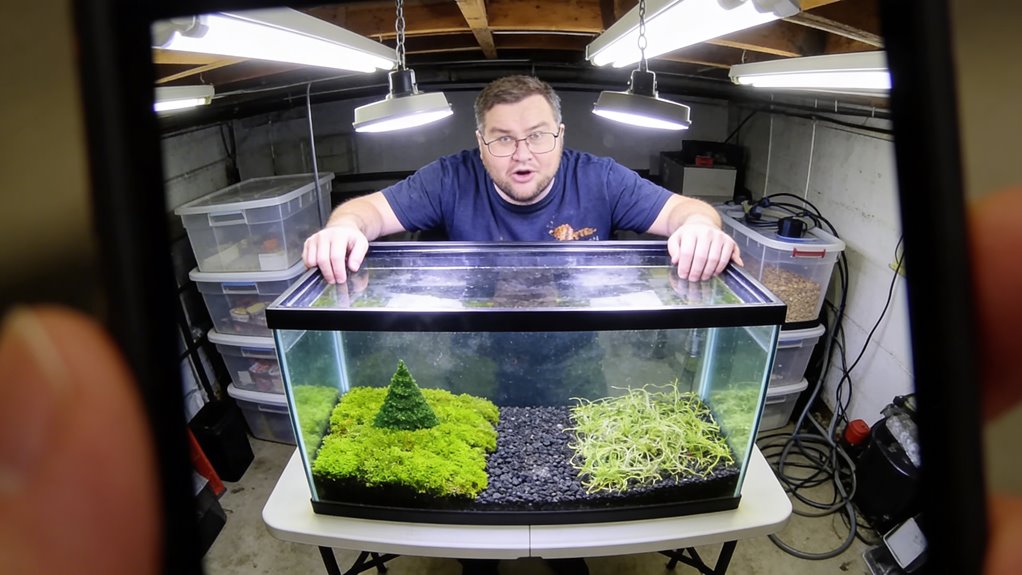
Since both plants look fuzzy and green at first glance, beginners often assume Christmas moss and Java moss behave the same way.
This assumption leads to disappointment.
The moss texture differs sharply. Christmas moss grows dense, triangular fronds that stand up like tiny trees, creating pillowy carpets with real dimension. Java moss lays flat and stringy, resembling wet spaghetti pressed against glass.
Growth speed tells the same story. Christmas moss anchors firmly, then spreads steadily, rhizoids gripping mesh within weeks. Java moss grows faster at first, yes, but floats away, tangles hopelessly, demands constant rescue.
Serious aquascapers notice. They choose the moss that respects their work.
Pick Your Carpet Method: Mesh vs. Super Glue vs. Letting It Float?
Anchor your moss to something solid, or watch it drift like confetti in a breeze. The mesh method sandwiches moss between plastic grids, letting its feathery moss texture weave through to form a soft, living rug. Super glue—really, cyanoacrylate gel—binds moss to rocks or wood in seconds, though fingers must work carefully to avoid stiff, white patches. Floating offers no substrate choice at all, just gentle wandering, which some find peaceful, others frustrating. Each path suits different temperaments. The patient grower favors mesh. The quick starter trusts glue. The dreamer lets it drift, accepting uncertainty.
Build a Sandwich-Style Moss Mat Step by Step
Mesh strips and plastic grids rest on the table, waiting to become something alive.
| Layer | Purpose |
|---|---|
| Bottom mesh | Holds structure flat against substrate |
| Moss center | Creates living Moss texture for grazing shrimp |
| Top mesh | Diffuses intense Light spectrum evenly |
The builder spreads moss three fingers thick between grids, stitches edges with fishing line like sewing a quilt. This sandwich sinks willingly, weighted by small stones. Rhizoids grip through holes, claiming territory slowly. Weeks pass. Patience feels like watching bread rise, invisible work becoming visible. The reward belongs to those who wait: compact green velvet, a floor for nervous fry to hide.
Anchor Your Carpet Without Disturbing Fish
A flat stone the size of a dinner plate lies ready on the tank bottom, its weight a promise of stillness.
Weight settles like a promise pressed into still water, holding what light cannot keep.
Set it gently atop your mesh sandwich, pressing rhizoids toward the substrate texture without crushing them. Wait three days, then lift slightly to check grip.
Fish safety demands patience during this settling. No sudden movements, no chasing swimmers with your hand. Let them investigate the new shadow as you stand back, watching. Trust builds when territorial fish recognize the stone yields nothing threatening.
In two weeks, remove the weight. The moss remembers its hold, and your fish remain calm, belonging undisturbed.
Water Flow Tricks That Keep Moss Carpets Lush
Position a small bubble wand along the back glass, six inches above the substrate, and watch how the current cradles the moss rather than flattening it.
Practitioners trace current flow mapping with a strip of thread held in tweezers, moving it inch by inch across the water to find still pockets where detritus settles. These quieter zones harbor斯里 the mind with steady, unhurried attention, like sweeping a porch with deliberate strokes.
Substrate turbulence, that gentle stirring just above the carpet, prevents dead spots without uprooting delicate rhizoids. Think of leaves fluttering in a doorway draft: movement enough for health, not so much as to scatter. The belonging here is quiet competence, shared among those who notice such things.
Dial In Light to Control Density Without Algae
Which hour of the day offers the kindest light for moss to thicken without inviting unwanted guests?
Morning light, patient and soft, thickens moss without waking the algae that wait for brighter hours.
The soft morning stretches, four to six hours daily, nurture density like a patient hand smoothing a quilt. Too much brightness invites algae; too little leaves moss thin and longing.
Light spectrum matters—red and blue wavelengths feed growth, whereas excess green-yellow encourages algae suppression struggles. Balance feels like tending a small fire, enough warmth without burning.
- Choose 6500K bulbs for natural woodland mimicry
- Layer floating plants as gentle umbrellas
- Begin with six hours, adjust slowly, watching each week
This rhythm belongs to those who wait.
Trim Your Carpet in Under 60 Seconds
Once the light settles into its quiet rhythm, the moss begins to tell you what it needs.
A pair of small scissors rests beside the tank, waiting.
Lift the mesh sandwich gently, feel the moss texture between your fingers, soft as a worn blanket.
Snip only the straggled edges, the parts reaching too far, taking less than sixty seconds once your hands remember the shape.
Each cut returns nutrients to the water, feeding the cycle beneath, nutrient cycling made visible in floating crumbs the shrimp will find.
Return the carpet to its place.
The tank breathes easier now.
Fix Floating Pieces and Patch Bare Spots Fast
Where do those drifting threads go when the water stirs, the ones that worked loose whereas you weren’t watching?
They tangle in filters, shade corners, and beg for rescue.
Patching bare spots and securing floaters demands swift, gentle action.
- Re-anchor loose strands with fishing line, pressing rhizoids firmly against mesh or rock within thirty seconds.
- Trim healthy neighboring growth to one inch, then press cuttings into gaps using tweezers for seamless repair.
- Reduce light intensity to six hours daily, maintaining algae‑prevention while new sections establish.
Swift pest control of drifting pieces preserves carpet unity, ensuring every member belongs in the green whole.
When to Fertilize and When to Skip It
A moss carpet often receives enough food from fish waste and tap water alone, so adding extra plant food becomes a choice, not a rule. CO₂ timing matters: inject only when lights glow, for moss breathes in step with brightness, wasting gas in darkness brings no gain, only lost coins. Nutrient timing follows water changes, weekly drops after fresh water enters, like feeding a garden after rain. Heavy fish loads mean skip the bottle, light stocks mean gentle help. Watch the green, feel the rhythm, belong to those who listen before pouring.
Spot Filter Clog Before It Kills Your Cycle
The filter intake sits half-hidden behind a driftwood branch, a plastic tube with tiny slits that pulls water through spongy layers inside the canister. Moss fragments drift everywhere, and catching them early saves the cycle.
A clogged filter starves bacteria of oxygen, and cycle disruption follows like night after day. These warning signs matter:
- Water flow drops to a trickle, measurable by how far output pushes surface ripples
- Filter hum climbs in pitch, motors straining against blockage
- Ammonia creeps upward on test strips, usually within three to five days of restriction
Spot filter troubles early. Your tank family depends on this vigilance.
Speed Up Growth or Slow It Down on Purpose
How could a gardener stand before a patch of moss and decide whether to hurry it along or ask it to pause?
The answer lies in two levers: CO₂ dosing and temperature tweaking.
For speed, add carbon dioxide—two to three bubbles per second through a diffuser—and nudge the thermometer to 75 degrees Fahrenheit, the cozy upper edge of comfort. The moss responds like a child given sugar, spreading thick and bright within weeks.
To slow, simply stop. Withdraw the CO₂, let the dial fall to 65 degrees, and watch growth settle into a patient crawl demanding scissors only twice yearly.
Either way, the gardener belongs to the moss, not the reverse.
Frequently Asked Questions
Can Moss Carpets Harbor Pests?
Yes, moss carpets can harbor pests.
Small snails often hide in the dense green threads, arriving as tiny eggs on new purchases. These creatures multiply quietly, becoming unwelcome guests that nibble tender leaves. Pest infiltration feels disappointing, like finding ants in a carefully packed picnic basket. Disease vectors such as harmful bacteria likewise cling to damp surfaces. Inspect moss carefully, rinse thoroughly, and quarantine new additions for two weeks to protect the living community.
Is Moss Safe for Shrimp to Eat?
Freshwater moss presents no moss toxicity concerns for shrimp, making it entirely safe for consumption.
Shrimp nutrition benefits from the biofilm—tiny living organisms—that grows on moss surfaces, providing vital food.
The soft, leafy texture allows shrimp to graze comfortably, supporting their natural foraging behavior.
No special preparation is required; simply place moss in the aquarium.
Regular trimming maintains healthy growth, ensuring continuous food availability.
How Long Do Moss Carpets Live?
A moss carpet lives indefinitely with care, its lifespan measured not in years but in growth cycles that renew it continuously.
Growthgevity factors include water temperature near 70-75°F, moderate light, and monthly trimming. Rhizoids anchor fresh sections within weeks, allowing the carpet to regenerate from cuttings. Without maintenance, sections brown or detach after 12-18 months, yet proper tending preserves the living green layer perpetually, like tending a familiar garden patch that never truly ends, only changes.
Will Carpets Block Substrate Gas Exchange?
Dense moss carpets can limit substrate oxygen exchange by creating a physical barrier between water and gravel.
Flow limitation occurs when the moss layer, typically one to two inches thick, slows water movement through the bottom substrate. This reduced circulation means less oxygen reaches beneficial bacteria living in the gravel below.
The effect feels similar to wearing a thick blanket—breathing still happens, but it takes more effort.
Aquarists notice this when testing shows lower dissolved oxygen readings near the tank bottom, or when anaerobic pockets develop, releasing occasional bubbles with a sour smell.
Prevention requires gentle maintenance: lifting the carpet edge weekly, using thinner mesh layers, or selecting coarser gravel that maintains pathways for water movement even under moss cover.
Can I Dye Moss Different Colors?
Moss dyeing is not recommended for living plants. Color pigments from fabric dyes or food coloring clog the tiny leaf pores moss uses to breathe and absorb nutrients. These chemicals, designed for dead materials like cotton or wool, poison the moss within days. The plant turns brown, stops growing, and usually dies within one to three weeks. Aquarium-safe alternatives do not exist. Those seeking visual variety must choose naturally colored moss species instead, accepting the living plant’s limits. Attempting artificial color denies the moss its nature, and the keeper feels disappointment when the gentle green fades to rot. True belonging comes from meeting another being on its own terms.
Rounding Up
A mesh sheet, the kind you might sew beads upon, holds Christmas moss like a blanket holds a sleeping cat—secure, but not squeezed. The rhizoids, tiny root-like threads, push through holes and grip, making a living rug. This patience, this gentle waiting for threads to catch, teaches that good things root slowly, then last. Your carpet thrives when you let it find its own hold, six inches above quiet bubbles, in morning light.