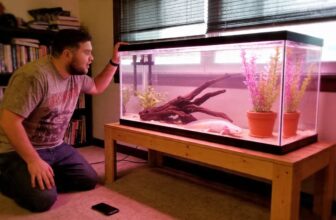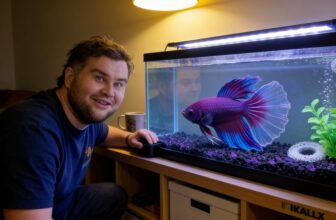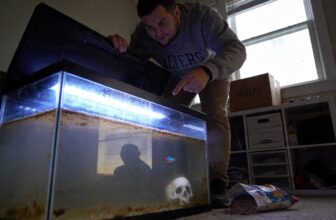
Betta fish need a five-gallon tank minimum—anything smaller won’t cycle properly, and yeah, that includes those cute “betta bowls” the pet store loves to push.
They’ll survive, I mean, they *breathe air* through this wild maze organ, but surviving isn’t thriving, right?
Keep water at 78–80°F with a gentle filter, test weekly for ammonia and nitrites, and feed them actual protein—flakes work, live food’s better.
They’ll flare, build bubble nests, maybe judge your life choices for three to five years.
Skip the plastic plants, grab some Anubias, and there’s still plenty more to unpack if water chemistry and fin rot prevention sound like fun.
At A Glance
- House bettas in heated, filtered tanks of at least five gallons with stable water parameters.
- Maintain 78–80°F temperature, gentle filtration, and weekly water testing for ammonia, nitrite, and nitrate.
- Feed high-protein betta flakes or live foods twice daily, portioned to consume in two minutes.
- Provide soft sand substrate, silk or live plants, and surface resting spots to protect delicate fins.
- Monitor for fin rot, ich, and behavioral changes, treating illnesses early to extend typical 2–5 year lifespan.
Can Bettas Live in Bowls? Debunking the Most Dangerous Myth
Now, the bowl myth persists since Bettas are maze fish, meaning they’ve got this funky organ that lets them gulp air at the surface. So people assume small spaces work fine.
The bowl myth dies hard: Bettas can breathe air, so cramped spaces must be fine.
They don’t.
Here’s myth exposing 101: that breathing trick doesn’t cancel out basic biology. Bettas still process waste, still need stable temperatures, still swim—well, they *want* to swim.
Bowl hazards stack fast:
- Ammonia spikes poison in hours, not days
- No heater means temperature swings that stress immune systems
- Surface area’s too tiny for gas exchange
It’s cramped, filthy, and frankly, embarrassing for a fish Thailand calls national treasure.
Bettas deserve better. Even the largest plastic bowl options, such as the 5-gallon Geelin round tank or Newpol’s 3-gallon model, provide minimum workable space with proper filtration—yet most “betta bowls” sold are far smaller and wholly inadequate.
Everyone wanting to belong in this hobby starts with one truth: bowls belong to cereal, not living creatures.
Tank Size: Why 5 Gallons Is the Minimum
Anything smaller? Don’t. Seriously, don’t.
Five gallons isn’t fancy—it’s functional. Here’s why:
- Water cycling filtration matters, and 5 gallons gives you room to actually cycle it
- Tank filtration won’t turn a tiny space into a washing machine
- Substrate choice—you’ll have room for plants, which helps with aeration needs
- Water hardness stays stable; crashes kill fish
- Breeding readiness? Males need space for bubble nest considerations
Below 5 gallons, you’re just managing a disaster. And species compatibility? Forget it. One betta. That’s the plet size.
The Fluval SPEC 5‑Gallon Kit demonstrates why this capacity works: its 3‑stage filtration and 7000 K LED lighting prove that 5 gallons supports both mechanical filtration and plant growth without overwhelming your betta with excessive flow.
Heaters, Filters, and Flow: Equipment That Keeps Bettas Healthy
While a betta can survive a brief temperature drop, thrive isn’t survive, and that’s the whole point. So, install a fully submersible heater—78 to 80°F keeps their labyrinth organ happy—and don’t guess with those sticky thermometers, I mean, invest in reliability. A dedicated temperature controller with alert capability, like those offering 0.1°F precision and alarm functions, ensures you catch heater failures before your betta suffers.
Now, filters. They’re non-negotiable, but flow selection matters more than you’d think. Bettas aren’t built for rapids; they’re built for rice paddies. Choose an adjustable-power filter, or baffle the outflow with a sponge, since strong currents exhaust them.
Filters are non‑negotiable, but gentle flow matters—baffle strong currents so your betta doesn’t exhaust itself fighting the current.
Your choice of equipment signals you’re in this community for real. No shortcuts, no excuses—just healthy fish.
Water Parameters: Temperature, pH, and Nitrogen Cycle Basics
Equipment’s only half the battle, though; what actually fills the tank matters just as much.
Water Parameters
Water parameters monitoring keeps bettas thriving, and it’s simpler than it sounds.
- Temperature & comfort: Heater calibration prevents temperature fluctuations that stress immune systems; aim for 74–81°F with stable dissolved oxygen levels.
- pH & hardness: pH stability lives between 6.0–8.0, while water hardness tolerates 5–35 dGH—test weekly, adjust gradually.
- The nitrogen cycle: Tank cycling demands patience; cycling duration typically spans 4–6 weeks for ammonia control and nitrite spike prevention before fish arrive.
- Maintenance rhythm: Water change schedule tackles nitrate buildup, plant absorption assists algae control, and substrate impact shapes overall chemistry—balance filtration methods with gentle flow regulation for happy, healthy fish. Weekly nitrate testing with ±5% lab-grade precision strips or liquid reagents helps catch dangerous accumulations before they harm your betta’s sensitive fins.
Sand, Plants, and Décor: Building a Safe Betta Habitat
Now, substrate texture matters more than you’d think. Sharp gravel tears delicate fins, so stick with 1–2 inches of fine sand, rinsed clean of jagged bits. Your betta’s belly’ll thank you.
Plant types? Go wild, but keep it safe. Silk or live plants work; plastic ones’ll shred fins like cheap tissue. Anubias, java fern, betta bulbs—low-effort, high-reward. Add a cave, maybe a leaf hammock near the surface, since they breathe air up there.
And skip the neon castle. I mean, really.
For bettas in particular, a gentle moonlight sand with its pinhead-soft texture reduces the risk of fin damage while creating subtle depth under aquarium lighting.
Male or Female Betta: Which Should You Choose?
Whether you’re standing in the pet store aisle or scrolling through rescue listings at 2 a.m., that question hits eventually—male or female betta?
Sexual dimorphism makes this choice visible. Male bettas flash those dramatic, flowing fins everybody recognizes, whereas females keep it sleek, compact, practical. Color intensity differences matter too—males generally blaze brighter, though females’ll surprise you.
Here’s what shifts your decision:
- Space constraints—smaller tanks suit females better
- Tank mate plans—females tolerate company more readily
- Visual impact desired—males deliver drama
- Breeding ambitions—you’ll need both, obviously
Either way, you’re joining something. Pick what resonates.
Proper filtration matters regardless of sex, and many keepers rely on quick connect fittings to simplify aquarium maintenance and equipment swaps.
Why Can’t Two Male Bettas Share One Tank?
That choice between male and female settles one question, but it opens another door—one that slams shut fast if you’re not careful.
Never, ever house two male bettas together.
- Territory drives everything. They’ve spent centuries as bred dominance triggers, literally shaped for aggression.
- They don’t even need to touch—visual signaling starts fights. Flaring, fin-spreading, that sideways movement? That’s war talk.
- In shared water, there’s no escape. No territory to claim, no retreat possible.
The result isn’t dominance. It’s shredded fins, infections, death—sometimes within hours, sometimes days of slow suffering.
Your tank becomes a boxing ring with no bell, no corners, no referee. And you’re the one who put them there.
Installing proper baffle separation systems in community aquaria can prevent similar aggression issues with other territorial species, though it remains insufficient for male betta cohabitation.
Just don’t.
Betta Tank Mates: Which Fish Can Live With Your Betta?
So who makes the cut? Peaceful companions, that’s who.
- Corydoras catfish—bottom dwellers, mind their business
- Harlequin rasboras—dull colors, no fin envy
- Mystery snails—slow, armored, zero drama
- Ghost shrimp—transparent, practically invisible roommates
Now, here’s the thing: breeding protocols matter. A male guarding his bubble nest turns territorial fast, so tank mates distract from paternal duties. I mean, it’s chaos otherwise. Community tanks work, indeed, but spare the male his bubble-nest phase. Add plants, break sightlines, and everyone’s got somewhere to sulk. Maintaining stable water parameters with low-noise filtration helps reduce stress for all inhabitants, ensuring your betta and its tank mates remain calm in their shared environment.
What Do Bettas Eat? Building a Carnivore Diet
You’ve sorted the roommates, now it’s time to sort the menu—and bettas aren’t exactly graze-the-day-away types.
These little carnivores need real protein, not some nut diet nonsense. Their nutrition depends on quality betta flakes, certainly, but live foods—brine shrimp, bloodworms—unlock their best colors, their vigor. It’s the difference between surviving and thriving, I mean, you can see it in how they move.
Real protein fuels these carnivores—live foods unlock their colors, their vigor. Surviving versus thriving, you see it in every movement.
For those setting up a dedicated betta habitat, the 2‑gallon Pronetcus offers front feeding port access that makes delivering these protein-rich meals seamless without disturbing your fish’s calm, low‑flow environment.
Now, feeding frequency matters, though we’ll nail the schedule next. For now, know this: tiny stomach, big appetite. Overfeed and you’ve got a bloated, miserable fish. Underfeed and you’ve got a dull, listless one. Dodge both, you’re in the club.
Feeding Schedule: How Often and How Much to Feed
When a betta’s stomach is roughly the size of its eye—which, let’s be honest, isn’t very big—that tiny organ somehow convinces them they’re absolutely starving, every hour of every day.
Now, feeding frequency matters here, since these little con artists don’t know when to quit.
- Feed twice daily, morning and evening—consistency keeps their metabolism steady.
- Portion control means two to three flakes per meal, or roughly what they’d eat in two minutes flat.
- Skip one day weekly; it clears their system, and honestly, they won’t hold grudges.
- Watch them hunt—that’s the good stuff, the belonging we all crave.
For travelers or busy owners, an automatic feeder with half-gram accuracy ensures your betta receives precise portions even when you’re away.
Overfeeding Signs: When to Fast Your Betta
Overfeeding Signs and When to Fast Your Betta
Even the most disciplined feeding schedule, the one where you’ve got it all mapped out—morning flakes, evening flakes, Sunday off—can still go sideways when your betta’s giving you that look. You know the one: pleading, desperate, absolutely convinced he’s starving.
Now, here’s your reality check. Overfeeding kills more bettas than hunger ever will. Watch for lethargy, bloated bellies, and lethargg, listless swimming near the bottom—sometimes called sedentary swimming when they’re just… parked. A disintegrating bubble nest can signal stress from digestive issues too.
| Sign | What You’re Seeing | Action |
|---|---|---|
| Bloated belly | Abdomen swells, scales may pinecone slightly | Fast 2–3 days |
| Lethargic swimming | Listless, drifting, sedentary swimming pattern | Skip feeding, check temperature |
| Floating at surface | Gulping air excessively, can’t stay down | Fast immediately, peas optional |
| Ignoring food | Spits flakes, hovers near bottom | 24-hour fast, then varied diet |
| Bubble nest decline | Male stops maintaining nest structure | Reduce feeding, improve water quality |
Fast your betta one day weekly—it’s not neglect, it’s prevention. They’ll forgive you. Probably.
Betta Diseases: Spot Fin Rot, Ich, and Lymphocystis Early
Early Signs of Fin Rot, Ich, and Lymphocystis
Since bettas can’t exactly tap you on the shoulder and say, “Hey, something’s off,” you’re the one who’s to notice—fast.
Early diagnosis saves fins, literally. Here’s what you’re hunting for:
- Fin rot – edges fray, darken, or recede; early rot treatment works, so act before it reaches the body
- Ich – tiny salt-grain spots, fish flashing against décor; it’s parasites, not glitter
- Lymphocystis – cauliflower-like growths, usually harmless but ugly; immune system stuff
- Behavior shifts – hiding, gasping, refusing food; your fish’s version of calling in sick
You’ve got this. Spot it early, treat it fast, and you’re already in the club.
Betta Lifespan: How Long Do They Live and How to Maximize It
Betta Lifespan and How to Maximize It
Betta fish typically survive two to five years, though three is the honest average most keepers actually see, and whether yours pushes toward that upper limit—or keels over in month six—depends almost entirely on stuff you can control. Genta lifespan isn’t luck, it’s longevity factors stacked in your favor.
| Your choice | What it costs them | What you’re really doing |
|---|---|---|
| Unheated two-gallon bowl | Shivering stress, crashed immunity | Stealing years they’ll never get back |
| Irregular water changes | Ammonia burns, rotting fins | Watching them fade slow |
| Overfeeding “just in case” | Constipation, organ failure | Loving them to death |
| Skipping the test kit | Silent pH swings, hidden suffering | Guessing while they pay |
| Proper five-plus gallons, filtered, heated | Dignity, curiosity, time | Earning their trust |
Lifespan genetics set the table, but care impact serves the meal. Environmental longevity demands stable temps, zero ammonia, places to hide. Health longevity means fasting days, quality food, eyes-on daily checks. Lifespan optimization isn’t obsessive—it’s baseline respect.
Aging prevention? Start now. Every skipped water change writes a shorter story.
What Makes Bettas Unique? The Labyrinth Organ Explained
The Labyrinth Organ
Years matter, definitely, but hardware matters too—the actual machinery keeping these fish alive.
The maze organ sets bettas apart, and frankly, it’s weirdly charming stuff. This spongy, folded structure—think of it as a crude lung sitting right behind those bugged-out eyes—lets them gulp surface air like tiny, disgruntled mammals. Air-breathing fish? Nature’s odd flex, honestly.
Here’s why fellow keepers geek out:
- Survival in stagnant rice paddies where oxygen flat-out disappears
- Bubble-nest building, that floating foam architecture males obsess over
- Direct air-to-blood oxygen transfer, no gills required for the job
- Labored breathing at the surface—your cue something’s off in the water
I mean, they’ve got backup lungs. Sort of.
Frequently Asked Questions
Can Bettas Recognize Their Owners?
Yes, they can.
Bettas show owner recognition through learned behaviors—they’ll swim to the glass, flare expectantly, or track movement when their specific human approaches, not just any shadow.
This owner bonding develops through consistent feeding routines, which, let’s be honest, mostly means “person equals food,” but the association’s real.
They don’t love you, exactly.
They love what you do.
Still, it’s something.
And something’s nice.
Do Bettas Need Light at Night?
Bettas don’t need light at night—they’ll actually get stressed by it, since they’re not built for night bubble lighting or nighturnal feeding schedules.
They’re surface-breathing maze fish from Southeast Asian rice paddies, so give them 8–12 hours of daytime light, then total darkness, maybe a dim blue moonlight if you’re feeling fancy.
Think of it like this: they’ve got nowhere to go, no eyelids to close, so respect their circadian rhythm or watch them twitch.
Why Is My Betta Building a Bubble Nest Alone?
He’s building a bubble nest since he’s healthy, happy, and hormonally optimistic—not since he’s lonely.
Now, solitary behavior doesn’t mean he’s suffering; males do this solo when water temperature sits right around 78–80°F. It’s instinct, not invitation.
But watch for real stress signals: clamped fins, gasping, hiding. No bubble nest justifies bad conditions.
He’s not pining for company. He’s just, well, ready.
Can Bettas Jump Out of Their Tanks?
Yes, bettas jump, they’re skilled escape artists in spite of their flowing fins.
- Tank size matters—small tanks mean stressed fish, and stressed fish leap. Five gallons minimum, people.
- Water temperature keeps them comfy; too cold, they get sluggish and weird, too hot, they panic. Aim for 74–81°F.
- Surface access, certainly, but they’ve got limits. Keep a lid on it, literally.
Now, about that jumping…
I mean, maze fish gulp air, right? They surface, they investigate, they *launch* sometimes.
No lid? You’re gambling. And you’ll lose.
How Do I Transport a Betta Safely?
Pack the betta in a small, cushioned container with original tank water, keeping water temperature stable around 78°F.
Cover it darkly; they’ll panic less.
Upon arrival, start tank acclimation by floating the sealed bag for 20 minutes, then drip new water in slowly.
Watch for stress signs—clamped fins, pale coloring, gasping at the surface.
And hey, no sudden movements; bubble nests collapse from vibration, and nobody wants that heartbreak.