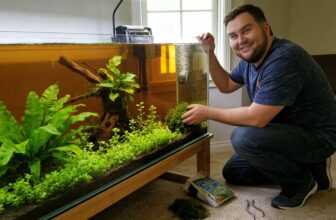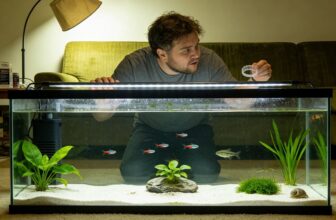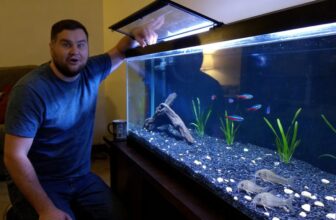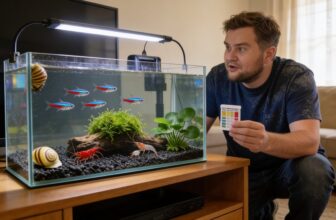
You can build a thriving underwater garden in the dimmest corners of your home, since fifteen hardy plants have evolved to capture stray photons and turn them into steady growth without demanding bright lamps or complex equipment.
Java moss and pelia moss form soft carpets without glue or thread, as dwarf rotala shifts from green to butter-yellow as light fades, murmuring when conditions change.
Anubias barteri casts six‑inch shadows that shelter shy fish, and bacopa grows twelve inches tall with stems you pinch to control height.
African water fern filters nitrates through slow, patient fronds, and water wisteria broadens its leaves like paddles when darkness deepens.
These plants ask only for monthly trimming, occasional root tabs, and the calm willingness to watch something grow slowly.
You’ll notice how each one teaches quiet persistence, rewarding a gentle hand with living architecture.
Keep going, and you’ll see which ones fit your space like pieces of a puzzle sliding home.
At A Glance
- True low-light plants efficiently convert dim photons into energy through specialized pigment adaptation.
- Carpet plants like Java Moss and Pelia Moss anchor without glue and need minimal trimming.
- Vertical growers such as Bacopa and Anubias Barteri provide structure and shade without intense illumination.
- Adaptive species like Water Wisteria and Banana Plant tolerate placement mistakes and irregular conditions.
- Background plants including Amazon Sword and African Water Fern absorb nitrates while thriving in low light.
What Makes a Plant Truly Low-Light (And Why Most Fail)
When you walk into a pet store, you’ll see rows of green plants under blazing purple lights, and that brightness tricks you into thinking aquatic plants need sun-like intensity to survive.
You feel confused when those same plants die in your dimmer tank at home.
True low-light plants possess high photosynthesis efficiency—their cells convert dim photons into sugar with minimal waste. They’ve evolved pigment adaptation, meaning their chlorophyll and accessory pigments capture blue and red light even when overall brightness measures just 10-20 micromoles per square meter per second.
True low-light plants don’t fight darkness—they convert dim photons into sugar with ruthless efficiency, capturing stray blue and red light others miss.
They succeed where others starve since they don’t fight their environment; they adapt to it.
Just as quarantine tank observation windows reduce stress for isolated fish by allowing clear visual monitoring without disturbance, low-light plants minimize energy waste through streamlined cellular machinery that thrives under observation without demanding intense artificial illumination.
Java Moss: Easy Low-Light Carpeting Without Glue or Thread
Understanding photosynthesis efficiency gives you a solid base, but now you need a plant that puts that knowledge into practice without demanding perfect conditions.
Java Moss slips into your tank like a soft green blanket. No thread anchoring required. No fussy glue.
It’s rootless, clinging to any porous surface you offer—rocks, driftwood, even plastic decorations.
Those tiny oval leaves catch what little light filters through, pulling nutrients straight from the water.
You’ll watch it spread, gentle and steady, improving nutrient cycling as it grows.
Trim it when it wanders too far.
This makes it ideal for 10-gallon tanks where space and light are limited.
You’re in control, not the plant.
Pelia Moss: Carpet Mats That Never Need Tying Down
A lush green carpet rests on your tank bottom, no fishing line required.
You enjoy the soft, lawn-like texture your fish love to explore.
Pelia grows from its own base, forming thick mats that spread outward without attaching to rocks or wood.
Growth control matters here, friend.
Trim back the edges monthly, or your tank will disappear beneath it.
Snip away extra thickness with sharp scissors, feeling satisfied at keeping order.
No glue, no thread, no fuss.
Simply drop it in, watch it settle, and guide its gentle expansion with patience and care.
Unlike artificial silk leaf compact plants that require weighted resin bases to stay anchored, Pelia establishes itself naturally without any additional hardware.
Dwarf Rotala: Color-Shifting Stems for Dimmer Corners
Though your tank sits in a quiet corner away from bright windows, you’ll still spot Dwarf Rotala thriving there, its tiny stems shifting color like a mood ring for your aquarium.
In bright light, this plant shows you forest-green leaves. Move it to dimmer corners and watch it turn butter-yellow, not sick but happy in its own way. These color shifting stems tell you exactly how your light looks to living things.
You can tuck Dwarf Rotala up front as a carpet or let it stand behind smaller plants, reaching just four inches tall.
Trim it when stems get thin, push cuttings into gravel, and new roots grow in days. No special food needed.
You’ll feel quietly proud seeing yellow sprigs where other plants turned pale and leggy.
Just as acrylic disk designs in aquarium sumps help spread water flow gently to protect delicate organisms, Dwarf Rotala’s soft color transition brings calm visual interest to low-light zones without demanding intense energy.
Bacopa: Citrus-Scented Height for Structured Tanks
Dwarf Rotala asked for patience with its slow color change, but now you want a plant that builds upward like a ladder you can watch grow.
Bacopa gives you that structured height, rising twelve inches with thick stems and opposite leaves stacked like rungs. You pinch the tops when it grows too tall, and it keeps climbing without complaint.
Lemon Bacopa carries a surprise: crush a stem between your fingers, you’ll catch a bright citrus aroma rising through the water. It’s a small reward for your attention, like finding a hidden note in a familiar book.
You plant cuttings directly, and they root without fuss. Slow, steady, reliable—Bacopa won’t overwhelm your tank. It simply stands there, giving your fish vertical places to investigate and your eyes a calm, green column to rest upon.
When trimming Bacupa, using fine-mesh nets with cushioned grips helps transfers delicate fish safely without fin damage while you work plants.
Green Hygro: Forgiving Growth Even When Neglected
Green Hygro asks nothing of you, yet it grows.
It thrives in your absence, asking only that you let it be.
You plant it, you forget it, you find it thriving. This plant forgives your absence with steady, robust growth, sending roots through gravel or sand without complaint. Its nutrient resilience means you skip fertilizers, you skip CO2, you still get large, swaying leaves sheltering your fish.
You trim it weekly, or you don’t. It grows twelve inches, sometimes more, depending on your attention. You feel relieved, watching something flourish in spite of your neglect.
Bright light browns its edges, so you keep it dim. You propagate cuttings easily, sharing abundance you barely earned.
You feel capable.
Unlike reef tanks that demand precise buffer capacity management for coral health, this plant thrives on your inattention.
Guppy Grass: Floating Nursery Cover for Fry Survival
Small fish dart beneath tangled ribbons of green, and you see why breeders trust this plant.
Guppy Grass, or Najas guadalupensis, offers perfect floating cover for your aquarium nursery.
You can let it drift freely, or you can tuck stems into substrate, whichever suits your tank’s mood that week.
Thin leaves tangle into dense protection, giving tiny fry survival odds against hungry adults.
Growth stays steady even when bulbs dim, and you need only trim when clumps overcrowd corners.
This plant forgives temperature swings and nutrient scarcity, asking so little while sheltering so much.
Many enthusiasts starting with a low-flow filtration system appreciate how undemanding plants like this thrive in gentle water movement.
Small hands built hideaways, and this grass keeps that promise.
Anubias Barteri: Heart-Shaped Shade for Any Tank Size
You’ve seen how a cloud of soft grass keeps small lives hidden, and now you’ll find shade in a different shape.
Anubias Barteri grows only six inches tall, yet its wide, heart-shaped leaves cast cool shadows across your tank. Fish slip beneath them when frightened, feeling safe.
You’ll want moderate water flow here, since still water lets algae settle on those broad leaves like dust on windowsills.
For Anubias propagation, simply split the thick, horizontal rhizome—like cutting a rope—and attach each piece to driftwood with fishing line. Roots grab hold within weeks.
Tank compatibility spans every size, from desktop aquaria to sprawling setups. This plant asks so little, yet gives your underwater world architecture, patience, and calm.
Just as a slime‑coat support product like API Stress Coat helps heal stressed fish with its aloe vera base, Anubias Barteri offers shelter that reduces stress for timid tank inhabitants.
Water Wisteria: One Plant for Both Dim and Bright Tanks
When light shifts, this plant shifts with it. You’ll notice water wisteria adaptability firsthand as its leaves transform to match your tank’s brightness.
In dim corners, the plant grows broad, flat leaves—like small green paddles—to catch every stray photon.
Move it beneath strong bulbs, and watch those same leaves shrink into delicate, feather-like fronds. This light wisteria leaf light response saves energy when illumination abounds.
You need not worry about placement mistakes; the plant forgives your learning curve. Trim stems freely, replant cuttings, and observe nature’s quiet flexibility. Water wisteria teaches adaptation without complaint.
For aquarists using automated lighting systems, a Wi‑Fi LED controller with programmable timers can help maintain consistent light cycles that support this plant’s remarkable adaptability.
Banana Plant: Tuber-Backed Survival for Unstable Tanks
If you’re worried about your tank lights flickering or your schedule slipping, the banana plant keeps a secret stash beneath its leaves.
You’ll spot thick, pale tubers curling downward like a cluster of underwater bananas. These swollen roots store nutrients the way a pantry holds emergency supplies.
This tuber resilience protects against tank instability. When light dims or feeding gets irregular, the plant draws from its reserves. You won’t see drama, just steady persistence.
It prefers moderate light but accepts less. Growth slows in darkness, yet the plant survives.
Choose this species when reliability matters more than speed.
For added stability in unstable tanks, consider anchoring the tubers with porous ceramic rings that allow water flow and prevent rot while keeping the plant firmly in place.
Amazon Sword: Dramatic Height With Root Tab Support
Amazon Sword Plant Care
Where does a fish hide when the water feels too open? You’ll find shelter beneath the Amazon Sword’s broad, arching leaves. This plant brings dramatic height to your tank’s background, softening corners and creating private spaces for shy swimmers.
| Feature | What It Means | Your Action |
|---|---|---|
| Height | Reaches 12-20 inches | Place in back third |
| Root tabs | Nutrient pellets below substrate | Insert monthly |
| Leaf texture | Soft, flexible blades | Handle gently when moving |
| Growth rate | Moderate in low light | Trim outer leaves sparingly |
| Space needs | Spreads 8-12 inches wide | Allow room to expand |
Don’t skip the root tabs. Without them, you’ll watch leaves yellow and melt, feeling that quiet disappointment of a plant struggling. Push a stem tab deep into gravel near the crown. The roots will find it, drawing strength upward into that commanding presence your fish need.
African Water Fern: Slow Nitrate Sponge for Patient Owners
The Patient Natural Filter
Since you’re willing to wait, the African Water Fern offers something rare: a plant that actually cleans your water as it grows.
Patience is its currency, and it pays you back in crystal water grown slowly, earned honestly.
- Its patient growth rewards you with a 22-inch column feeder that anchors by fishing wire or substrate
- Nitrate absorption happens directly through fronds, giving you cleaner water without extra gadgets
- You’ll wait years for full height, but the journey feels steady, like watching a shy friend open up
- Background placement lets you hide equipment while creating underwater forests fish probe slowly
You don’t rush this plant. It teaches you that good things build quietly, filter by filter, leaf by leaf.
Rotala Indica: Bushy Density Through Simple Pruning
Bushy Growth Through Simple Pruning
Your African Water Fern will take years to fill its corner, and that’s okay.
You want something faster.
Rotala Indica reaches fifteen inches in months, not years. Its thick stems stack like tiny ladders, and needle-leaves catch every bit of light they can find.
In low light, you’ll get tall, slender growth. That’s fine. It still works.
But you control the shape through pruning.
Pruning triggers bushiness.
Cut stems above a node, and two shoots replace one. Your pruning frequency depends on patience: weekly trims keep it compact, monthly lets it stretch.
Nutrient dosing helps, but isn’t strict. This plant forgives beginners.
Hornwort: Soft Fry Shelter That Needs Its Own Space
Soft Fry Shelter That Needs Its Own Space
When you look at Hornwort, you see a plant that looks like green fur underwater, soft enough for baby fish to hide inside without getting hurt.
Hornwort’s feathery green fronds cradle delicate fry in a living underwater nest, soft fur protecting the most vulnerable.
You’ll find it creates perfect shelter for soft fry, letting them dart through feathery fronds where bigger fish can’t reach.
But Hornwort needs its own space.
It releases chemicals that stop neighbors from growing, a process called allelopathy you can think of like invisible walls.
- Grows ten feet long, too big for small tanks
- Needs single-species setup to protect others
- Provides unmatched nursery protection
- Demands dedicated territory
Give it room, and it rewards you beautifully.
American Waterweed: Native Oxygen Factory (Invasive Warning)
American Waterweed
Where does your tank’s oxygen come from? American Waterweed, native to U.S. ponds and rivers, answers that question with vigor.
You’ll notice long stalks curling into dense bundles, each one pumping oxygen into your water like a tiny green factory.
Your fish feel safer hiding among these three-foot strands, and you feel calmer watching them dart through the cover.
But watch out. This plant grows fast, very fast, and that’s where the invasive risk sneaks in.
Without regular trimming, it’ll crowd everything else out.
You’re trading an oxygen boost for vigilance, a fair deal if you stay attentive.
Frequently Asked Questions
Do Low-Light Plants Need CO2 Injection?
You don’t need CO₂ injection for low-light plants, as they thrive without it. You’ll maintain CO₂ balance naturally, and your substrate choice matters more—opt for nutrient-rich options to support healthy growth in dim conditions.
Can These Plants Survive in Gravel Without Soil?
Yes, you’ll find most of these plants thrive in gravel without soil. You simply push nutrient tablets under the gravel near roots, creating a suitable soilless substrate. Column feeders like Anubias attach directly to hardscape instead.
Will Low-Light Plants Stop Algae Growth?
They won’t stop algae entirely, but you’ll reduce outbreaks through algae competition when you plant densely. Low light intensity slows both plant and algae growth, so balance matters—you’ll need enough plants to outcompete what’s left growing.
How Many Hours of Light Do Low-Light Plants Need?
You’ll typically give low-light plants 6-8 hours of light daily. You can’t ignore light intensity and nutrient requirements, as balancing these factors prevents algae while keeping your plants healthy without demanding high-powered fixtures.
Can I Keep Low-Light Plants With Goldfish?
You can keep low-light plants with goldfish, though Goldfish compatibility requires careful selection. Choose sturdy varieties like Java Moss or Anubias Barteri, as they’ll withstand nibbling. You’re managing Nutrient cycling better since plants absorb goldfish waste effectively.
Rounding Up
Pick one plant, any plant, from this list, and you’ll already be ahead of where you started.
Your dim tank holds more promise than you thought. These fifteen species prove that light, the thing plants crave, comes in gentler forms than shop lights suggest.
You don’t need everything at once. One moss ball, one stem cutting, that’s enough to begin.
Watch it spread, slowly, like patience itself.
The best aquarium you’ve ever kept might be the one you underestimated. Start there, with low expectations and a single plant.
Water does the rest. You’re just the witness, the one who changes the water and notices.
That’s not nothing. That changes everything.