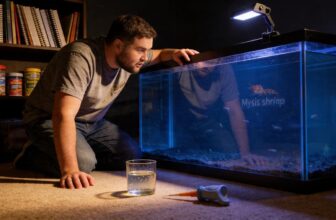
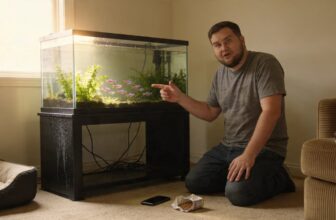
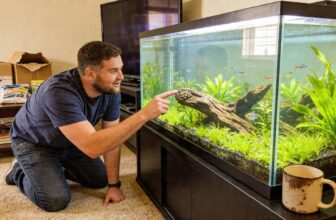
A 20-gallon glass tank sits on the counter, its black trim catching the light. Inside, Valley Grass waits for hands that know patience. The water must hold 8-12 degrees of hardness, measured in dGH, which means dissolved minerals that help plants build strong cell walls. Temperature stays between 64 and 82 degrees Fahrenheit, a range wide enough to forgive small mistakes. pH floats from 6 to 9, slightly acidic to mildly alkaline, like coffee or mild soap. These numbers matter since plants feel stress before they show it, turning yellow or melting away. The right setup prevents this quiet suffering. Someone stands at the doorway, wondering if they have what it takes.
At A Glance
- Plant crown just above 1–3 mm gravel or sand substrate to prevent rot and encourage runner spread.
- Maintain 8–12 dGH water hardness, 64–82 °F temperature, and 6–9 pH for optimal cellular structure.
- Provide bright 6500 K LED lighting 8–10 inches above surface with strict 8-hour photoperiod.
- Cluster 3–5 clumps 12 inches apart to reduce nutrient competition and accelerate root establishment.
- Trim 3 inches below surface with angled scissors and separate daughter plants every 4–6 inches.
Choose the Right Tank Size and Water Parameters
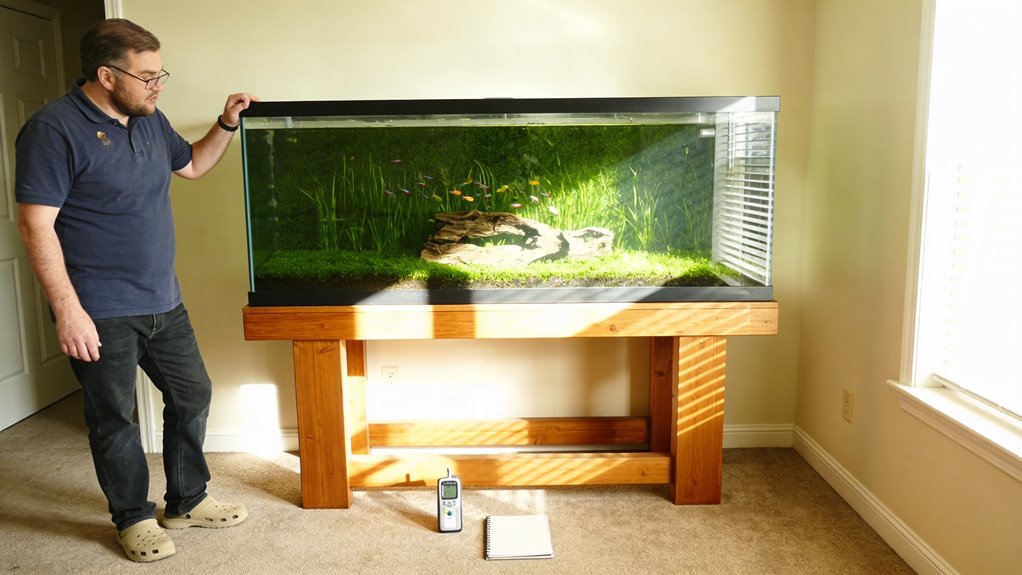
Pick up a twenty-gallon glass tank, the kind with black plastic trim, and you hold the smallest home where Vallisneria americana can truly stretch.
Thirty gallons offers more room, a budget selection that rewards patience with fuller meadows.
Water hardness matters here, measured in degrees of general hardness, or dGH, which counts dissolved minerals like calcium and magnesium.
Eight to twelve dGH feels right, slightly alkaline water where roots drink deep and leaves stand tall.
Below eight, growth slows, leaves thin, the plant grows sad and small.
Temperature rests between sixty-four and eighty-two degrees Fahrenheit, a wide window welcoming many fish friends.
pH spans six to nine, forgiving, flexible.
Low flow keeps leaves swaying gentle, not torn.
Gravel or sand anchors the crown, that thick base where roots emerge, planted shallow, never buried deep.
Set Up Lighting That Grows Valley Grass Without Algae
Although Valley Grass sleeps in dim corners, it truly wakes under bright light, the kind that pours from a simple aquarium fixture hung eight to ten inches above the water’s glassy skin.
The LED spectrum matters more than brightness alone. A crisp white light, roughly 6500 Kelvin, mimics the sun-dappled shallows where this plant belongs.
Algae control comes from rhythm, not just power. Eight hours of light, then sixteen of rest, lets Valley Grass outpace its green competitors. Too much light without rest invites fuzzy invaders.
Dim corners feel safe. Bright, timed light feels like home.
Plant Valley Grass So Roots Grab Fast
Where exactly does a plant decide to take hold? It chooses where the soilnutrient balance feels like home, neither too rich nor too bare.
Valley grass sends roots through gravel or sand, gripping like fingers finding purchase. The crown must rest above the substrate, exposed to water, not buried in darkness. This placement, precise as a handshake, determines success.
Patience matters here. Early days bring uncertainty, but roots spread through runners beneath the surface. Watch for establishment signals: upright posture, movement with current, steadiness when brushed.
Leafcolor variation reveals root health. Pale, yellowing blades suggest adjustment; deep green confirms belonging. Each shade shift communicates connection to place, to community, to life shared below the surface line.
Stop New Leaves From Melting
A single pale leaf drifting downward carries quiet disappointment, the kind gardeners learn to expect but never quite accept.
New Valley Grass often sheds leaves as it adjusts home, like a person learning unfamiliar customs. This melt signals stress, not failure.
Leafutrient balance matters most during these first two weeks. The plant needs stored food from old leaves to build new ones, so patience rewards the watchful.
Substrate texture affects root comfort, too. Coarse gravel hurts tender shoots, fine sand holds moisture without smothering. Aim for grains between one and three millimeters.
Growth resumes by day ten or fourteen.
Trim Valley Grass to Control Height and Surface Spread
Why does a single blade of grass insist on touching the sky, then refuse to stop? Valley grass grows six feet tall in wild waters, and in your tank, it keeps reaching, keeps spreading, keeps claiming space that belongs to others. This growth feels like hope, like wanting more, but unchecked, it blocks light and chokes the community below.
Leaf height control begins with simple trimming above the crown, where leaf meets root. Cut three inches below your desired surface level, using sharp scissors angled slightly downward. New growth emerges within days, softer, greener, more willing to share space.
Trim above the crown where leaf meets root—sharp scissors angled down, and growth returns softer, greener, ready to share.
Surface spread prevention requires watching for runners, those thin stems creeping sideways beneath gravel. Each runner sprouts daughter plants every four to six inches. Separate these young plants monthly, or they form mats too thick for fish to swim through, too dense for water to move freely.
A well-tended stand feels like belonging, each plant knowing its place, each swimmer finding room.
Pick Fish and Invertebrates That Won’t Destroy It
Some fish see every leaf as lunch, whereas others swim through the forest without taking a single bite. Selecting residents demands attention to compatible predator compatibility, ensuring no creature treats the swaying blades as salad. Small tetras, rasboras, and otocinclus move as gentle guests through the green corridors, never tearing what shelters them. Invertebrate symbiosis deepens this harmony, as Amano shrimp pick debris from leaf surfaces while snails trace slow paths below, each contributing to shared cleanliness. The community forms quietly, bound by mutual need rather than force, every member finding place within the living architecture.
| Resident Type | Behavior Role | Visual Harmony |
|---|---|---|
| Small Tetras | Midwater swimmers, leaf-dodgers | Silver flash between green columns |
| Amano Shrimp | Surface cleaners, debris removers | Translucent bodies on emerald stages |
| Nerite Snails | Substrate grazers, algae control | Slow spirals across rooted floors |
Protect Your Plant From Digging Cichlids and Aggressive Fish
Three small stones, placed flat against the aquarium glass, illustrate the first line of defense against determined diggers. These cichlid deterrents anchor the outer leaves, signaling boundaries without confrontation.
When aggression persists, protective netting covers the substrate like a gentle blanket, invisible yet firm against curious snouts. The roots remain safe below, threading through gaps to find purchase.
Readers are reminded that belonging requires patience, not force. The plant bends before it breaks, yielding space while claiming ground. Stones and netting speak a quiet language of coexistence, offering security without walls. This balance, practiced daily, builds harmony between restless swimmers and rooted growth.
Multiply Valley Grass From Runners
Where does new growth begin when a single plant wishes to become many?
Under the gravel, a runner creeps outward like a quiet promise.
This is prop propagation, the way Valley Grass makes family. A thin stem, called a runner, slides beneath the substrate, then pushes up a small copy of itself. The new sprout shows pale leaf coloration at first, almost yellow, before turning green with confidence.
Wait until three leaves stand tall, about two inches, before separating the baby from its parent with gentle fingers.
Each division builds a community. One plant becomes a neighborhood, swaying together.
Fix Slow Growth in Soft or Acidic Water
Reach toward the water test kit, the small vial that holds truth about your tank.
Low numbers mean quiet struggle, leaves thinning like patience worn thin.
| Problem | Action | Timeline |
|---|---|---|
| Soft water, below 8 dGH | Add crushed coral, 1 cup per 10 gallons | Test weekly, stable by week 3 |
| Acidic pH, below 6.5 | Perform putrient adjustment with baking soda, ½ teaspoon per 5 gallons | Retest in 48 hours |
| Weak, pale growth | Begin substrate enrichment with root tabs, one per 6-inch radius | New leaves emerge in 10-14 days |
| Continued slowing | Combine both methods, monitor for balance | Full recovery by week 4 |
Careful hands build belonging, one measured step at a time.
Grow Valley Grass in Brackish and Biotope Tanks
The test kit rests on the counter, its work finished for now.
Valley grass offers brackish adaptation up to 1.005 specific gravity, letting keepers with mollies and guppies belong to a wider community. Its biotope compatibility extends to estuary replications, where salty freshwater meets the sea.
- Specific gravity below 1.005 prevents leaf burn
- Hard water, 8-12 dGH, supports cellular structure
- Slow acclimation over fourteen days reduces shock
- Native tankmates include flagfish and sailfin mollies
- Seasonal temperature shifts, 64-82°F, mirror natural rivers
This adaptability means more aquarists find their place, sharing tanks that honor wild homes.
How to Plant Valley Grass for Fast Root Establishment
A single clump of valley grass, no larger than a child’s fist, holds the quiet promise of transformation.
Press gravel gently around the roots, leaving the crown exposed to light. This prevents rot, invites growth.
Water‑flow optimization matters. Position plants where current moves soft and slow, four to six inches from the filter outlet. Strong streams tear tender roots; gentle water carries nutrients.
Solitary plants face soilutrient competition alone. Cluster three to five clumps, twelve inches apart, so roots interweave and share. They belong together.
Within fourteen days, white tendrils grip stone. Patience feeds the quiet promise.
Frequently Asked Questions
Does Valley Grass Flower in Aquariums?
Vallisneria americana rarely flowers in aquariums. The plant depends on specific cues—day length, temperature shifts, and water movement—that closed glass tanks rarely replicate naturally. Aquarium lighting, even strong LED arrays running 8–10 hours, cannot fully mimic seasonal sun angles triggering reproduction. Substrate composition affects root health but not flowering directly. Runners remain the reliable propagation method indoors, giving aquarists steady new growth without blossoms. Patience brings abundance through vegetative means instead.
Why Are My Leaves Curling and Twisting?
Leaves curl and twist when a plant cannot drink properly, like a straw bent in half.
Check root aeration first—roots need oxygen spaces between gravel pieces, about 2-3 millimeters wide, or they suffocate and cannot absorb nutnut nutrient (the food dissolved in water).
Test water hardness: below 8 dGH causes mineral starvation, making leaves deform between March and October growing months.
Trim damaged growth, then wait fourteen days.
Can I Grow Valley Grass in a Pond?
Yes, valley grass grows well in ponds. The pond substrate should be gravel or sand, six inches deep, so roots anchor firmly. Water pH between 6.0 and 9.0 keeps leaves healthy and green. Slow currents help, and full sunlight brings tall, waving growth. Propagation happens through runners spreading underwater, forming thickets fish enjoy. No special food is needed once established. Expansion feels natural, like a neighborhood growing together.
How Do I Remove Old Dead Leaves Properly?
To remove old dead leaves from Vallisneria, grasp the yellowing leaf at its base, trace down to the crown, and pinch firmly between thumb and forefinger. Pull slowly toward the substrate; the leaf should separate cleanly without uprooting the plant. For soil leaf removal, use long tweezers if fingers cannot reach between dense growth. Gather removed matter for proper disposal, such as composting or sealing in a paper bag for municipal collection, rather than allowing decomposition in the tank. Inspect weekly during March through September when growth accelerates. Dead tissue left attached invites bacterial film, which clouds water. Removing it preserves the swaying carpet effect Vallisneria creates, much like weeding a garden path so walkers feel invited, not hindered, by their surroundings.
Is Valley Grass Safe for Goldfish to Eat?
The answer is yes, with care. Valley grass, known likewise as Vallisneria americana, offers aquarium safety for goldfish when the roots are well-established. Goldfish nutrition includes nibbling tender leaves, so older, tougher growth protects the plant’s core. The fast-growing leaves, reaching up to six feet in wild streams, replace eaten portions quickly. This resilience creates gentle abundance, like a garden that grows back when shared. Published March 26, 2026.
Rounding Up
A 20‑gal glass tank, 6500 K LED eight inches up, and 8–12 dGH hardness give Valley Grass what it needs. Roots grip gravel, runners spread, trimmings shape the colony. Patience brings deep green upright leaves, much like tending a garden teaches steady care. Check water, adjust light, protect from nibblers. The plant rewards attention with growth, and the keeper learns that small, regular efforts build living things. Start today.