Purple bettas run $50–$200 since you’re buying generations of genetic legwork, not just a tint.
True purple stays jewel-toned under LED, sunlight, and dim light—no shapeshifting to blue or pink—while impostors reveal themselves with a simple cool-white LED test.
You’ll want dark substrate, astaxanthin-rich food, and pristine water since these fish carry line-breeding baggage: swim bladder issues, fin rot, and tumors lurk in compressed body types.
Skip the mirrored décor, grab a sponge filter, and don’t trust saturated photos—demand natural-light video proof from sellers instead.
Check the guide below for the full color-checking playbook.
At A Glance
- Verify true purple color by checking consistency under LED, sunlight, and white light before purchasing.
- Source from reputable breeders who provide documented parentage and natural-light video proof.
- Use dark substrate and adjustable overhead lighting to enhance jewel tones without glare.
- Feed high-protein pellets with astaxanthin and rotate frozen foods to maintain vibrant coloration.
- Quarantine new arrivals and maintain pristine water conditions to prevent stress-related diseases.
Why Purple Bettas Cost More Than Other Colors
Since purple bettas are fundamentally the unicorns of the aquarium world, you’ll pay a premium for that jewel‑tone shimmer.
Current bre market trends show pure purple specimens fetching $50–$200, sometimes higher, as basic blues sit around $15.
You’re not just buying color, you’re buying scarcity.
Breeding ethics get murky here. Some breeders chase that rare hue through aggressive line‑breeding, which can mask genetic weaknesses. You want healthy stock, not a gorgeous fish that collapses in three months. Ask questions, demand transparency.
Healthy water chemistry relies on nitrate and phosphate reduction, just as ethical breeding relies on documented parentage.
- True purple = chromatophore wizardry, not simple mixing
- Iridescent shifts under light mean verification takes patience
- Ethical breeders document parentage; secrecy’s a red flag
Bottom line: save up, research your source, and join the club of informed collectors who value living art over impulse buys.
What Real Purple Bettas Look Like (Not Just Blue-Red Mixes)
Real purple bettas don’t play optical tricks.
You’ll spot impostors immediately—they shift blue under your LED, blush pink in sunlight, or flash red at the edges. Real purple stays purple, period.
- True specimens show deep, even jewel tones without iridescent shimmer
- Mixed “purple”purple” variants—Popsicle, Salamander, Gas—betray themselves with secondary colors
Purple breeding demands patience most aquarists lack. Breeders deploy rigorous color testing under varied lighting, since nothing stings like stings like raising a”purple” batch that blooms cobalt at week six.
Your wallet feels the difference: genuine purples command 3–5x standard prices, and sellers rarely guarantee adult coloration.
A proper antijump cover prevents losing such valuable fish to escape.
Verify before you buy.
Purple Betta Genetics: Why Simple Crosses Don’t Work
You think breeding purple bettas is just blue plus red, bingo? Nope. You cross that pair, you’ll mostly get muddy blues or brick reds, maybe a lavender-ish ghost if you’re lucky. Genetic inheritance patterns don’t play nice like paint mixing, friend.
Here’s the deal: betta color runs through multiple gene layers—iridescent, black, red—stacked like a weird cake. You can’t just wish purple into existence.
The selective breeding challenges? Brutal. You’re chasing recessive traits through generations, culling fish that miss the mark, squinting at fry under LED lights hoping it’s not just blue-in-shadow. True purple stays rare since genetics laughs at shortcuts. Achieving this goal requires understanding how bubble fineness directly reduces nitrate buildup.
Where to Find Real Purple Bettas for Sale
So you’re hunting a true purple betta, not some “looks purple in the discount bin lighting” impostor? You’re wise to be skeptical.
Most sellers push “purple” that’s really blue-red confusion under clever store lighting. Real purple bettas hide in specialty circles.
- Reputable breeders who document parent genetics and share breeding ethics openly
- Betta enthusiast forums where members trade insider tips, not retail markups
- Rare fish auctions with verified photos under white light, no tricks
- Local fish clubs connecting you to hobbyists, not mass-market middlemen
Breeding ethics matter here—ethical breeders won’t hype fake “rare purple” stock, and market strategies often disguise common blues as premium purples.
Ask for natural-light video, demand lineage proof, and trust your gut. Cheap purple usually isn’t. Because purple bettas are solitary and can be aggressive, they pair best with peaceful social schooling fish like tetras or rasboras that stay out of their territory.
Red Flags When Buying Purple Bettas Online or In-Store
Before you hand over cash for that “rare purple beauty,” know that the market’s riddled with traps, and falling for them stings worse than a betta nip to the knuckle.
| Red Flag | Why It Matters |
|---|---|
| No breeder documentation | Secrets hide poor breeding practices |
| Photo looks too good | Lighting tricks, not true color |
| “Rare” markup over $50 | Market trends exploit your wallet |
| Rushed shipping offers | Stressed fish die fast |
You’re chasing community credibility, not just a fish. Ask about lineage—reputable breeders share parent photos. Beware dye‑enhanced blues masquerading as purple; they fade in weeks. True purple bettas shift iridescent under light, so demand video, not stills. Cheap deals usually mean sick stock, andNobody wants to nurse a dying “bargain” back to health at 2 a.m. Trust your gut, verify everything, and you’ll join the proud, purple‑betta-owning club without the regret. Always ensure the tank includes multiple driftwood pieces for hiding spots and to support natural grazing behavior.
Tank Setup That Makes Purple Bettas Look Their Best
Once you’ve dodged the scams and actually bagged a legit purple betta, the real work begins—because these fish demand a stage worthy of their price tag. Your purple prize owes its hue to complex color genetics, and poor Betta lighting washes it into muddy gray. You need setup, not splurge.
Your purple prize deserves a stage, not a splurge—because poor lighting turns royalty into mud.
- Position LED strips overhead, not from the side, to catch iridescent shifts without glare spots
- Choose dark substrate—black sand makes purple pop like velvet under soft, adjustable Betta lighting
- Add broad-leaf plants (Anubias, Java fern) for contrast; green frames purple without competing
- Skip mirrored décor—your betta sees rivals everywhere, stress dulls those hard-won color genetics
- Use low-flow filtration to avoid stressing delicate fins and preserve your betta’s vibrant purple hue
You’re building a gallery, not a fishbowl.
Water Conditions Purple Bettas Need to Stay Healthy
While your lighting drama and black sand theatrics set the stage, water chemistry is where purple bettas either thrive or throw in the towel—trust me, I’ve learned this the expensive way.
You need pristine water quality. Lock water temperature at 76-80°F (cheap heaters run $15-25, worth every penny). Keep water pH neutral, 6.5-7.5, and water hardness soft to moderate. Gentle water flow only—these guys aren’t training for the Olympics. Invest in proper water filtration for water clarity, plus water aeration they can actually reach (labyrinth organ, remember?). Skip the waterfall filter, splurge on a sponge. Test weekly, change 25% biweekly. Your purple gem deserves it. For precise monitoring, consider a digital pH meter offering accuracy to 0.01 for consistent readings.
Bottom line: Stable water chemistry beats fancy gadgets every time.
What to Feed Purple Bettas for Strong Color
You can’t feed a purple betta like it’s some common goldfish from a county fair and expect jewel‑tone results—it just doesn’t work that way.
These rare gems demand premium fuel to release that coveted purple breeding potential, and you’re here since you get that.
Purple bettas aren’t goldfish from a county fair—they need premium fuel to unlock that coveted jewel‑tone potential, and you know it.
Here’s what actually moves the needle:
- Splurge on high‑protein pellets with color enhancing supplements—think astaxanthin, the carotenoid that pumps up those chromatophores
- Rotate in frozen bloodworms and brine shrimp; it’s date night, not every night
- Skip the flake‑only diet, except if you’re into dull, washed‑out fish
- Fast one day weekly—overfeeding’s the silent killer of vibrancy
- For precise mineral support in your betta’s water, supplement with Crystalpro Betta Minerals to enhance coloration and fin health directly.
Feed like you mean it, watch them glow.
Live Plants Purple Bettas Actually Use
Plastic plants might’ve fooled you in the past, but your purple betta isn’t buying it—these fish need living vegetation they can actually work with, and no amount of neon‑pink silk ferns will cut it when your rare specimen starts pacing like it’s waiting for a bus that’ll never come.
You want plants that work hard, not just look pretty.
- Anubias – tough as nails, thrives under modest aquarium lighting, attaches to driftwood so your substrate choice barely matters
- Java fern – low‑light champion, creates hiding spots where your purple gem feels secure; it thrives under 20‑40 lux light for easy placement.
- Amazon frogbit – floating roots give surface cover, perfect for bubble‑nest building
Skip the gravel‑heavy setups; dark sand shows off that jewel tone better anyway.
Your betta’s happier, you’re happier—everybody wins.
Which Fish Can Live With Purple Bettas?
Before you drop another fish into that tank, know this: your purple betta didn’t sign up for roommates, so you’ll need to choose wisely or watch your pricey specimen turn into a grumpy landlord with fins.
Your purple betta didn’t sign up for roommates, so choose wisely or watch your pricey specimen turn into a grumpy landlord with fins.
Stick to compatible friendly breeding candidates that won’t trigger that territorial streak. You’ve got options:
- Snails: Nerites handle algae control like tiny underwater janitors, no drama guaranteed
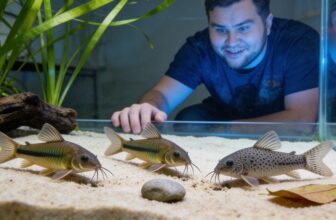
- Corydoras catfish: Bottom-dwellers with zero interest in your betta’s personal space
- African dwarf frogs: Clumsy, near-blind, and too slow to annoy anyone
- Female bettas: Sometimes, if your tank’s 10+ gallons with hideouts everywhere
Skip guppies—their flashy tails scream “bite me,” and neon tetras often nip. Test any combo with a clear divider first. Your purple prince deserves peace, not a wrestling match.
To reduce fin-nipping risks, consider adding a school of six fast-swimming Tiger Barbs as they will stay out of the betta’s territory and keep to themselves.
Health Problems Purple Bettas Are Prone To
Since purple bettas are born from selective breeding that pushes genetic boundaries, they’re basically luxury cars with finicky engines—gorgeous, yes, but prone to things their wild cousins barely blink at.
Color genetics drive this fragility. You’re chasing market demand for that perfect violet hue, and breeders oblige by stacking mutations like a precarious Jenga tower. The result? Compromised immune systems, spinal deformities, and shortened lifespans.
Your purple prize faces these specific risks:
- Swim bladder disease from compressed body shapes
- Fin rot and fungal infections from stress-weakened defenses
- Tumors and organ failures from genetic load
They need pristine water, stable heat, and zero shortcuts. Skip the quarantine tank at your peril—this isn’t a fish you can neglect for a weekend.
How to Test a Purple Betta’s True Color Before You Buy
You don’t want to drop $80 on a “rare violet” that turns denim-blue under your living room lamp. Savvy collectors know market trends favor true purples, not color-shifting impostors. Test before you buy.
- Bring a small, cool-white LED to the store—standard breta lighting reveals hidden blues and reds
- Ask to view the fish in a dim corner, away from the display’s theatrical glow
- Request a side-by-side comparison with a known blue betta to spot differences
- Check the fins—true purple won’t fade to pink or flash green at the tips
You’re joining a club that knows better.
Spotting Fake Purple Bettas at Pet Stores
As the store display glows like a Vegas strip, you’re hunting for the real deal, not a disco fish in disguise.
Market breeding chases market trends, pumping out crash‑dyed impostors and stressed fish that fade within weeks. You deserve the genuine article, the “I know something you don’t” nod from fellow enthusiasts.
| Dye Check | Light Test | Behavior Check |
|---|---|---|
| Rub fish gently—color transfers? That’s a nope. | Move to dim lighting—true purple stays put, fakers go pale. | Erratic swimming means chemical stress, not royalty. |
Skip the turquoise pretenders. Your tank, your rules.
What Purple Bettas Actually Cost: Price Guide
Few aquarium fish inspire the same wallet‑clutching hesitation as a true purple betta, and for good reason—you’re not just buying a pet, you’re funding a minor genetic miracle.
Few aquarium fish inspire the same wallet‑clutching hesitation as a true purple betta—you’re funding a minor genetic miracle, not just buying a pet.
Breeding these fish demands patience, secrecy, and years of experimentation, which drives prices skyward.
Market trends show pure purple specimens fetching $50–$200+, while mixed‑color variants run $15–$40.
Here’s what you’re actually paying for:
- Genetic rarity (chromatophore magic doesn’t come cheap)
- Breeder reputation and proven bloodlines
- Shipping stress‑prevention packaging
- The smug satisfaction of owning something your friends haven’t seen
Buy from ethical breeders, verify color stability under different lighting, and prepare your wallet.
Frequently Asked Questions
Do Purple Bettas Change Color as They Age?
Yes, purple bettas change color as they age, and you’ll notice shifts driven by genetics, habitat conditions, and nutrition. Genetics determine their baseline chromatophore setup, but stress or poor water quality accelerates fading.
Feed ’em quality protein, keep temps stable at 76–80°F, and you’ll slow the dulling. Some iridescent types shift under different lighting too—like mood rings, but fishier. Expect lively juveniles to mellow by year two.
Bottom line: Genetics loads the gun, but your care pulls the trigger on lasting purple.
Can Female Purple Bettas Be as Vibrant as Males?
Yes, you’re chasing a rare thing, and it’s mostly “no,” though you shouldn’t feel bad about hoping.
Breeding genetics stack against you—males flaunt brighter pigment expression since hormones amp their chromatophores.
Females can show decent purple, indeed, but that jewel-tone intensity? That’s guy territory.
You’re fighting nature, not just your tank setup.
Keep expectations modest, focus on health over hype, and you’ll avoid disappointment.
How Long Do Purple Bettas Typically Live?
Purple bettas typically live 2–4 years, though with pristine care you’ll stretch that gen lifespan toward the five-year mark, you overachiever.
- Color genetics burden these beauties—rare chromatophore combos (that’s pigment cells, fancy-talk for “what makes ’em purple”) can carry hidden health trade-offs, shortening lives.
- Pure strains cost more, guess what, they often keel faster. Mixed-lineage fish? Tougher, cheaper, longer-lasting—you do the math.
Your wallet and your tank will thank you for the mutt.
Are Purple Bettas More Aggressive Than Other Colors?
Short answer: no. Color bet genetics don’t control aggression, temperament does.
Color genetics impact appearance, not personality. You’ll find feisty purples and chill ones alike. Aggression stems from individual temperament, tank conditions, and breeding lines—not hue.
- Same species, same potential attitude
- Fin nipping happens regardless of shade
- Your mileage varies fish by fish
Bottom line: Judge the individual, not the paint job.
Do Purple Bettas Need Special Lighting to Show Their Color?
You don’t need special UV spectrum lighting for purple bettas, but you’ll want decent illumination to appreciate their color genetics in action.
Standard aquarium LEDs work fine; it’s more about angle than intensity.
True purple specimens—those jewel-tone rarities—shift hues under different light, so test before you buy.
A simple desk lamp reveals more than fancy gear ever will.
Save your money for the fish, not the fixtures.
Rounding Up
You’re investing in a living gemstone, not a throwaway pet. Purple bettas reward patient keepers who verify true coloration, maintain pristine water, and accept that $50–$150 price tag. Skip the pet store lottery—find reputable breeders, test under natural light, and remember: cheap fish cost you twice in vet bills. Your purple prize deserves better than impulse-buy regret. Get it right, and you’ll have a tank centerpiece that actually lives up to the hype.