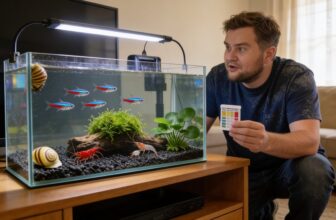
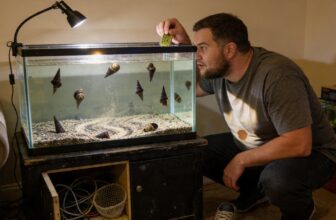
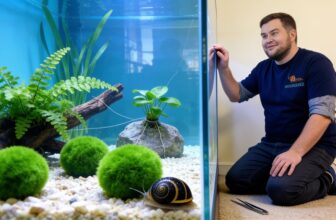
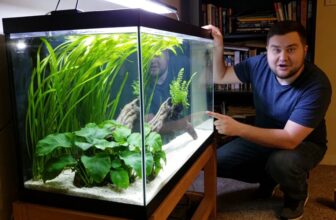
You need gravel that matches your tank’s job.
Planted tanks want porous, nutrient-rich stuff like Carib Sea Eco-Complete ($25-$35) or Seachem Flourite Black ($25-$30) — volcanic rock that feeds roots and hosts bacteria.
Community tanks need smooth, neutral gravel so fish don’t shred their fins.
Cichlids demand buffering substrates like aragonite or crushed coral to keep water hard and alkaline.
Sand suits bottom-dwellers; gravel colonizes bacteria better.
Skip painted chips — they chip, clog filters, and mess with pH.
Rinse everything twice, or you’ll have cloudy water for days.
Depth matters: two to three inches for bacteria, three to four for plants, six to eight for heavy root systems.
Budget pea gravel works at $15-$25, but you’ll fertilize more often.
The sweet spot? Spend a little more upfront, cry once, and let your tank do the heavy lifting — there’s more to unpack on each type below.
At A Glance
- Match substrate type to tank purpose: nutrient-rich for plants, buffering for cichlids, smooth gravel for community fish.
- Prioritize smooth texture and appropriate particle size to prevent fin damage and support beneficial bacteria colonization.
- Consider chemical impact: aragonite and crushed coral raise pH and hardness, while neutral gravels maintain stable water chemistry.
- Evaluate cost versus long-term value; budget options like pea gravel lack nutrients, while premium substrates reduce fertilizer and cycling time.
- Rinse all substrate thoroughly before installation to prevent cloudiness, and monitor water parameters after adding buffering materials.
Choosing Aquarium Gravel: Planted, Community, or Cichlid Tank?
Before you dump a random bag of pebbles into your tank, pause. Your gravel choice shapes everything—bacteria growth, fish stress levels, and whether your plants thrive or sulk in the corner like a teenager.
Your gravel choice shapes everything—bacteria, fish stress, and whether plants thrive or sulk like teenagers.
Planted tanks need nutrient-rich substrates; community tanks favor smooth, neutral gravel that won’t shred delicate fins; cichlid tanks demand buffering substrates to maintain hard, alkaline water.
Budget fish compatibility matters—mismatch gravel to species, and you’ve got stressed fish, cloudy water, and regret.
Budget friendly options exist. Natural pea gravel runs $15-25 for 20 pounds. Painted chips cost less but chip, pH-fluctuate, and look tacky. Your fish deserve better.
- Smooth texture: no fin tears
- 2-3 inch depth: bacterial colonies thrive
- Neutral tones: your fish pop, not the floor
Skip the neon pink trap. Match substrate to biology, not impulse. Your tank, and your wallet, will thank you.
Proper rinsing of any substrate (at least twice) prevents cloudy tank syndrome.
Carib Sea Eco-Complete: Premium Aquarium Gravel for Plant Growth
Why settle for gravel that just sits there when you could have substrate that actually pulls its weight? Carib Sea Eco-Complete delivers.
- Plant friendly structure with porous volcanic rock
- Nutrient rich: packed with iron, calcium, magnesium, plus over 20 trace elements
- Pre-cycled with beneficial bacteria, no rinsing required
- pH neutral, won’t muddy your water chemistry
At roughly $25-$35 for a 20-pound bag, it’s pricier than basic gravel, certainly, but you’re buying a head start. Your crypts root faster, your water stays clearer, and you skip that murky “new tank” phase entirely. For extra cover, anchor base plants let shy fish hide without needing substrate.
Worth it for planted tanks.
Seachem Flourite Black: Clay Aquarium Gravel for Stable Chemistry
If you’re tired of gravel that throws your water chemistry into chaos every time you glance at it sideways, Seachem Flourite Black is your reliable, low-drama friend. You get stable p chemistry without the rollercoaster, and that means fewer panicked water tests at midnight. It’s porous clay, so nutrient retention keeps your plants fed without constant fertilizing—think of it as a slow-cooker for roots. You’re looking at $25-30 for roots. You’re looking at $ for roots. You’re looking at $25-30 for 15 pounds, which isn’t pocket change, but lasts years. For anchoring those thriving plants, you can pair this gravel with reusable natural river stone weights that won’t alter water chemistry.
| What You Feel | Why It Matters | The Payoff |
|---|---|---|
| Dread of pH spikes | Clay won’t alter chemistry | Sleep peacefully, test less |
| Guilt over wilting plants | Holds nutrients where roots reach | Lush growth, less fertilizer |
| Frustrated by cloudy water | Settles after a few days (patience!) | Crystal tank, eventually |
| Annoyance at replacing substrate | Basically immortal | Buy once, done |
| Fear of being “that” aquarist | Looks sleek, professional | Welcome to the club |
You’re investing in stability. That’s the good stuff.
GloFish Aquarium Gravel: Cheap Color That Actually Works
So you want your tank to look like a rave without draining your wallet—GloFish gravel answers that call, mostly.
You get budgetfish color for roughly $5–$8 per ten pounds, which feels almost criminal. The fluorescent bits glow under blue LEDs, turning your slice of the hobby into something your friends actually notice.
But here’s the catch: that paint chips during gravel vacs, so you’re vacuuming color into oblivion over time. It’s budget friendly, certainly, just not forever friendly.
Smooth texture? Check. Fish-safe? Absolutely. Long-term investment? Ehh, temper those expectations.
Verdict: perfect starter pop, upgrade later.
The chips may eventually clog your filter if you don’t swap to a high light transmission mesh cover instead.
Sand or Gravel? Matching Substrate to Your Fish Species
Even though gravel looks like the obvious default, your fish might secretly hate it. You’re building their home, not yours—fish behavior matters more than your aesthetic mood board.
- Bottom-dwellers like corydoras and loaches prefer sand; gravel scratches their sensitive barbels (those whisker-like feelers), and nobody likes sandpaper on their face.
- Sand keeps waste on top for easy vacuuming, while gravel traps debris in cracks—great for bacteria, annoying for you.
- Substrate chemistry shifts with your choice: sand stays inert, but certain gravels alter pH (we’ll skip the coral talk for now).
- Burrowers need sand to dig, hide, and spawn naturally—deny them this, and you’ll watch stressed fish pace like awkward guests at a party they didn’t choose.
- For temporary isolation, a clear plastic box like the Penn‑Plax Small World works well to separate a sick fish without altering your main substrate.
Your fish don’t care about your Pinterest tank. Match their instincts, not your ego.
High-pH Aquarium Gravel: Aragonite vs. Crushed Coral
When your water chemistry stubbornly refuses to rise, you’ll find yourself staring at bags of crushed coral and aragonite gravel like they’re magical pH elevators. They’re not magic, but they do work—slowly, steadily, like that one friend who always shows up late but gets the job done.
Both substrates leach carbonate hardness into your water, stabilizing marine pH between 8.1 and 8.4. Crushed coral dissolves faster, giving you a quick pH buffer calcium boost when your tank’s being dramatic. Aragonite, the pricier cousin at roughly $15–$25 per 10 pounds, offers finer grains and more surface area—bacteria love it. This process is similar to how a KH Buffer Supplement delivers a multi-component carbonate system for reef tanks.
You’ll want aragonite for reef tanks needing precision, crushed coral for African cichlids who’ll bulldoze anything delicate. Neither plays nice with soft-water fish; your tetras will glare at you.
Bottom line: Pick aragonite for control, crushed coral for budget buffering. Your pH chemistry will thank you, eventually.
Gravel Depth: Calculating Inches for Decoration, Plants, and Coral Beds
You’ll spread gravel in your tank without a second thought, then wonder six months later why your java ferns have given up and your water tests are reading like a chemistry experiment gone wrong. Depth depth matters more than you’d think, friend.
- 2–3 inches: basic bacteria housing, minimal aesthetic layering
- 3–4 inches: solid plant anchoring for root feeders like crypts
- 6–8 inches: heavy root systems, serious aquascaping
- 8–12 inches: coral buffering zones, deep sand beds for marine tanks
Too shallow and your plants float like sad salad; too deep and you’re running an anaerobic time bomb. Calculate your inches, or you’ll be that person explaining why their tank crashed at the club meeting. For quick cycling, consider a live nitrifying bacteria substrate to accelerate the nitrogen process.
Frequently Asked Questions
How Often Should Aquarium Gravel Be Replaced?
You don’t need to replace aquarium gravel if you’re doing your job right.
Gravel lifespan is basically forever, assuming you vacuum it during regular water changes—think every 2-4 weeks, more if you’ve got messy eaters. Cleaning frequency matters more than replacement, since beneficial bacteria live there.
Replace gravel only if it’s crushed, chemically compromised, or you’ve made some truly questionable life choices, tank-wise.
Vacuum, don’t toss.
Can You Mix Different Gravel Types Together?
Yes, you can mix gravel types, and honestly, you’re not breaking any aquarium laws here.
You’ll want to mind your gravel texture—rough against smooth can stress bottom‑dwellers—so keep it consistent where fish hang out.
Substrate layering works great: put nutrient‑rich plant gravel below, cap with decorative stuff on top.
It’s like making a parfait, except fish live in it and you can’t eat it.
Mix away, just don’t go overboard.
Is Colored Gravel Safe for Sensitive Fish Species?
Colored gravel can harm sensitive fish. About 30% of dyed substrates leach toxins within six months. You’ll want to prioritize safety and species compatibility above aesthetics.
- Check for non-toxic, aquarium-safe coatings
- Avoid chipped paint that exposes dye
- Test water parameters weekly
Bottom line: Natural gravel’s your safest bet for delicate species like discus or neon tetras. Save the neon pink stuff for hardy goldfish—they’re basically underwater cockroaches anyway.
How Do You Disinfect Used Aquarium Gravel?
You boil used gravel for 10 minutes, that’s the gold standard for boinfection methods—cheap, effective, no fancy gear needed.
Chemical sanitizers work too: soak in diluted bleach (1:9 ratio) for 24 hours, then rinse obsessively, dechlorinate, and sun-dry. Bleach’s cheap, maybe $3 a jug, but you’ll taste paranoia until that final rinse.
Skip the dishwasher. Trust me, your partner will thank you.
Boil if you’re lazy; bleach if you’re thorough.
Does Gravel Affect Water Temperature Regulation?
Gravel’s thermal impact is minimal—you won’t notice it buffering temps like a heater would.
It absorbs and releases heat slowly, so you’re looking at maybe a degree or two of temperature buffering during power outages.
Darker gravel holds warmth slightly better than light stuff.
Bottom line: don’t buy gravel for climate control, buy it for bacteria and looks.
Rounding Up
You really only need 2–3 inches of gravel, tops. Any deeper and you’re just trapping nasty pockets of hydrogen sulfide gas—trust me, *that* smell will haunt your laundry room. One study found tanks with 2-inch substrate beds grew 40% more beneficial bacteria than bare-bottom setups. So grab that Eco-Complete, don’t overthink the color, and remember: your fish don’t care about your Pinterest aesthetic. They want stable water and a place to poop. Done.