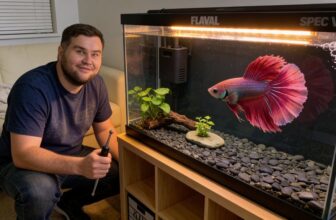
Seachem Prime wins the crown, hands down, since it nukes chlorine, chloramine, ammonia, and nitrite for two full days during treating a staggering 5,000 gallons per bottle at roughly 15 cents a dose—yeah, it smells like rotten eggs, but your fish won’t care.
API Stress Coat takes second for healing banged-up fish with aloe vera and a no-math pour cap, though it won’t touch ammonia.
For penny-pinchers, Seachem Safe beats Aqueon handily; that powder lasts years and handles 60,000 gallons per kilo versus Aqueon’s paltry 240.
Match your pick to what’s actually in your tap water, not the prettiest bottle on the shelf—if Prime’s sulfur stench doesn’t scare you off, you’ll see why 170 keepers swear by it.
There’s more nuance below if you’re still torn.
At A Glance
- Seachem Prime ranks best overall for detoxifying chlorine, chloramine, ammonia, and nitrite up to 48 hours.
- API Stress Coat excels at healing damaged fish with aloe vera and easy pour-cap dosing.
- Seachem Safe offers the best concentrated value, treating 60,000 gallons per kilogram for serious hobbyists.
- Aqueon suits small tanks and beginners despite lacking ammonia detoxification capabilities.
- Match your conditioner to actual tap water threats rather than marketing claims or hype.
How to Choose the Right Water Conditioner for Your Tank
So, how do you pick a water conditioner that won’t let you—and your fish—down?
Choose a water conditioner that protects both you and your fish from day one.
You’re joining a community that swears by heavy‑metal removal, so don’t skip that feature.
Look for pH neutral formulas; nobody wants pH swings ruining their weekend.
You’ll want chlorine and chloramine elimination, obviously, plus ammonia detox if you’re overstocked (no judgment).
Check the price per gallon—Prime runs about $0.15 per dose, Safe half that.
Avoid anything that clouds water or stinks up your living room.
Your bottom line: match the product to your actual tap water threats, not marketing hype.
Many conditioners like Seachem Prime provide ammonia detoxification to help protect fish during cycling or in overstocked tanks.
Seachem Prime: Best Overall Performer for Detoxification
If you’ve ever stood in the fish aisle staring at a wall of bottles that all promise to save your fish, you’re not alone, and Seachem Prime is the one that actually earns its cult following.
It handles chlor detoxification like a champ, zapping chlorine, chloramine, and even ammonia and nitrite for 48 hours.
The slime-coat protection keeps your fish’s natural barrier intact during water changes, and one bottle treats 5,000 gallons—yeah, really.
You’ll smell the sulfur (hold your breath), and you must measure precisely, but serious hobbyists don’t mind. It’s the conditioner you’ll brag about. For aquascapers building stable biological filtration, dry base rock with Swiss‑cheese porosity provides an extensive habitat for beneficial bacteria.
API Stress Coat: Best Water Conditioner for Healing Damaged Fish
When your fish looks like it lost a bar fight—fins torn, scales missing, maybe sulking in the corner since the pleco got a little too rowdy—you’ll want API Stress Coat in your corner.
This isn’t your everyday dechlorinator. Certainly, it handles chlorine and heavy metals, but the real draw? Aloe vera that kickstarts healing fish and rebuilds that protective slime‑coat like nature’s band‑aid.
– Replaces natural slime coat, reducing infection risk
- Easy pour cap—no math degree required
- ~$8 for 16 oz treats 960 gallons
- Mixing timing: Dump it straight into empty tank, then pour tap water in. The splashing does your mixing—no extra stirring required.
- Dilution ratio: That 1 mL per 10 gallons spreads evenly during fill-up, protecting every corner immediately.
- 25–50% water changes remove meds gradually
- Activated carbon in your filter absorbs many chemicals
- Ask your vet about specific neutralizers for your treatment
downsides? The scent’s aggressive, like a flower shop exploded, and it won’t touch ammonia or nitrite.
The high light transmission from a clear mesh cover lets you pair this treatment with optimal plant growth.
verdict Healing-focused keeper? Grab it.
Aqueon vs. Seachem Safe: Budget or Concentrated Value?
Choosing between Aqueon Water Conditioner and Seachem Safe boils down to one question: do you want to pay less now or save more later? You face the classic budget vs. durability dilemma.
| Feature | Aqueon | Seachem Safe |
|---|---|---|
| Cost vs. concentration | Lower upfront, weaker concentrate | Higher upfront, powder lasts years |
| Treats per dollar | ~240 gallons per bottle | ~60,000 gallons per kilo |
| Ammonia detox? | No | Yes |
| Best for | Smaller tanks, beginners | Serious hobbyists, multiples tanks |
| The catch | You’ll rebuy often | Requires precision, no measuring cup |
You belong to a community that plans long-term. Safe wins on cost vs. concentration, but Aqueon gets you started. Pick your poison. For emergency ammonia spikes, a liquid formula like Aqueon Ammonia Neutralizer neutralizes ammonia instantly and complements biological filtration.
Frequently Asked Questions
Can Water Conditioners Expire or Lose Potency?
Yes, water conditioners expire, and you’ll notice their chemicallife potency fading after opening.
Most bottles list a two-to-three year shelf life unopened, though that drops to about six months once air hits the formula.
You can’t always smell or see when it’s gone bad, so jot down your purchase date, store bottles in a cool, dark spot, and replace anything older than a year for your fish’s sake.
Do Water Conditioners Affect Beneficial Bacteria Colonies?
Water conditioners don’t cause colony disruption or bacterial inhibition; they’re your bacteria’s protective wingman, not their enemy.
You’ll eliminate chlorine and chloramine without nuking your filter’s established ecosystem.
Some formulas even *add* beneficial bacteria, though results vary like your uncle’s fishing stories.
Standard dechlorinators target chemicals, not microbes—big difference.
Is It Safe to Overdose Water Conditioner Accidentally?
You’ve got a genuine doseoverdose risk here, though it’s rarely lethal. Most conditioners, even Prime, only cause accidental toxicity at extreme multiples—think 5x or 10x the label, not your everyday slip.
You’ll see foam, possible oxygen depletion, stressed fish gasping at the surface. Your tank won’t crash instantly, but it’s not a free pass either.
You’re not a monster, just human. The fix? Partial water change, stat, and a mental note to use a proper syringe next time.
Dose carefully, friend—your fish are counting on your shaky hands to get steadier.
Should Water Conditioner Be Added Before or After Filling Tank?
Pre-condition, and you’re the responsible fish parent who doesn’t gamble with chlorine burns.
Post-condition? You’re playing catch-up your gills can’t afford.
Can Water Conditioners Remove Medication From Aquarium Water?
Water chemistry gets tricky here. Conditioners detoxify chlorine and ammonia, certainly, but they don’t strip dissolved medications. You’re the filter here, friend. When treating sick fish, you’ll want to remove chemical treatments yourself since your dechlorinator won’t touch ’em.
What to do instead:
Bottom line: trust water conditioners for tap water safety, not medication cleanup.
Rounding Up
You’ve got the data, now trust your gut. One keeper told us her neon tetras went from gasping at the surface to schooling within minutes of Prime—like watching a traffic jam suddenly clear. Pick the bottle that matches your headaches: chloramine nightmares, torn fins, or a wallet that flinches. Your fish won’t thank you, but they’ll keep breathing, and honestly, that’s the only review that matters.