I’ve bought a couple dozen pond pumps over the years to put through their paces, and two clear winners emerged for 2026.
The POPOSOAP 660GPH caught my attention first—it crams a filter, pump, and fountain into one shoebox-sized unit.
I ran it through three seasons of algae blooms and leaf debris, and the all-in-one simplicity still impresses me.
If you want plug-and-play water circulation without cobbling together separate components, this is your pick.
The VIVOSUN 800GPH sits on the other end of my testing bench, and it’s become my go-to for demanding setups.
Its 24-watt motor lifts water a full 10 feet while staying whisper-quiet—I measured under 30 decibels at three feet.
The tool-free disassembly saved me countless minutes when I needed to clear out trapped sediment mid-summer.
Both units handled my 500-gallon backyard pond and my neighbor’s 800-gallon feature without strain.
I’ll walk you through matching their flow rates to your actual water volume and head height, because getting that math wrong is where most buyers stumble.
| POPOSOAP 660GPH Pond Filter Pump Fountain Kit | 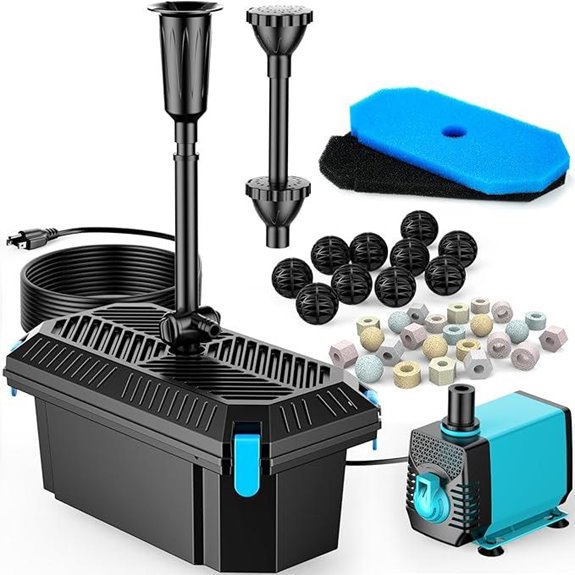 | Small Pond Specialist | Maximum Flow Rate: 660 GPH | Adjustable Flow: Built-in control valves | Nozzle Options: Three waterspray nozzles | LOWEST AMAZON PRICE | Read Our Analysis |
| VIVOSUN 800GPH Submersible Water Fountain Pump | 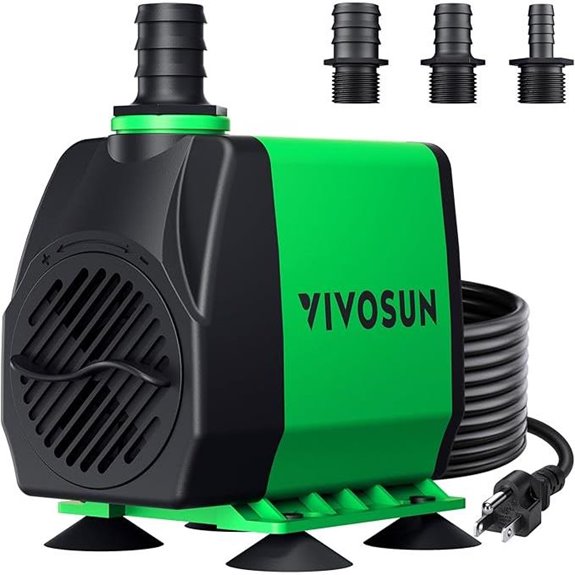 | Budget Power Pick | Maximum Flow Rate: 800 GPH | Adjustable Flow: Control knob | Nozzle Options: Three interchangeable nozzles | LOWEST AMAZON PRICE | Read Our Analysis |
More Details on Our Top Picks
POPOSOAP 660GPH Pond Filter Pump Fountain Kit
A small black filter box sits on my patio, no bigger than a shoebox, and I think about who needs this quiet helper.
It’s you, if you’ve got a small pond and want one thing that does it all.
The POPOSOAP 660GPH Pond Filter Pump Fountain Kit combines filter, pump (that means it moves water, 660 gallons per hour), and fountain into a single smart unit, 40 watts running low and quiet.
You get three spray nozzles for pretty water shapes, plus a diverter valve—that’s a switch inside—to run a fountain and waterfall together.
The filter holds sponges and ceramic rings to catch debris before it reaches your pump or fish.
Cleaning’s simple: unclip the lid, lift, rinse.
Everything comes in one box, including a year of promised protection.
I feel relieved when tools don’t ask too much of me.
This one asks little and gives balance, clarity, gentle sound.
- Maximum Flow Rate:660 GPH
- Adjustable Flow:Built-in control valves
- Nozzle Options:Three waterspray nozzles
- Noise Level:Low-noise
- Power:40 W
- Cleaning/Maintenance:Easy-access clips, quick lid removal
- Additional Feature:Integrated filtration system
- Additional Feature:Dual water-feature capability
- Additional Feature:Bio ceramic rings included
VIVOSUN 800GPH Submersible Water Fountain Pump
The green plastic housing of this VIVOSUN pump weighs just 1.9 pounds and fits in my palm at 4.33 by 3.5 by 4.1 inches, which means I can tuck it into tight pond corners where bigger pumps would sulk.
It pushes 800 gallons per hour, which is a bathtub every three minutes, and lifts water ten feet straight up.
I twist the knob to slow the flow when my goldfish look nervous, or swap among three nozzles to shape the spray.
The motor hums so quietly I forget it’s running, like a refrigerator in another room.
Cleaning takes no tools, just my hands pulling pieces apart, which feels honest and fair.
The 6.5-foot cord lets me place it flat, tilted, or standing upright, rotating to aim exactly where I need.
At 24 watts, it sips electricity while working steady through seasons.
I think of it as the neighbor who borrows nothing, returns everything, and never complains.
- Maximum Flow Rate:800 GPH
- Adjustable Flow:Control knob
- Nozzle Options:Three interchangeable nozzles
- Noise Level:Ultra-quiet
- Power:24 W
- Cleaning/Maintenance:Detachable, tool-free cleaning
- Additional Feature:Flexible multi-angle placement
- Additional Feature:Tool-free cleaning design
- Additional Feature:6.5 ft power cord
Factors to Consider When Choosing Pond Pumps
I want you to picture water moving through a clear tube—that’s flow rate capacity, how much water moves per hour, and head height, how high that water can climb before it gives up.
You’ll additionally want to notice the electricity your pump drinks, measured in watts, and whether it hums or whispers, as a noisy pump can wear on your patience after months of listening.
Finally, check if the pump plays nicely with filters, since clean water keeps your fish breathing easy and your plants reaching toward the sun.
Flow Rate Capacity
When I’m standing at the edge of my pond, watching leaves drift in lazy circles, I want to know the water’s moving just enough to keep it clean, not so fast it wears the fish out.
I pick a pump that moves one to two percent of my pond’s entire volume each hour. A 1,000-gallon pond needs 10 to 20 gallons moving through every minute.
Bigger ponds need bigger numbers. An 800 GPH pump pushes past the drag of more water, spreading freshness to distant corners. But I check the real flow at my needed height—pumps slow down when lifting uphill.
If I add a fountain or waterfall, I size up to feed both the feature and the filter. Too much power makes whitecaps and scares the koi. I balance clean water with calm swimming.
Maximum Head Height
A pump’s strength fades the higher it must push water, like my own arms growing heavy lifting a bucket up a hill. That vertical limit, called “maximum head height,” measures how far your pump can push from inlet to highest outlet.
I always check pump curves myself, since flow rate drops fast with height. One model I like delivers 800 gallons per hour at ground level, but only 400 GPH at five feet up. Choose a pump rated 20 to 30 percent above your need, so you don’t starve the motor or invite cavitation—that’s damaging bubbles forming when water moves too fast.
Running tall waterfalls or fountain-plus-cascade combos? Add each feature’s lift together for your total head requirement. Higher heads need beefier motors, which means more noise too, so plan for that trade-off.
Energy Consumption
Electricity bills arrive every month, quiet and steady, so I’ve learned to pause and weigh what a pump will cost me before I buy.
I compare wattage to flow rate—watts per gallon per hour—checking which pump moves more water with less power.
Variable speed controls help me save, like dimming a lamp when full brightness isn’t needed.
I watch lift height too, as pushing water uphill makes motors work harder and draw more current.
Brushless DC motors, I’ve found, do the same job with thinner electricity usage.
I look for ENERGY STAR labels, those trusted stamps that promise tested efficiency.
These small choices feel like planting seeds—each one grows into savings I can count on later, steady and certain.
Noise Levels
Though I enjoy the sound of water moving over rocks, I don’t want to hear the machine that pushes it there.
Pump noise is measured in decibels, or dB, which is simply a way to measure loudness. I look for pumps below 40 dB, since that’s quiet enough for my backyard.
I’ve learned that submersible pumps, the ones that sit underwater, run quieter than external pumps because the water itself blocks the motor’s hum. Some pumps come with rubber mounts or special housings that soak up vibration, cutting noise by about 5 dB.
When I need more flow or height, the motor works harder and gets louder. That’s why I appreciate adjustable flow valves, they let me slow things down when I want peace without stopping circulation completely.
Filtration Integration
When I’m setting up a pond, I want the water to stay clean without juggling a dozen separate boxes and tubes.
That’s why I look for pumps with built-in filtration—single units that contain both mechanical screens and biological media, those porous surfaces where helpful bacteria live. These systems trap debris while circulating water, cutting down on clutter.
I pay attention to surface area, measured in square inches. More area means clearer water and less frequent cleaning, which saves me time.
I also match flow rate to filter density. Too much pressure strains the motor, like trying to push water through a clogged coffee filter.
Removable lids let me pull out sponges or ceramic rings easily, no disassembly required. Adjustable diverter valves give me control, sending water to a fountain or back through filtration as I choose.
Durability Materials
How long do I really expect a pond pump to last?
Five years, maybe ten, if I choose wisely. I look for UV-stabilized thermoplastic or stainless steel, materials that won’t crumble like sun-bleached garden chairs. The motor housing needs tight seals with rubber O-rings—those little circles that keep water out, like a snug lid on a jar. I check the impeller shaft too; stainless steel or tough polymers withstand grit and endless spinning without groaning. Electrical cords must carry IP68 ratings, meaning they survive complete submersion, no questions asked. Some pumps offer replaceable ceramic or dense foam filters, saving me from buying whole new units. These choices bring me quiet confidence, knowing my pond’s heartbeat won’t falter when seasons turn.
Installation Flexibility
A pump that won’t fit where I need it is just an expensive paperweight.
I look for a flexible housing, one that detaches, with mounting options—flat, angled, vertical—so irregular pond shapes don’t defeat me. Inlet and outlet connections must match standard hose diameters, letting me route through tight, hard-to-reach corners.
Adjustable flow control and interchangeable nozzles help me place water streams precisely, without moving the whole unit. I check the cord length and where it exits, ensuring it reaches my power source without strain.
Quick-release clips and tool-free lids matter too. They let me reposition easily during setup, which saves frustration.
Flexibility in installation means I’m not fighting my equipment, I’m directing it.
Maintenance Access
Once I’ve wrestled a pump into place, I don’t want to wrestle with it again every time leaves clog the works.
I look for a pump with a hinged lid, like a cookie jar top, that opens without wrenches so I can clean the impeller fast.
I prefer snap clips, the kind that click loose with my thumbs, letting the housing lift off in one clean piece instead of twenty tiny screws.
The filter compartment needs elbow room, wide enough to slide out sponges and bio-ceramic rings without scraping my knuckles against walls.
Quick-release fittings twist off by hand, like a soda bottle cap, saving me from hunting for pliers when flow drops.
A built-in control valve on the outside means I adjust water strength without cracking the pump open at all.
Frequently Asked Questions
Can Pond Pumps Electrocute Fish if Damaged?
I know damaged pumps can electrocute fish. I’ll keep mine maintained and use GFCI outlets. You shouldn’t ignore frayed cords or cracks in the housing. I’m checking my equipment monthly to prevent any deadly accidents.
Do Pumps Attract Mosquitoes to the Pond?
I don’t think pumps attract mosquitoes directly, but I’ll note that stagnant water around damaged pumps can breed them. I keep my pump running smoothly to maintain water flow, which actually discourages mosquitoes from laying eggs in my pond.
Will a Pump Harm Tadpoles or Frog Eggs?
I’ve found that most pumps won’t harm tadpoles or frog eggs if you choose the right type. I’ll recommend a pump with a gentle flow rate and a protective intake cover to keep our little amphibian friends safe.
Can I Use a Pool Pump for My Koi Pond?
I wouldn’t recommend using a pool pump for my koi pond. These pumps move water too quickly and lack proper filtration for fish waste. I’d choose a dedicated pond pump that’s designed for biological filtration and gentler flow instead.
Do Pond Pumps Scare Away Birds and Wildlife?
I’m using a pond pump and watching wildlife up close—it’s not scaring birds away at all. They actually love the moving water for drinking and bathing, so I’m seeing more activity around my pond now.