A small green crown sits just above dark gravel, waiting. Light measured in watts per gallon feeds its slow, steady hunger. Water chemistry, neither harsh nor soft, cradles roots that drink from hidden soil. The patient keeper watches, trims, waits some more. Something unexpected always comes.
At A Glance
- Keep plant crown above substrate to prevent root rot and ensure healthy growth.
- Provide moderate full-spectrum lighting at two to three watts per gallon daily.
- Maintain stable water parameters: pH 6.5-7.5, temperature 72-82°F, minimal daily fluctuations.
- Dose liquid fertilizer every three days and run CO₂ at one bubble per second.
- Quarantine new plants for fourteen days and inspect for pests before introducing.
Amazon Sword Plant Overview: Size, Growth Rate, and Tank Placement
What does an Amazon Sword plant actually look like when it settles into a tank?
The rosette unfolds like a green fountain, each leaf arching outward from a central crown.
Leaf growth begins slowly, steady and predictable, reaching twelve inches in most homes, sometimes twenty in spacious quarters. This patience rewards the keeper with manageable beauty.
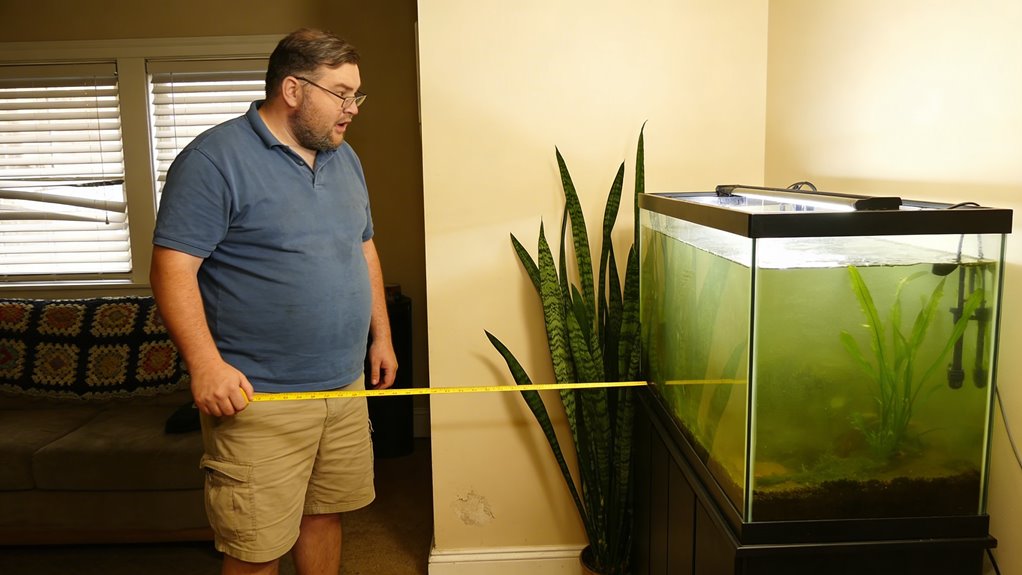
Tank layout determines success. The plant needs room to spread its roots wide, like a tree needing soil to breathe.
Leaf placement shapes the whole scene. Foreground blocks the view, background recedes, but midground—midground lets the eye rest, then travel.
Aesthetic design follows: the Sword anchors community, offering shelter, belonging made visible in green.
Quarantining New Plants: Pests, Diseases, and Prep Before Planting
New plants carry invisible travelers. Snails, algae spores, and tiny bugs hide inside, waiting to disturb your careful aquarium community. Pest quarantine protects everyone you have already welcomed into your tank. Place new Amazon Swords in a separate container with clean water for fourteen days. Watch quietly. Look for movement, fuzzy growth, or sad, drooping leaves. This waiting shows respect for your underwater family.
Disease diagnostics means checking for sickness before it spreads. Healthy leaves feel firm and look bright green. Remove any brown or slimy parts with clean scissors. Rinse roots gently under room‑temperature water.
Your patience here keeps future troubles small and your pride intact.
| Sign of Trouble | What You See | What You Do |
|---|---|---|
| Tiny snails | Spiral shells on glass or leaves | Pick them out, or accept harmless helpers |
| Algae coating | Green film on leaves | Wipe gently, reduce light a little |
| Melting leaves | Clear, mushy tissue | Trim away, wait for new growth |
| White cotton patches | Fuzzy fungus | Remove plant, start quarantine over |
| Black spots | Dark, spreading blotches | Cut affected leaves, check water quality |
Substrate, Lighting, and Hardness: Building Your Amazon Sword Setup
Spread the roots gently across a bed of small, loose gravel, pressing just enough so the crown sits visible above the surface. A nutrient-rich soil substrate beneath feeds hungry roots, anchoring the plant like a child needs steady ground to grow tall. Lighting intensity matters: two to three watts per gallon, full-spectrum, mimics dappled sun through rainforest canopy. Too bright invites algae; too dim brings slow decline. Hardness, measured in degrees, reflects mineral balance in water. Three to eight KH keeps leaves dark green and strong. Test weekly, adjust slowly, and watch confidence build through patient care.
Temperature and pH Ranges That Keep Sword Plants Healthy
Where does an Amazon sword feel most at home?
It settles into water between 72 and 82 degrees Fahrenheit, like bathwater that has cooled slightly.
The pH matters too, best between 6.5 and 7.5, which means neither sour nor soapy.
Stability brings comfort here, sudden changes cause wilting, like how我们更感到安全 when routines hold steady.
| Parameter | Ideal Range | What Happens If Wrong |
|---|---|---|
| Temperature | 72-82°F | Below 70°F, growth slows; above 84°F, leaves bleach |
| pH | 6.5-7.5 | Too acidic, roots weaken; too alkaline, nutrients lock away |
| Light intensity | Moderate (2-3W per gallon) | Too bright, algae coats leaves; too dim, plants starve |
| Nutrient balance | High in nitrate, phosphate, iron | Imbalance causes yellowing, holes, transparent patches |
| Stability | Daily swings under 2°F or 0.2 pH | Fluctuation shocks the system, invites disease |
Proper light intensity allows photosynthesis, the plant’s way of making food from sunshine.
Nutrient balance feeds this process, like breakfast before school.
Together they build belonging.
Planting Amazon Sword: Avoiding Root Rot and Crown Burial
How does one set a living thing into the ground without harming it?
The crown, where roots meet leaves, must sit above the substrate, not below.
Burying it invites decay, a slow drowning in darkness. Soil rot control begins with placement: roots spread beneath small gravel, one to two inches deep, whereas the crown breathes at the surface.
Nutrient balance follows. Rich substrate feeds the foundation, liquid fertilizer supplements, and steady light completes the triangle. Too much, too little, both wound.
The aquarist learns patience here. Observation replaces haste. The plant settles, secure and visible, joining the community it anchors.
Amazon Sword After Planting: Melting, Recovery, and Early Care
Leaves soften and pale within days of planting, a process aquarists call “melting,” and this sight stirs quiet worry in the observant keeper.
The melting begins quietly—softened leaves, pale translucence, and the keeper’s unspoken fear.
This response signals adaptation, not death. The Amazon Sword sheds leaves grown in air, trading them for foliage suited to water.
Leaf aesthetics suffer temporarily. New growth emerges from the crown, smaller then lengthening, true green replacing translucent yellow.
Stable conditions matter now. Growth soil anchors roots as they rebuild; disturbance causes setback.
Patience rewards the community-minded. Six to eight weeks pass before robust form returns. The keeper who resists intervention, who trusts the cycle, finds their tank transformed.
Does Your Sword Plant Need CO₂ and Fertilizer?
Even though the Amazon Sword grows without assistance, it thrives with measured help.
Carbon dioxide feeds its hunger, like breakfast fuels a school morning. A gentle CO₂ dosage of one bubble per second suffices. Fertilizer schedule means weekly liquid feed, half strength on Tuesday mornings.
| Without Help | With Care |
|---|---|
| Pale, small leaves | Deep green, broad foliage |
| Slow, thin runners | Thick, frequent plantlets |
| Yellow edges, sighing | Sturdy stems, proud |
| Waiting, uncertain | Growing, belonging |
The plant does not demand; it simply responds. Thoughtful tending returns visible reward, leaf by leaf.
Trimming Amazon Sword: Controlling Size and Removing Dead Leaves
A pair of scissors rests beside the tank, waiting.
Trimming maintains leaf fertilizer aesthetics, that pleasing uniformity enthusiasts recognize as membership in practiced care. Remove outer leaves first, those oldest stems browning near the substrate, cutting close to the crown without wounding new growth. Dead foliage drains energy; its removal redirects nutrients to lively tissue. Touch the remaining leaves—robust leaf texture signals health, thin or papery surfaces demand attention. In small tanks, trim monthly to control spread. Each cut shapes community, the collective work of hands tending shared spaces, patient and deliberate, building belonging through visible, measured effort.
Propagating Through Runners: When to Separate New Plantlets
Thin stems snake outward from the plant’s heart, each one a runner carrying future life.
These runners, called stolons, stretch horizontally from the mother plant’s base like umbilical cords offering nourishment to unborn plantlets. Runner timing matters: watch for three to four leaves emerging from a node, and examine leaf coloration. Deep green signals readiness; pale yellow suggests waiting. Wait fourteen to twenty-one days after root emergence, measuring half-inch white tendrils anchoring the baby plant. Cut the runner one inch from the daughter plant using clean scissors. Replant gently, pressing roots into substrate with a small stone for stability. The mother remains strong; the child begins its own journey.
Yellow Leaves, Algae, and Stunted Growth: Troubleshooting Guide
Leaves speak their troubles in color, and the patient eye learns to read their quiet complaints.
Yellow leaves signal leaf nutrient deficiency, often missing iron or nitrogen, pale and heartbreaking like faded hope. Algae control demands balance: reduce light to eight hours daily, add floating plants for shade, and wait.
- Test water weekly for nitrates and phosphates
- Dose liquid fertilizer every three days
- Wipe algae from leaves with gentle fingers
- Trim yellow leaves at the base, close to the crown
Stunted growth feels lonely, like speaking unheard. Patience, steady care, and belonging follow.
Fish and Invertebrates That Won’t Destroy Your Amazon Sword
Choose tankmates with soft mouths and calm habits, for not every creature respects rooted things.
The gentle guppy darts between broad leaves without tugging roots, establishing compatible housing for fragile ecosystems. Neon tetras form silver schools above the rosette, casting no shadow of disturbance upon anchored stems. Shrimp—tiny armored cleaners—graze algae from leaf surfaces, offering algae control through patient labor. Mystery snails glide on glass, mouths too soft to tear green flesh. Avoid cichlids and goldfish; their hunger uproots what communities need. Select peaceful dwellers, and the sword becomes shared shelter, a place where all belong, rooted together in still water.
Frequently Asked Questions
How Long Do Amazon Sword Plants Live?
An Amazon sword plant, with proper care, lives three to five years.
Slow growth rate means it builds sturdy leaves gradually, not rushing.
Propagation methods extend this presence: the mother plant sends runners, thin stems creeping outward, and baby plantlets root while still attached.
Once roots hold firm, these daughters become separate plants, continuing the line.
The lifespan feels brief, yet propagation offers continuity, like stories passed hand to hand.
Can Amazon Sword Grow Emergent Above Water?
The Amazon sword can truly grow emergent, sending leafent growth above the waterline when given shallow conditions. Its submersion limits extend roughly to twelve inches of depth, though it tolerates deeper water with strong light. In nature, seasonal floods force this flexibility, and aquarium keepers replicate this by lowering water levels. The plant feels no confusion in either domain, simply adapting its leaf shape—broader in air, lankier below.
Do Amazon Swords Flower in Aquariums?
Small white blooms sometimes rise on thin stalks above the water surface when conditions satisfy the plant. Flowering patterns emerge rarely, rewarding patience with quiet beauty. Healthy leaf coloration—deep green without brown patches—signals readiness. The flowers feel like secret gifts, modest and brief. Growers who wait uncover connection through this small miracle. Emergent growth allows pollination, completing a cycle hidden from hurried eyes.
Why Are My Amazon Sword Leaves Transparent?
Transparent leaves signal a nutrient shortage, often nitrogen or iron, starving the plant’s green-making chlorophyll. Substrate blending with nutrient-rich plant soil helps, but liquid fertilizers work faster. Check that lighting reaches 2-3 watts per gallon; too dim weakens nutrient uptake. Trim dying leaves so energy flows to healthy growth. Test water weekly, keep pH near 7, and patience rewards you—recovery takes two to four weeks.
Can Amazon Sword Survive in Sand Substrate?
Yes, it can survive in sand substrate, though growth remains slower than in nutrient-rich alternatives.
The fine grains compact easily, pressing against the spreading roots and limiting root oxygenation—the process where roots absorb dissolved air from water pockets between particles. This breathlessness feels like trying to inhale through a thick pillow.
Success requires action: layer the sand two to three inches deep maximum, stir gently weekly with fingers to break hard spots, and bury root fertilizer tablets every six inches. Liquid fertilizers help, too.
Patience matters here. The plant adapts, but slowly, offering quiet proof that care, not perfection, builds belonging.
Rounding Up
A healthy Amazon Sword begins with the crown resting above soil and gravel, not buried beneath it, where roots can breathe and stretch.
Light, measured in watts per gallon, feeds the leaves like sunshine feeds a garden outside, turning energy into steady green growth.
Water parameters—pH, hardness, temperature—create a stable home, the way a steady room temperature keeps a child comfortable.
Patience brings results. New plantlets emerge on runners, small copies of the parent, ready to anchor and rise on their own.