You hold a sinking pellet in your palm, and your crayfish waits below, antennae twitching. Wild crayfish scrape algae from rocks and catch dead leaves, but yours depends on you. That responsibility feels heavy, doesn’t it? You’re balancing protein for growth, calcium for shells, and vegetables for color. Get it wrong, and she fades, or worse. The good news: a simple rotation fixes everything. You’ll learn the exact portions, the timing, and the one mistake that kills appetite. But first, you need to see what she’s really eating when you’re not watching.
At A Glance
- Wild crayfish consume algae, aquatic plants, detritus, and opportunistic protein like small fish or insects.
- Captive diets center on sinking pellets, algae wafers, and supplemental proteins such as dried krill.
- Tank menus benefit from weekly rotation of commercial foods, vegetables, and occasional live treats.
- Blanched zucchini, peas, and spinach provide essential fiber and nutrients unavailable in pellets alone.
- Calcium-rich foods support molting, while varied nutrition prevents deficiency and stimulates natural foraging behaviors.
What to Feed Your Crayfish: A Complete Diet Guide
When you lift the lid on your crayfish tank, you’re looking at a creature whose stomach works like a tiny recycling plant, turning scraps into strength.
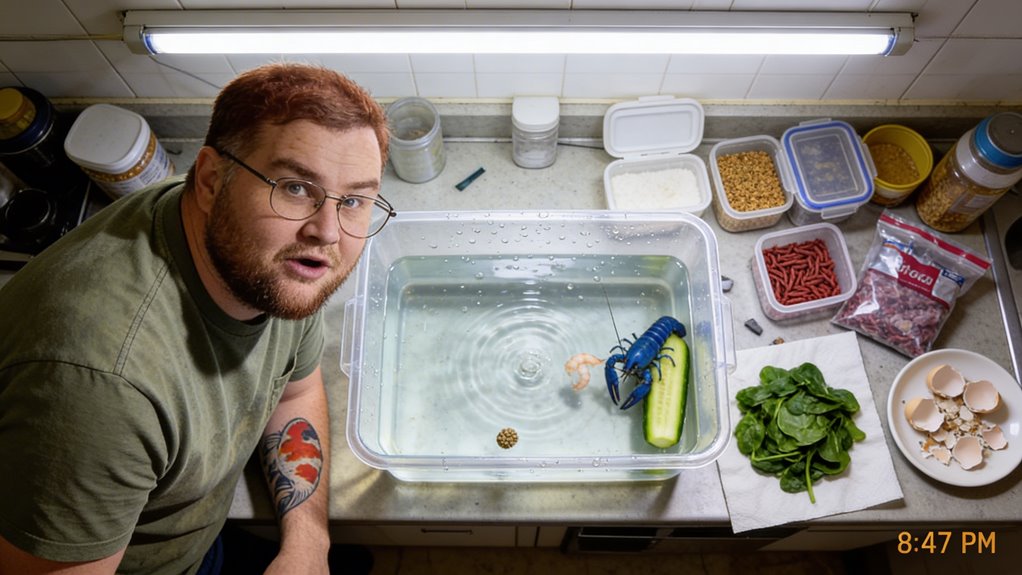
Your crayfish needs sinking pellets, algae wafers, and bits of vegetable—think ¾-inch pieces, about the size of your thumbnail. Young ones eat daily; grown-ups need food every other day.
Feed young crayfish daily, adults every other day—sinking pellets, algae wafers, and thumbnail-sized veggie pieces.
Spirulina flakes keep colors bright, supporting tank aesthetics you’ll proudly show friends.
Protein snacks like bloodworms help crayfish breeding succeed, giving mothers strength for healthy eggs. Rotate foods weekly. You’re building a community here, one careful meal at a time.
Crayfish Diet in the Wild vs. Your Tank
Out in a creek, a crayfish claws its way across silt and stones, hunting scraps of dead leaves, tiny water bugs, and algae film that coats every rock like green paint.
You watch your tank crayfish at midnight, don’t you? That’s their nocturnal behavior calling, same as wild cousins. You offer pellets, they scavenge like creek-dwellers, yet your hab tank impact differs—no currents sweep food. You become the stream itself, delivering meals. They filter, they shred, they clean your glass. You’re part of their world now, keeper and kin, bridging wild hunger to glass walls.
Algae and Biofilm: The Natural Foundation
A thin green film coats your aquarium glass, and you feel relief, not disgust.
You’re witnessing algae composition in real time, the living soup your crayfish craves.
Watch them scrape, graze, and filter invisible meals from this slimy carpet.
Biofilm dynamics create miniature ecosystems, bacteria and diatoms layering like tiny pancakes on every surface.
Your crayfish aren’t cleaning for you, they’re harvesting what you cannot see.
- Green spot algae, soft and powdery, spreads across glass like dust on a windowsill
- Brown diatom films coat new driftwood during the first three weeks of setup
- Cyanobacteria patches feel slick, smell earthy, and contain protein your crayfish sense immediately
- Periphyton, that fuzzy underwater carpet, holds more nutrition than lettuce leaves you might add
- Rotifers and nematodes living in biofilm provide live prey for young crayfish learning to hunt
Best Commercial Foods for Crayfish
So you’ve watched your crayfish scrape algae from the glass, and now you’re wondering what else to drop into their world.
Sinking pellets bring real diet variations to your tank. You’ll find shrimp-based formulas, algae wafers, and dried krill at most shops. These foods sink past aquarium lighting, reaching your crayfish where they hide.
Young crayfish need small pellets, about half an inch wide. Adults handle larger pieces. Feed once daily when they’re small, every other day when grown.
Rotate between pellets, wafers, and protein snacks. Your crayfish stays healthier, and you belong to a community that gets it right.
Vegetables Safe for Crayfish (And How to Offer Them)
Commercial pellets settle the foundation, yet your crayfish evolved to tear through leaves, stems, and roots. You can join their world by offering what their ancestors found.
- Blanch zucchini slices for three minutes; vegetable preparation softens the flesh, helping nutrient absorption.
- Sink cucumber rounds, skin-on, for nibbling through the night.
- Drop in de-shelled peas; they’re gentle on growing bodies.
- Offer raw carrot shavings; orange means safety here.
- Try boiled spinach leaves, cooled, like a blanket of green.
Remove uneaten bits by morning. You’re learning their language, and they notice.
Protein Foods: Bloodworms, Shrimp, and Live Treats
Few creatures match your crayfish’s hunger for flesh that wriggles, snaps, or once swam. You can offer frozen bloodworms, tiny shrimp, or live treats like mosquito larvae, and watch them snatch with those quick claws.
Protein builds strong shells and keeps colors bright, but you must mind nutrient balance, mixing meaty foods with the vegetables you already provide.
Live foods feel exciting, like a treat, but seasonal availability matters, you might find bloodworms scarce in winter, so stock your freezer. You’re creating a little community where your crayfish thrives, and that belonging matters to you both.
How Often Should You Feed Your Crayfish?
Your crayfish eats when its body tells it to, not when the clock strikes twelve. You’re learning its language, and that belongs to you.
Feeding feeding timing shapes this conversation. Watch the tank bottom. Food gone by morning means you’re listening well. Food lingering past noon whispers, “slow down, friend.”
Seasonal appetite shifts arrive like clockwork without the clock. Summer brings hunger, winter brings rest, and you’ll adjust since you care.
- Feed juveniles once daily, small pinches they finish in two hours
- Offer adults meals every other day, roughly ¾‑inch portions
- Drop food near hiding spots, their safe dining rooms
- Check morning remains to calibrate tomorrow’s gift
- Trust skipped meals; crayfish know their own fullness
Feeding Baby Crayfish for Fast, Healthy Growth
Those daily pinches you measured so carefully for the adults, they shrink to something smaller when you’re feeding babies. You crush sinking pellets into grains half the size of your pinky nail, no bigger than half-inch portions for these little ones.
Your baby crayfish need dense protein to power through molt timing, that vulnerable stretch when they shed armor and grow. You offer frozen bloodworms, algae wafers, and dried krill, rotating daily so they don’t lack.
Watch your bre habitat stay clean; uneaten bits foul water fast. Feed small meals once daily, and you’re raising strong crayfish alongside fellow keepers who’ve walked this path too.
Why Your Crayfish Eats at Night (And When to Offer Food)
Since crayfish carry armor plated with shadow, they wait until your tank light clicks off and the room turns blue-dark before they stretch their legs and hunt.
You belong to a quiet fellowship of night-watchers when you learn their rhythm.
Set your feeding schedule to match this nocturnal activity.
Drop food just before bed, and you’ll feel the calm of knowing they’re thriving as you sleep.
- Dim your lights at dusk to signal hunting time
- Offer sinking pellets that settle where claws reach
- Check leftovers by morning to gauge appetite
- Note ignored food as a warning sign
- Trust patience; you’ll bond through observing shadows
Is Your Crayfish Overfed? 5 Warning Signs
A heavy pellet sinks to the corner of your tank, and your crayfish pounces, claws flailing, in spite of the fact that you fed her an hour ago. You’re noticing leftover food piling up on the gravel, and that worries you—it should.
Rapid weight gain and a distended abdomen, that’s sign two.
Your water tests show rising ammonia, the nitrates climbing fast—that’s your overall overload hitting, number three.
You see water cloudiness you can’t explain, no matter how you filter, that’s four.
Broken antennae from clumsy molting, that’s five.
You’re feeding love, not need. Pull back. Watch her thrive.
When Crayfish Stop Eating: Troubleshooting Guide
You were pulling back on the food, maybe a little worried you’d pushed too far, and now your crayfish sits still as a stone beside her favorite rock, claws folded, not touching the algae wafer you dropped in last night.
She’s not broken. She’s preparing.
Your crayfish enters molting cycles regularly, shedding her hard shell to grow larger. Before this change, she stops eating for days, even a week. Her wateral tank must stay clean, parameters stable, calcium available for the new shell forming beneath the old.
Molting crayfish retreat into stillness, fasting days before the old shell cracks open to reveal what waits beneath.
Check these when appetite vanishes:
- Water temperature swings beyond 70-78°F
- pH crashes below 6.5 or spikes above 8.0
- Ammonia or nitrite readings above 0 ppm
- Days-before-molt hiding behavior intensifying
- Post-molt refusal eating until shell hardens, roughly 48 hours
You belong here, learning her quiet signals.
Frequently Asked Questions
Can Crayfish Eat Fruit?
Yes, you can offer your crayfish small pieces of fruit. Their fruit tolerance varies, with softer options like melon and cucumber working best.
You’ll notice seasonal preferences emerge as they eat more plant matter in warm months.
Cut fruit into tiny cubes, about half an inch, and remove uneaten pieces within twelve hours to keep water clean.
Don’t make fruit a daily staple. You’re building trust through careful observation, and that patience rewards you both.
Do Crayfish Need Calcium Supplements?
Yes, you do need to give your crayfish extra calcium. Their shells are like your own bones, hard and protective, and they grow a new one each time they molt. Without enough calcium, shell hardness suffers, and calcium deficiency makes them weak, slow, and vulnerable. You can add cuttlebone, crushed eggshells, or calcium-rich pellets. You’ll see them grow stronger, molt safely, and feel proud you’re caring well.
Will Crayfish Eat Snails?
Yes, your crayfish will eat snails.
You watch their claws, strong and quick, and you understand this predation risk—small snails become food. Slow snail behavior, like gliding on glass, makes easy targets. You feel a quiet sadness, maybe, but you accept nature’s pattern. You choose: separate them, or let the tank teach its lessons. You’re not cruel, you’re observing, learning, belonging to this watery world.
Can Different Crayfish Species Share Food?
Yes, different crayfish species species can share food, but interspecies feeding requires care.
You’ll watch a shared diet work when each species gets enough protein and plant matter. Communal nutrition succeeds if you drop food in multiple spots, so slower species species aren’t bullied.
You’ll feel calm seeing them eat together, knowing you’ve prevented fights over scraps by spacing meals apart.
Should I Remove Molts From the Tank?
You can leave molts in the tank for one to two days. Your crayfish will eat its old shell to regain calcium, which helps harden the new exoskeleton faster during this critical molt timing. After that brief window, you’ll remove leftover pieces during regular tank cleaning to prevent ammonia spikes. Discarding them sooner robs your pet of needed minerals. Waiting longer risks water quality problems.
Rounding Up
A small ceramic dish holds your crayfish’s varied meals—sinking pellets, blanched zucchini, and occasional bloodworms. You’ve learned that rotation prevents boredom, that calcium rebuilds shells after molting, and that darkness invites feeding. Trust these rhythms. Watch your crayfish grow steady, colored bright, active through the months. You’re not just feeding. You’re building a small, complete world. Keep it patient, keep it consistent, and your crustacean companion thrives under your careful hand.