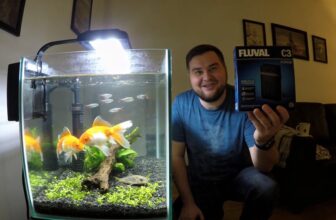
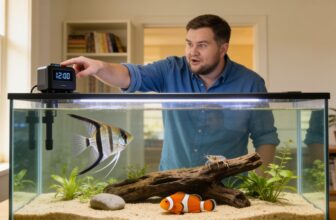
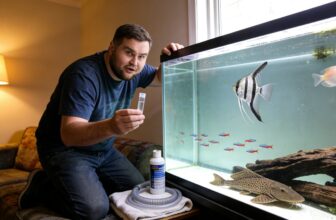
The Fluval 407’s a solid workhorse—whisper‑quiet at 45 dB, pushing 300‑320 GPH in real tanks, and built to run for years on that three‑year warranty.
You’ll get four media baskets, a self‑primer lever (no more mouth‑siphoning, thank goodness), and an Aqua stop valve that keeps maintenance from turning into a flood.
But here’s the catch: the stock media’s pretty skimpy—thin floss, sparse bio‑rings, carbon that poops out in a month—so budget another $40 for upgrades if you want filtration you can actually trust.
Best for 55‑85 gallon community tanks, not so hot for messy cichlid setups or beginners who hate tinkering.
The motor won’t quit on you, the hoses need careful cutting (measure twice, cry once), and that eTEC design resists clogging better than most.
For hands‑on fishkeepers who don’t mind swapping baskets and learning a proper media rotation, it’s a quiet, reliable win—just know what you’re signing up for before you open the box.
Stick around if you want the full breakdown on setup tricks and which upgrades actually matter.
At A Glance
- Whisper-quiet eTEC motor runs at ~45 dB with energy consumption comparable to an LED bulb.
- Effective flow of 300–320 GPH suits 55–85 gallon tanks best; performance drops above 85 gallons.
- Self-primer lever, Aqua stop valve, and included hoses enable tool-free installation and mess-free maintenance.
- Stock media requires upgrades—$40+ for dense floss, additional ceramic rings, and tailored chemical filtration alternatives.
- Three-year warranty covers pump durability; regular monthly basket cleaning preserves flow and prevents noise increase.
First Impressions: What the 407 Actually Does
The Fluval 407 is a workhorse, not a show pony, and that’s exactly why it earns its keep.
You unbox it, and yeah, the aesthetic design won’t win beauty contests—black plastic, no frills. But you’re not buying art, you’re buying clean water. The warranty coverage runs three years, so Fluval’s got your back when that pump inevitably tests your patience.
You’re looking at 383 gallons per hour, handling tanks up to 100 gallons (though 85 keeps it happiest). That’s 3-4 turnovers hourly—industry talk for “your fish won’t suffocate in their own waste.”
Built for tanks up to 100 gallons—85 keeps it purring—pumping 383 GPH to keep your fish breathing easy.
eTEC tech means whisper-quiet operation. You’d swear it’s off sometimes.
Energy bill? Barely registers. We’re talking LED-bulb territory.
For aquarists concerned with water quality, ammonia removal is critical. Bottom line: It’s the reliable friend who shows up, doesn’t dress flashy, and stays for dinner.
What’s Inside the Box
So what’s actually waiting for you under that lid? You’ll find four media baskets—biological, chemical, mechanical, and one for media, plus (thanks to the high light transmission of polypropylene] mesh, you can even consider adding a clear aquarium cover for easy DIY trimming to reduce evaporation and light loss)—plus the self-primer lever that saves your lungs, intake and output hoses you’ll need to cut, and that brilliant Aqua stop valve for mess-free maintenance. The warranty coverage backs up Fluval’s confidence in their filter durability, and you’ll feel like you’ve joined the club of aquarists who’ve figured this out.
| Component | Purpose | Your Win |
|---|---|---|
| Media baskets | House filtration stages | Customizable setup |
| Self-primer | Easy startup | No mouth-siphoning |
| Aqua stop valve | Stops water flow | Clean maintenance |
Bottom line: You’re equipped, covered, and ready to belong.
Tank Sizes the 407 Handles Best
Once you’ve got those baskets unpacked, you’ll want to know if this thing actually fits your tank—or if you’re trying to stuff a whale into a kiddie pool.
Here’s the straight answer: Fluval says 100 gallons max, but you’ll hit better flow efficiency around 85. That’s your sweet spot, your Goldil, your Goldilocks zone.
Push past those tank limits and you’re asking for trouble—turnover drops, debris lingers, and your fish give you that disappointed look.
Heavily stocked tanks? Cichlid chaos? Size down or upgrade. The 407’s a workhorse, not a miracle worker.
Bottom line: 55–85 gallons, you’re family. Push 100, you’re pushing your luck.
For smaller setups like a 20-gallon tank, you can achieve efficient flow with a hang-on-back filter that delivers consistent turnover.
Flow Rate: Lab Specs vs. Real Tank Output
Fluval’s lab boys clock the 407 at 383 gallons per hour—sounds beefy on paper, like those horsepower claims that vanish the moment you hit a hill.
You drop one into your 85-gallon community tank, you lose maybe 15-20% to hose friction, media resistance, and that one Aquaclear rock you wedged in basket three. Spec efficiency? Solid, not spectacular—you’re getting honest 300-320 gph where the rubber meets the road.
Pump durability bails you out here. Two years in, clogs slow things further, but that eTEC motor doesn’t wheeze. You clean baskets monthly, since neglect turns “whisper-quiet” into “angry refrigerator.” Unlike some HOB filters with self-priming motors, the 407 may need a manual assist after maintenance.
Bottom line: Buy for the 85-gallon sweet spot, not the 100-gallon stretch.
Setting Up Your Fluval 407 Step by Step
Those real‑world flow numbers settle whether this filter fits your tank, but they don’t tell you how much you’ll sweat during setup. The aesthetic design looks sleek black on your stand, but you’ll wrestle hoses first.
Installation tips:
- Position the canister on a level surface with hose clearance, or you’ll regret it
- Follow the manual’s basket stacking order—mechanical, chemical, biological, optional
- Use the self‑primer lever; 3‑4 pulls with two fingers beats mouth‑siphoning every time
- Place the output nozzle above waterline for proper priming
You’ll join the club of 407 owners once it hums quietly. Worth the brief frustration. For best results, ensure your stand can handle 1,100 lb weight capacity if you plan to stack a lower tank underneath.
The Hose-Cutting Step That Trips Everyone Up
You’d think measuring a hose would be simple, right? You’ll grab those shears, eyeball the distance, and—whoops—you’ve got a hose that’s too short and dreams that die hard.
Here’s the truth: hose calibration matters more than your ego wants to admit. The Fluval 407 gives you standard hose length, barely enough wiggle room for mistakes. Experienced aquarists know this pain, and you’re not alone in it.
Measure twice, cut once (dad wisdom, free of charge). Lay the tubing along your tank’s path, accounting for bends, loops, and that “I’ll just move it later” certainty you’ll actually have.
Extra hose would’ve saved your Saturday. Pairing your setup with 200 µm filter socks can also reduce debris that clogs hoses and slows flow.
Priming the 407 Without the Mess
Verdict first: you’ll actually enjoy priming this thing.
The self‑primer lever on the 407 is a small, elegant solution to a problem that’s soaked countless carpets. You pull it three, maybe four times with two fingers—no lung workouts, no “please‑work” chants.
Position that output nozzle above the waterline (non‑negotiable for success), and you’ll nail this quieting technique every startup. The mess free design means no siphon hoses, no mouthful of tank water, no explaining wet socks to your partner.
Aqua stop valve helps if you forget step one, but you won’t. That’s the 407 difference—you belong in the dry‑floors club now. For maintaining proper ammonia testing after setup, use a reliable kit twice weekly to keep your tank safe.
Output Positioning for Maximum Flow
Too high, and you’ll aerate aggressively; too low, and you’re suffocating surface exchange.
You’ve cut those hoses already, so commit to the optimal water depth optimal water depth for stable bubble flow is between six-and-a-half and eight inches.
You’re building a system here, not just hanging hardware.
How Loud Is the Fluval 407 Really?
45 dB operation – comparable to light rainfall or a quiet suburb at night.
You won’t wake the fish, let alone yourself.
The noise comparison puts this near-refrigerator hum territory, except your groceries don’t judge you. eTEC tech (that’s Fluval’s energy-efficient motor thing) keeps things steady, and after a durability test spanning months, the pump stays hushed—no rattling, no grinding, no “what’s that sound” panic at 2 AM.
You’ll place this in bedrooms without grief. Short sentences hit harder: it’s quiet. Longer ones fill gaps—so quiet, in fact, you might suspect it’s broken, which, dad-joke alert, means it’s working perfectly.
Bottom line: barely there. With noise levels this low, your fish will stay calm even near magnetic mesh covers designed to prevent escapes.
The 15-Minute Cleaning Routine
Since maintaining a canister filter shouldn’t feel like rebuilding an engine, Fluval designed the 407 for speed.
Filter maintenance shouldn’t feel like rebuilding an engine—Fluval built the 407 for speed, not suffering.
You grab the Aqua stop valve, twist, and water flow halts—no buckets flooding your living room. The quick-release clamps pop open like a stubborn pickle jar (finally, something cooperative). Lift out baskets individually, rinse mechanical media in tank water, and you’re practically done. A collapsible bucket from the top-rated list helps you carry the dirty water without taking up space in your cabinet. Filter maintenance finishes in 10–15 minutes, coffee still warm. This time-saving routine means you’ll actually stick to your schedule instead of procrastinating until your tank looks like pea soup.
The lock-top lid comes off clean, no wrestling required.
Bottom line: You’ll keep your tank pristine without sacrificing your Saturday.
Swapping Media Baskets Mid-Cycle
That cleaning routine’s all well and good until you realize you’ve loaded your baskets bass-ackwards, or you’re six months in and the floss looks like cottage cheese.
You pause. You wonder if ripping everything out will crash your cycle. Good news: it won’t, not if you’re clever about it.
Swap one basket at a time, spacing it across your cleaning schedule—biological last, always. Your media basket lifespan stretches, your bacteria bank stays solvent. Build a rotation calendar, treat it like oil changes. Skip it, and you’re the guy explaining green water at the club.
Bottom line: stagger your swaps, save your sanity.
Why the Included Media Runs Out Too Soon
Though the box claims “everything you need,” you’ll burn through that starter floss in six weeks flat, maybe eight if you’re stingy with feedings. The included media? Barely enough for a beta test.
| Media Type | What’s Included | Reality Check |
|---|---|---|
| Mechanical floss | One thin pad | Clogs in 6-8 weeks |
| Biological rings | Sparse handful | Insufficient for full bioload |
| Carbon insert | Single 150g pouch | Exhausts at 4 weeks |
| Potentially empty basket | Nothing at all | Wasted space, wasted opportunity |
| Replacement cost | “Free” starter | $40+ to restock properly |
Media lifespan here is a joke. You’re buying into a system, then immediately buying again. Cost efficiency tanks when restocking becomes your hobby. Veteran aquarists saw this coming. Plan for basket upgrades, or plan for frustration.
Three Upgrades That Actually Improve Filtration
Three upgrades turn this filter from adequate into genuinely capable, and you’ll want all of them before that starter floss turns gray.
- Swap the thin stock floss for dense mechanical pads—you’ll trap debris before it clogs your bio-media, extending cleaning intervals by weeks.
- Pack the bottom basket with ceramic rings or bio-home, doubling your biological filtration capacity for that heavily stocked community tank you’re eyeing.
- Ditch the carbon pouch for Purigen or crushed coral, tailoring chemical filtration to your water chemistry needs.
These media upgrades cost maybe forty bucks total, and you’ll finally stop second-guessing whether your fish are secretly judging your maintenance schedule.
Who Should Buy the 407: and Who Should Skip It
If you’re running a standard 40- to 85-gallon community tank with tetras, rasboras, or a modest school of barbs, you’ll find the 407 hits a sweet spot between price and performance—granted, you’re willing to swap out that skimpy starter media and measure twice before slashing those hoses.
You’ll love this filter if you value budget friendliness without total compromise, meaning you’ve got oh, maybe thirty bucks earmarked for real media upgrades. The budget suitability shines for planted setups, low-stock communities, or that first “serious” tank where you’re proving you belong in this hobby.
Skip it if you’re obsessed with African cichlids or goldfish—messy beasts that’ll overwhelm your 383 gph flow rate faster than you can say “water change.” ** pass if you despise DIY hose trimming, or if your tank sits above 90 gallons, where you’ll want beefier turnover.
Skip the 407 if you keep messy fish, hate DIY trimming, or run tanks above 90 gallons— you’ll need more muscle.
Bottom line: join the 407 club if you’re a pragmatic beginner or value-conscious intermediate. Everyone else, keep scrolling.
Frequently Asked Questions
Can the Fluval 407 Handle Saltwater Aquariums?
– Mechanical, chemical, biological trays work fine for basic saltwater, yet you’ll outgrow them fast with corals or fish that poop like they’ve got something to prove.
The filter’s quiet, efficient, and energy‑savvy, certainly, but it’s really optimized for freshwater. Saltwater critters need pristine water, heavy filtration, and usually protein skimmers, too.
For a small fish‑only marine tank, it’ll do. For a thriving reef? You’ll want something beefier, probably a sump.
Does the Pump Require Periodic Lubrication?
You’ve lucked out here—no oil motor upkeep needed.
The 407’s eTEC pump runs sealed, so you’ll skip that whole lubrication schedule entirely.
Just keep it clean, keep it level, and you’re golden.
Can Replacement Parts Be Purchased Individually?
Yes, you’ll find replacement parts sold separately.
- Individual components—impellers, seals, hoses, clips—run $8-$35, keeping your filter cost manageable over years of use.
- Warranty coverage spans three years, so you’re protected against manufacturing defects, though normal wear isn’t included.
You won’t need to replace the whole unit when one piece fails.
Buy what breaks, fix what’s fixable—simple as that.
Bottom line: it’s built to last, and repairs won’t drain your wallet.
Is the Filter Submersible in Case of Leaks?
No, you’ll keep this canister external. It’s built like a submarine in spirit, not in practice—pump stays dry, leak detection alerts you early, and submersible safety isn’t part of the deal.
You’d need a different filter for underwater duty. Keep it on level ground, use that Aqua stop valve if trouble hits, and you’ll sleep soundly knowing your tank’s filtered, not flooded.
Does the Warranty Cover the Motor Assembly?
Yes, the motor warranty covers assembly failures—₃ years on the motor,₁ year on parts.
You’ll need your receipt, and damage from user error (like running dry) voids coverage.
Assembly coverage includes factory defects, not wear from ₃0,₀0₀ hours of grinding.
Keep that manual, register online, and you’re golden.
It’s solid protection, honestly, though you’ll still handle shipping if things go sideways—small print, big headache, but fair enough.
Rounding Up
The Fluval 407 fits firmly, faithfully, and fairly for freshwater fans seeking silent, steady service. You’ll pay premium pennies—roughly $300—but gain genuine grit: 383 gallons per hour, four-stage filtration, and blessedly brief basket swaps. It’s overkill for tiny tanks, underwhelming for reef radicals, yet perfect for planted prowlers and community keepers craving calm, clean currents. Buy it for reliability, not uprising. Your fish, and your frazzled nerves, will thank you.